Once again it’s time for the blog challenge Three Things Thursday, the purpose of which is to “share three things from the previous week that made you smile or laugh or appreciate the awesome of your life.”

Today is birds’ day Thursday in Tacoma, WA
Here are a few birds we’ve seen on recent walks around the neighborhood. Thanks to my husband for supplying these photos. (He’s the one with the huge telephoto lens.)
Information below comes from the following sources:
- Washington Department of Fish & Wildlife
- Peterson Birds of North America, electronic edition
We are very amateur bird watchers, so if you find anything here that needs correcting, please post to the comments. (Of course, you’re also welcome to post even if everything is correct.)
1. Pileated Woodpecker
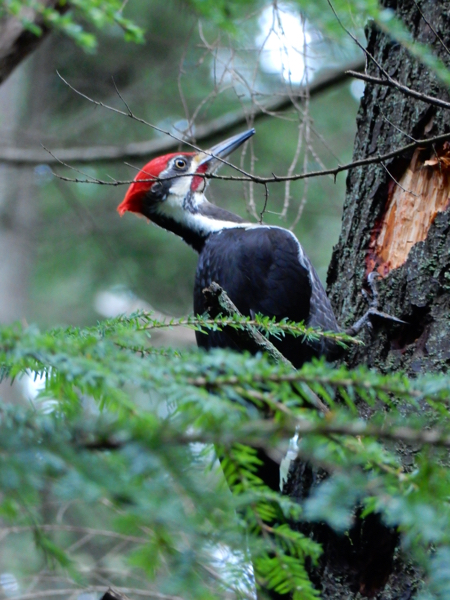
These guys are big: 16.5–17 inches (42–44 cm) long.
If you’ve ever been walking in a wooded area and heard a sound like loud hammering, you may have been around these magnificent woodpeckers. Another indication of their presence is large holes in dead trees. Woodpeckers feed by pulling the bark off of dead trees to get at insects underneath. They also use large dead tree trunks as a way to announce their presence during courtship by hammering their bills against the tree’s resonating surface.
Woodpeckers are called “primary cavity nesters” because they excavate their own holes in dead trees for nesting. They do not reuse nesting holes but rather create a new hole each year. The physical motions of creating a new nesting hole stimulate reproduction. Their older holes then become homes for other birds, such as bluebirds, chickadees, nuthatches, and house wrens, which are known as “secondary cavity nesters.”
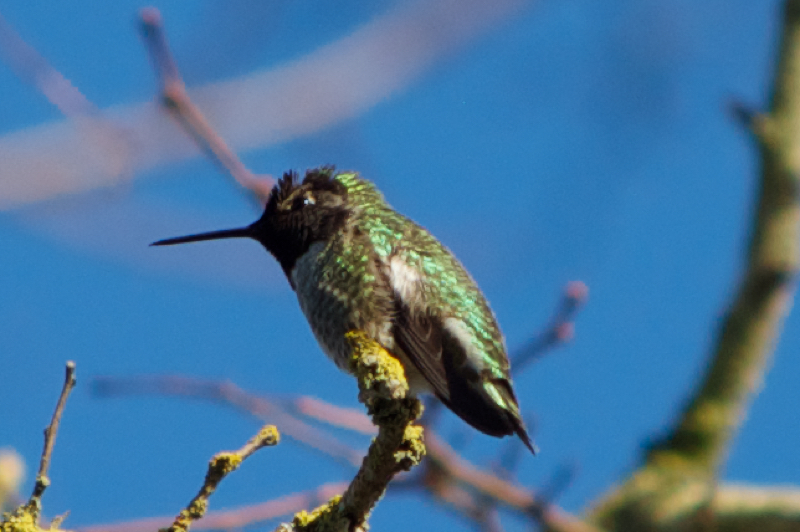
2. Hummingbird

Hummingbirds are tiny: 3–4 inches (10 cm) long. In Washington, both Rufous and Anna’s hummingbirds live west of the Cascade Mountains. This is probably an Anna’s hummingbird, since that’s the only species that stays here year round; other hummingbirds arrive in western Washington in May and depart in October.
3. Bald Eagle

These magnificent birds are 31–37 inches (79–94 cm) long, with a wingspan of 7–8 feet (213–244 cm). This one was soaring over the water, looking for fish.
Bonus. Western Grebe

At least we think this is a western grebe. In Washington western grebes occupy near-shore marine waters during the winter. We saw this one on the rocks next to the water of Commencement Bay. Fish, which grebes pursue under water, make up 80% of their diet
According to the Washington Department of Fish & Wildlife, “Wintering western grebes have declined by almost 95% in Washington’s inner marine waters since the late 1970s (Puget Sound Action Team 2007). Recent data suggest that numbers may have stabilized since 1998 … Up to 20–25% of the world’s population of western grebes overwinters in Washington.”

If you find anything here that’s incorrect, please let me know in the comments.


 Retreading for Retirement