Juneau & Icy Strait Point

On Friday the Statendam spent the day docked at Juneau. This was our first day of inclement weather: It rained almost all day. We took a look outside early in the day and agreed we’d wait until the weather cleared up before heading out. But the weather never did clear up, and we spent the day on the ship, reading and relaxing.

Yesterday (Saturday) we visited Icy Strait Point, an island now owned by Alaskan Native people as a result of the Alaska Native Claims Settlement Act of 1971. The site includes the Hoonah Packing Company facility of the 1930s (shown in photo at the top of this post) that has been converted into a museum, restaurant, and shops.

Many of the inhabitants of the island are of the Tlingit people, a matriarchal people indigenous to the Pacific Northwest Coast. We attended a performance at which several people acted out some of the Tlingit origin myths. We were allowed to take photos before and after, but not during, the performance.

Tlingit young man

This young man spoke to us as the audience gathered. He’s 16 years old and attends the local high school. The bear skin on the wall behind him is from one of the largest bears caught on the island in recent years.

Tlingit blanket

The performers wore as robes these beautiful blankets.

Three Things Thursday

What a super experience today was for Three Things Thursday, the purpose of which is to “share three things from the previous week that made you smile or laugh or appreciate the awesome of your life.”

three-things-thursday-participant

Endicott Arm and Dawes Glacier

Our original itinerary called for us to cruise Tracy Arm today. However, we were awakened just before 9:00 AM by an announcement from our captain. He said that there were winds of 40 knots in Tracy Arm, which is a narrow passage. Because he deemed it unsafe to enter Tracy Arm in such windy conditions, we would be cruising Endicott Arm instead.

Tracy Arm and Endicott Arm are two deep fjords near Juneau in the Tracy Arm – Fords Terror Wilderness area of the Tongass National Forest. Both fjords are more than 30 miles (48 km) long, and about one-fifth of their area is covered with ice. Endicott Arm is shorter and wider than Tracy Arm.

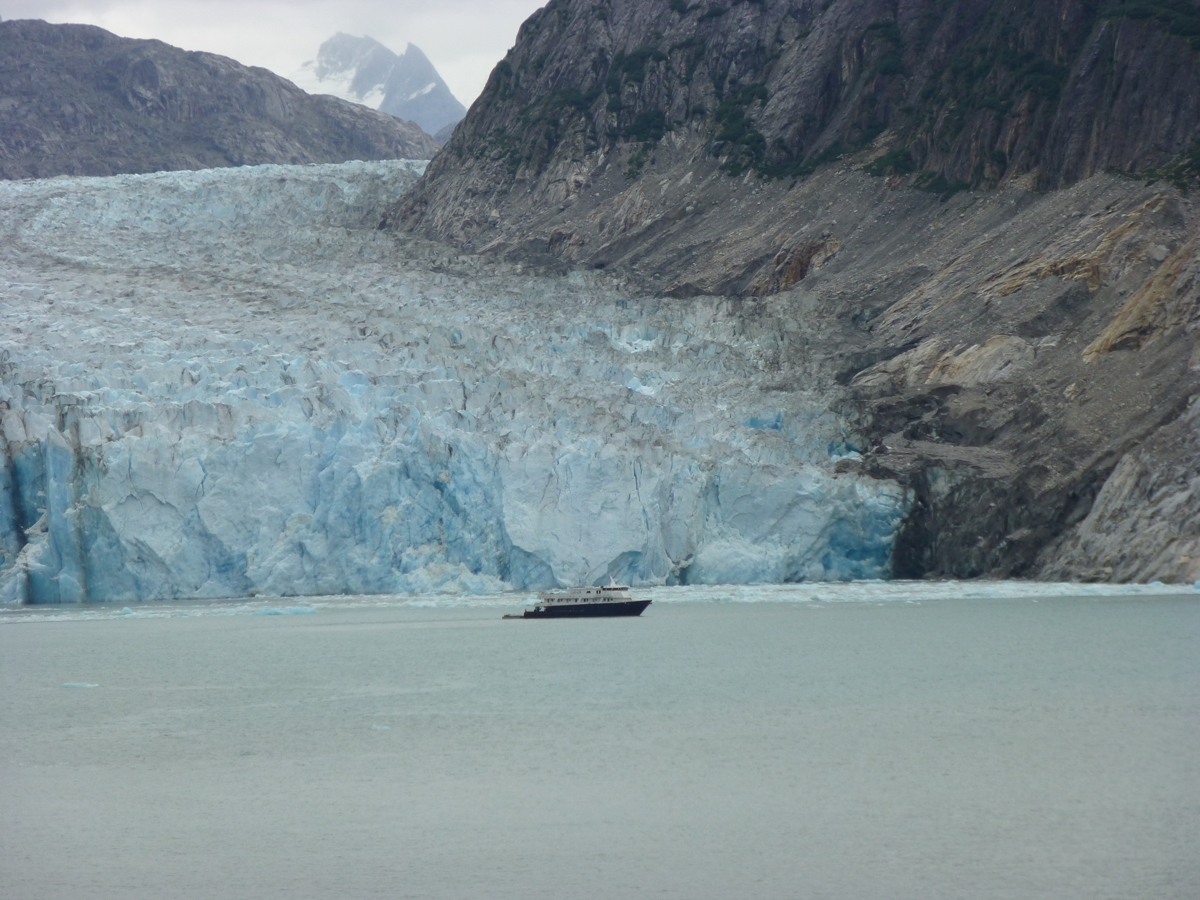
As the ship entered Endicott Arm, people flocked outside to watch our approach to Dawes Glacier, a wall of blue ice half a mile across. The captain even opened access to the ship’s bow so we could get a good look. The massive wall of blue was visible from a distance and became more and more spectacular the closer we got.

I was surprised at how close we were able to get in such a large cruise ship. There was a much smaller ship that got even closer, but we get a good look even though we were farther back.

Now I wish I had paid more attention to those earth science units we studied back in junior high. I always found them supremely boring. If I had taken them more seriously, I would probably have better understood how the glaciers carved out the terrain here during the last Ice Age and appreciated how several glaciers come together here today.

Eventually the captain pivoted the ship around and we headed back out into open water.

Here are three photos from our visit to Dawes Glacier. Click on photos to see larger versions.

Photo #1: Small Boat, Blue Ice

small boat, blue ice

Photo #2: Waterfall

small boat, waterfall

This is the same small boat cruising away from the glacier, past a waterfall fed by a melting glacier.

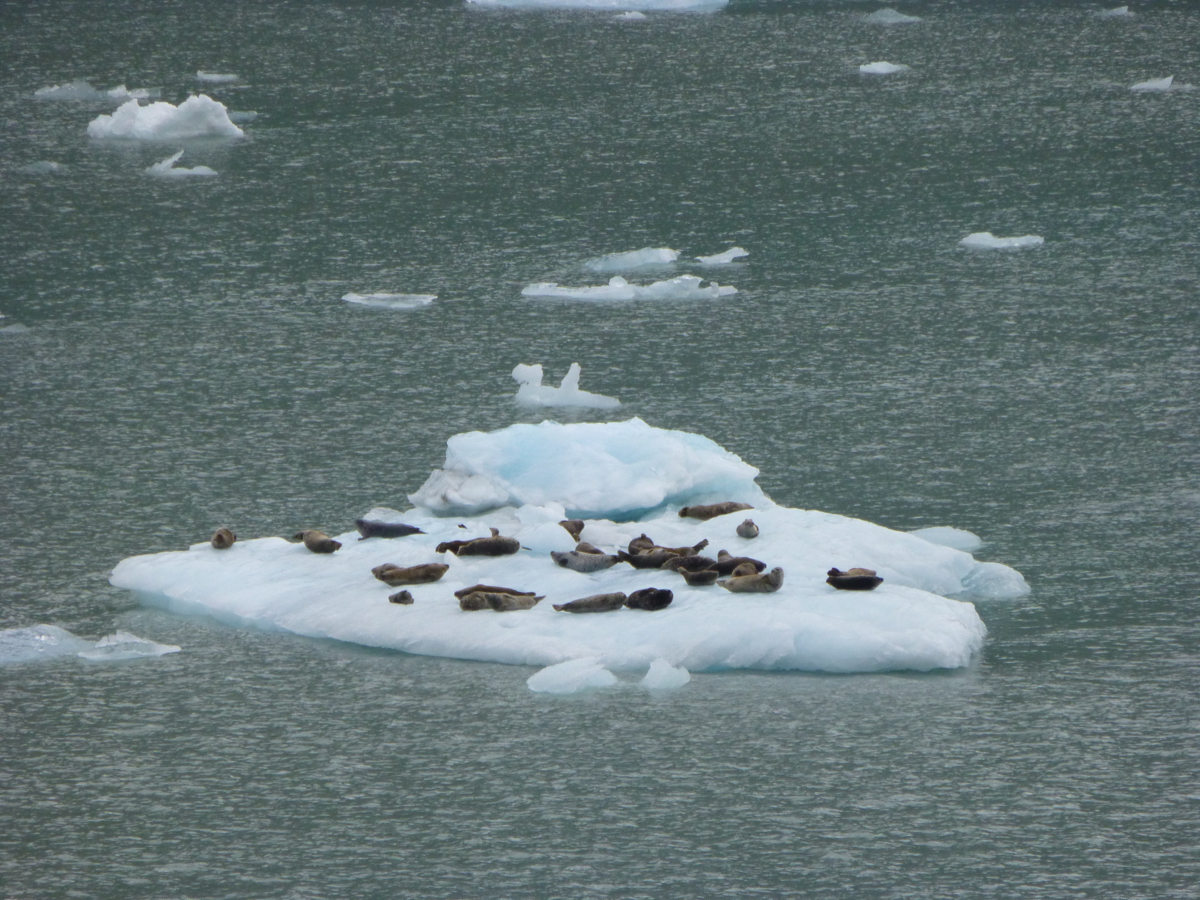
Photo #3: Seals Like Cruising, Too

Seals relaxed on several small ice floes that drifted past our ship and out to sea. This was the largest, most highly populated hunk of ice.

seals cruising on ice floe

Ketchikan, AK

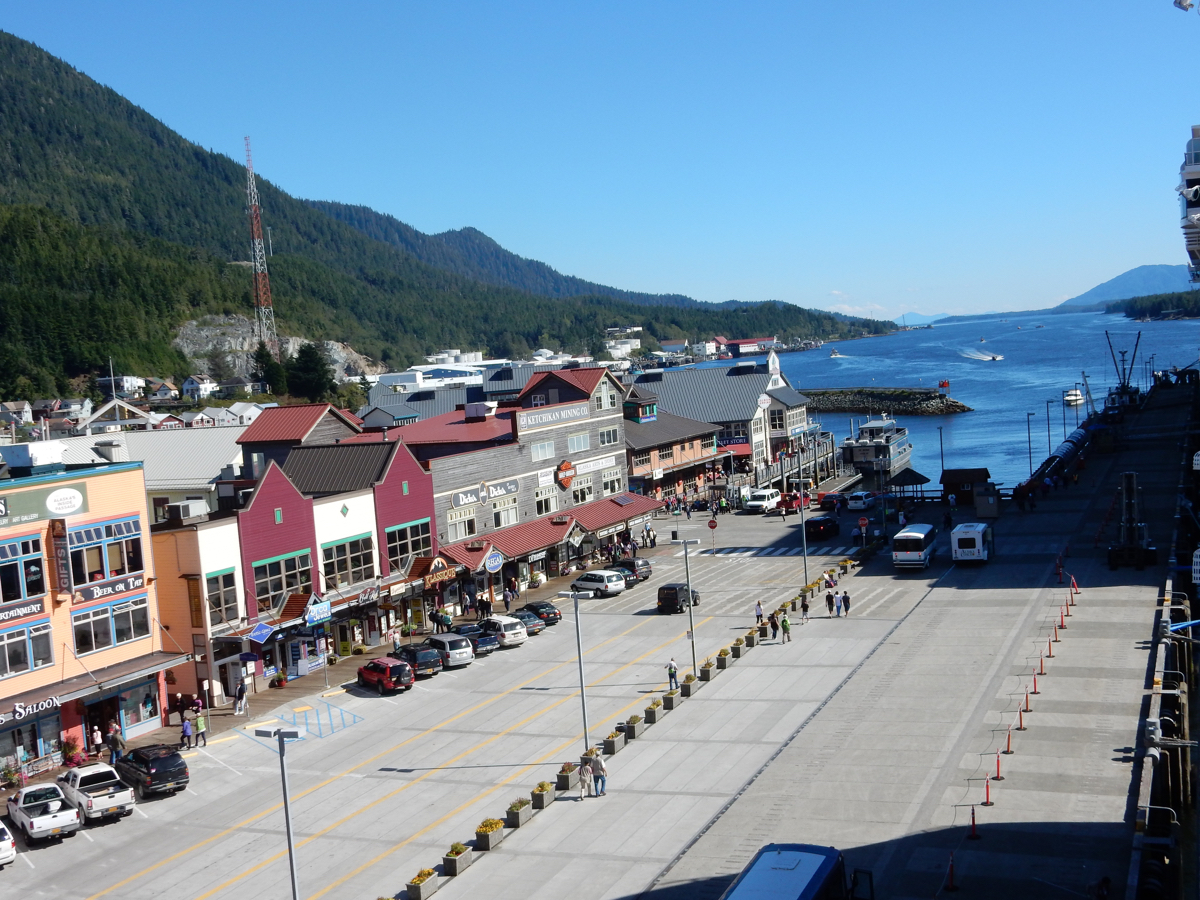
Early this morning we docked in Ketchikan, the most southeastern city in Alaska. It calls itself the first city in Alaska (incorporated on August 25, 1900). Named after Ketchikan Creek, the area was a fishing camp for the native Tlingit people before the town was established in 1885. Located on the shore of Tongass Narrows, Ketchikan features the Tongass Historical Museum and the headquarters of the Tongass National Forest.

A statue entitled The Rock, by Dave Rubin, greeted us in the plaza where we got off the ship. Unveiled on July 4, 2010, this statue portrays the people who have contributed to the region’s history.

Statue: The Rock
The Rock

Ketchikan promotes itself as the salmon capital of the world:

Salmon Capital of the World

In addition to commercial fishing, tourism is a big part of the local economy. We did what most people do when visiting Ketchikan: We shopped.

shopping
Shops line the streets of Ketchikan

All the shopkeepers pointed out that Lady Luck was with us, as we arrived in Ketchikan on one of its few sunny days. The area receives an average annual rainfall of 153 inches (3,900 mm), mostly in the autumn and winter.

Rain gauge

We were also lucky in that we arrived near the end of the cruise season. After our cruise the Statendam will make one more two-week cruise, and then the season will be over. One salesperson told us that he will then leave for the Caribbean to work in a store down there for the winter. This timing meant that every store was having a sale. We took advantage of the opportunity to get quite a few holiday gifts. I’ll be ready, provided that I can remember where I put them.

We’re Cruising North to Alaska

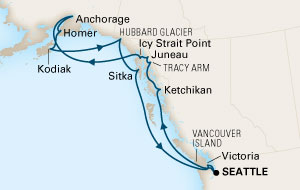
Today we leave for our first visit to Alaska, a two-week Holland America Line cruise on the ms Statendam. Here’s where this trip will take us:

Alaska cruise map

This cruise leaves from and returns to Seattle, so we don’t have to fly anywhere. This is a big bonus for us, since flying has become less and less fun as procedures have gotten more and more cumbersome.

Our instructions told us boarding would begin at 1:00 PM. Our cab dropped us off at Seattle’s Pier 91 at noon. When we entered the terminal to check in, there were nowhere near as many people as I expected. We got through the check-in process by about 12:30. I thought we’d have to wait in a big, crowded room until 1:00, but we were allowed to board the ship as soon as we had been processed through.

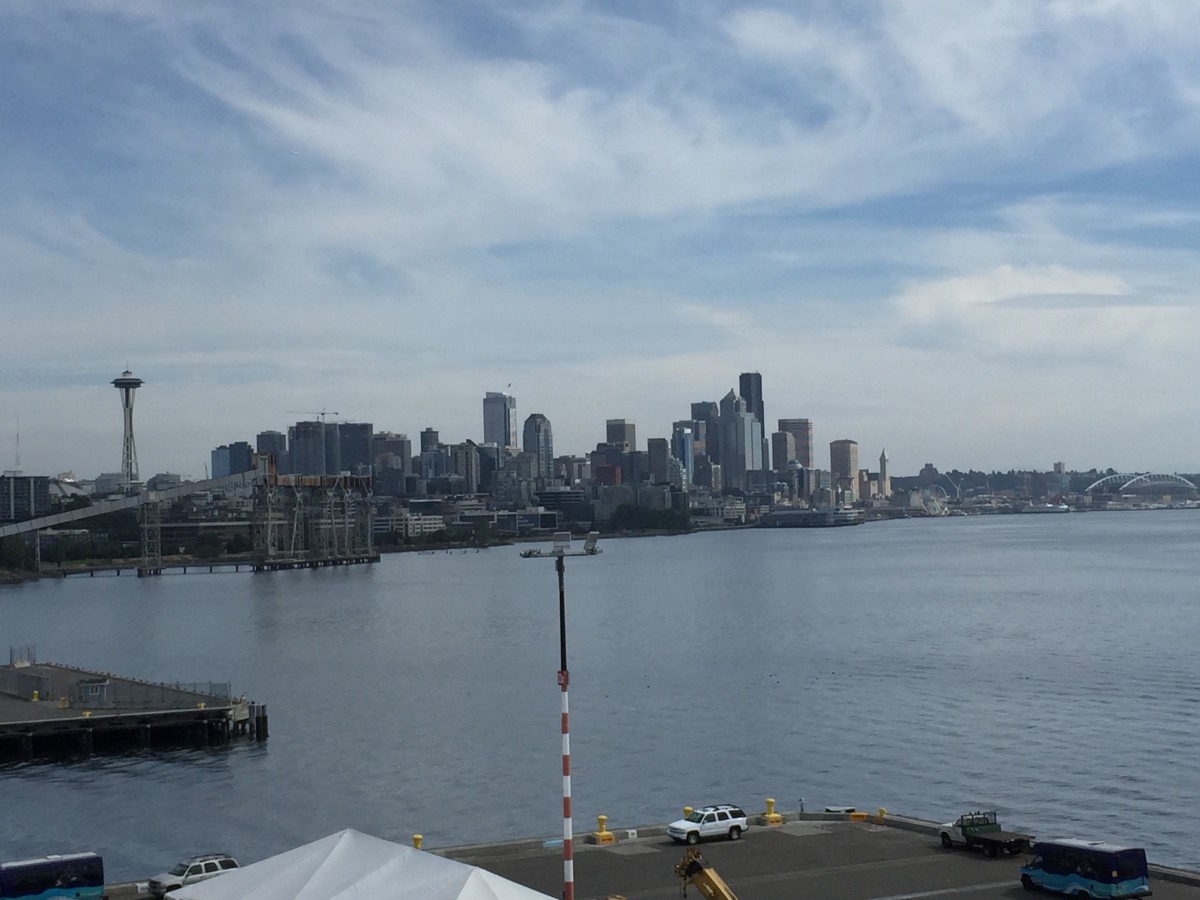
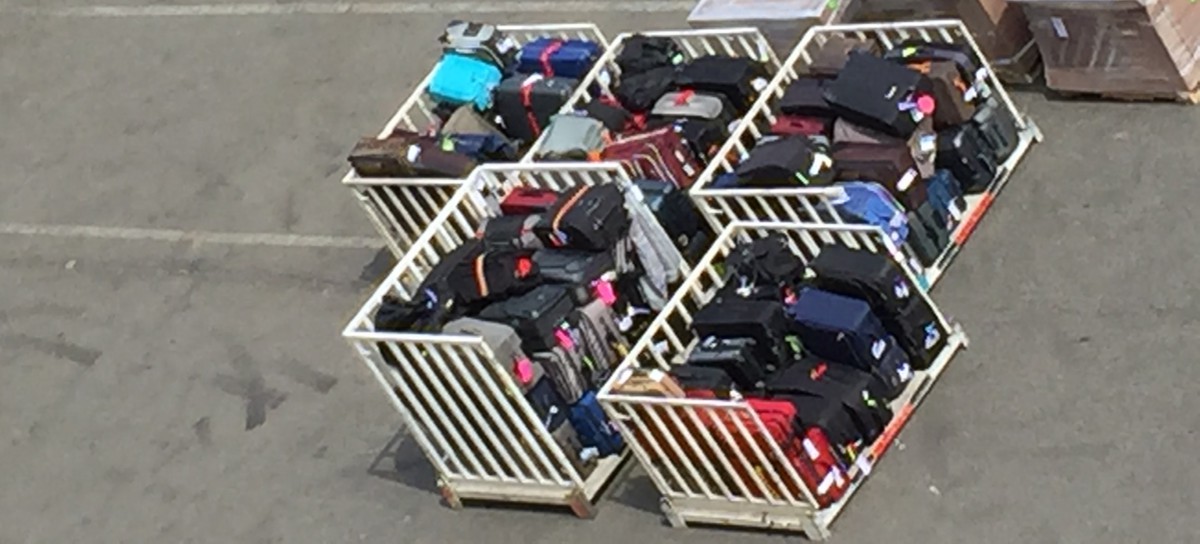
The only experience I have to compare with this one is the two-week European Viking River Cruise we took in June. That ship, the Viking Vidar, had three decks and held about 190 passengers. In comparison, the Statendam seemed huge to us—and a bit intimidating. We waited in our stateroom for about a half hour, marveling at the view of the Seattle skyline and at the amount of luggage that had to be loaded on board. Here’s a look at only a small portion:

Lots of luggage

We only had to wait about a half hour for our luggage to arrive. After unpacking, we got up our courage and ventured out of our stateroom. We made sure to locate the main dining room so we’d know where to go for dinner. We participated in the mandatory emergency safety drill at 3:15, then ventured up to the poolside sea view area on Deck 10 for some snacks and a Yukon Jack Margarita to sip on as the ship left Seattle at 4:00 PM.

After dinner, at which we ate way too much, we spent a lot of time just looking out the window in our stateroom and trying to imagine what it must have been like for crews on whaling ships, who often were out on the open sea for two or three years at a time.

Three Things Thursday

It’s Thursday again!

Time for Three Things Thursday, the purpose of which is to “share three things from the previous week that made you smile or laugh or appreciate the awesome of your life.”

three-things-thursday-participant

Trip to Leavenworth, WA

Since moving to Tacoma we’ve traveled along the West Coast between Seattle and San Francisco, but we haven’t yet gone inland from here into eastern Washington State. One of our new neighbors, a life-long Tacoma resident, suggested that Leavenworth would be a good place to visit. So when Franke Tobey Jones offered a three-day, two-night trip to Leavenworth, we jumped on the opportunity.

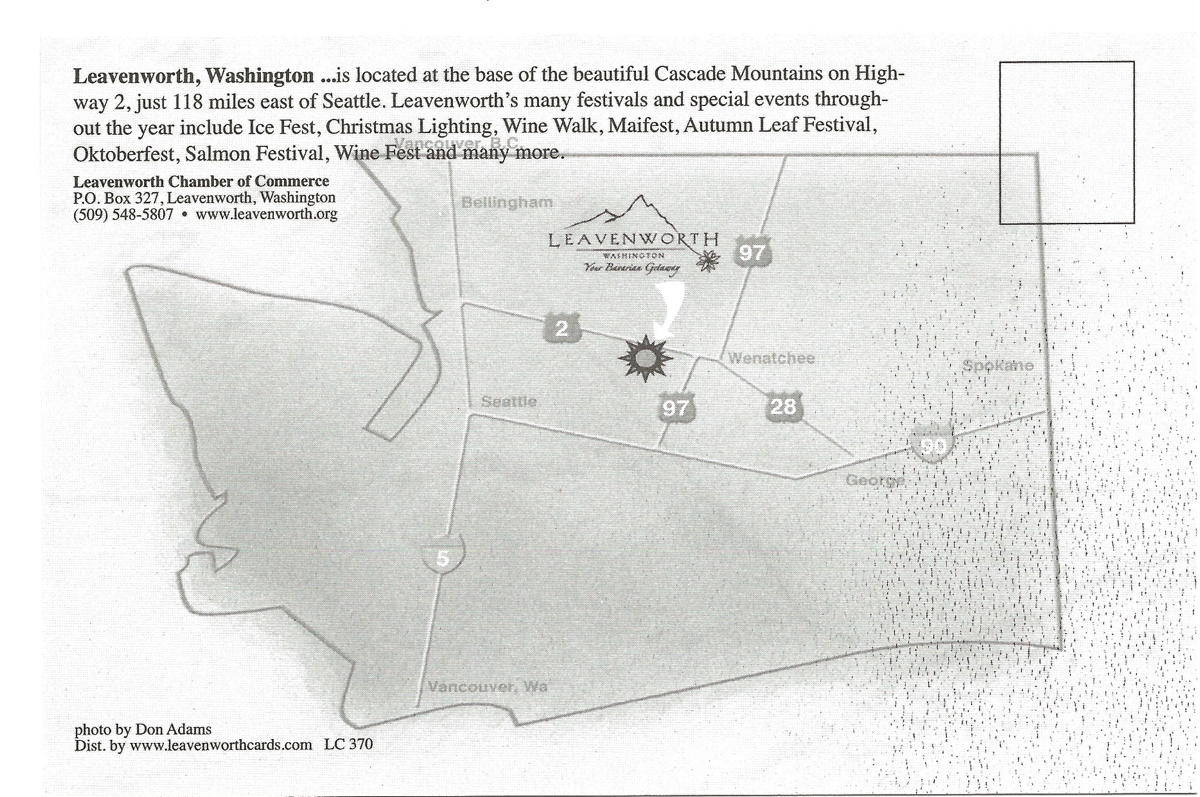
Leavenworth is located in the foothills of the Cascade Mountains, about 120 miles east of Seattle. It’s Washington’s Bavarian Village, with most buildings in town decorated with ornate woodwork and murals of Bavarian motifs. In summer the buildings and grounds in the city are ablaze with full-color flower displays.

(Click on any photo to see a larger version.)

1. Bavarian Lodge

Bavarian Lodge
Bavarian Lodge

We stayed at the Bavarian Lodge, which epitomizes the city’s identity with its painted decorations and flower boxes. Our room was large, the bed was comfortable, and the free breakfast was delicious.

2. Decorated Building

Decorated Building, Leavenworth

Imagine a town full of buildings similar to this one and you’ll visualize Leavenworth. The paintings on the buildings were fascinating. The many stores carry a variety of items, from typical tourist souvenirs to hand-crafted cuckoo clocks and music boxes, nutcrackers, Dresden china, and artwork by local artists. There’s even a nutcracker museum, although we did not get a chance to visit it. Behind the building you can see the steep, rocky Cascade foothills.

With its Bavarian village setting, Leavenworth obviously caters to tourists. For outdoors folks there are nearby centers for hiking, climbing, biking, skiing, snowmobiling, kayaking, and horseback riding. Leavenworth is beautiful in summer, but it also offers lots of festivals and events during other seasons, including the following: Ice Fest, Christmas Lighting, Wine Walk, Maifest, Autumn Leaf Festival, Oktoberfest, Salmon Festival.

The highway to Leavenworth passes through Stevens Pass, elevation 4,061 feet, the site of a winter downhill and cross-country ski resort. Stevens Pass is often closed in winter when there’s snow in the Cascade Mountains, so plan accordingly if you decide to go in winter.

3. Eagle Creek Winery

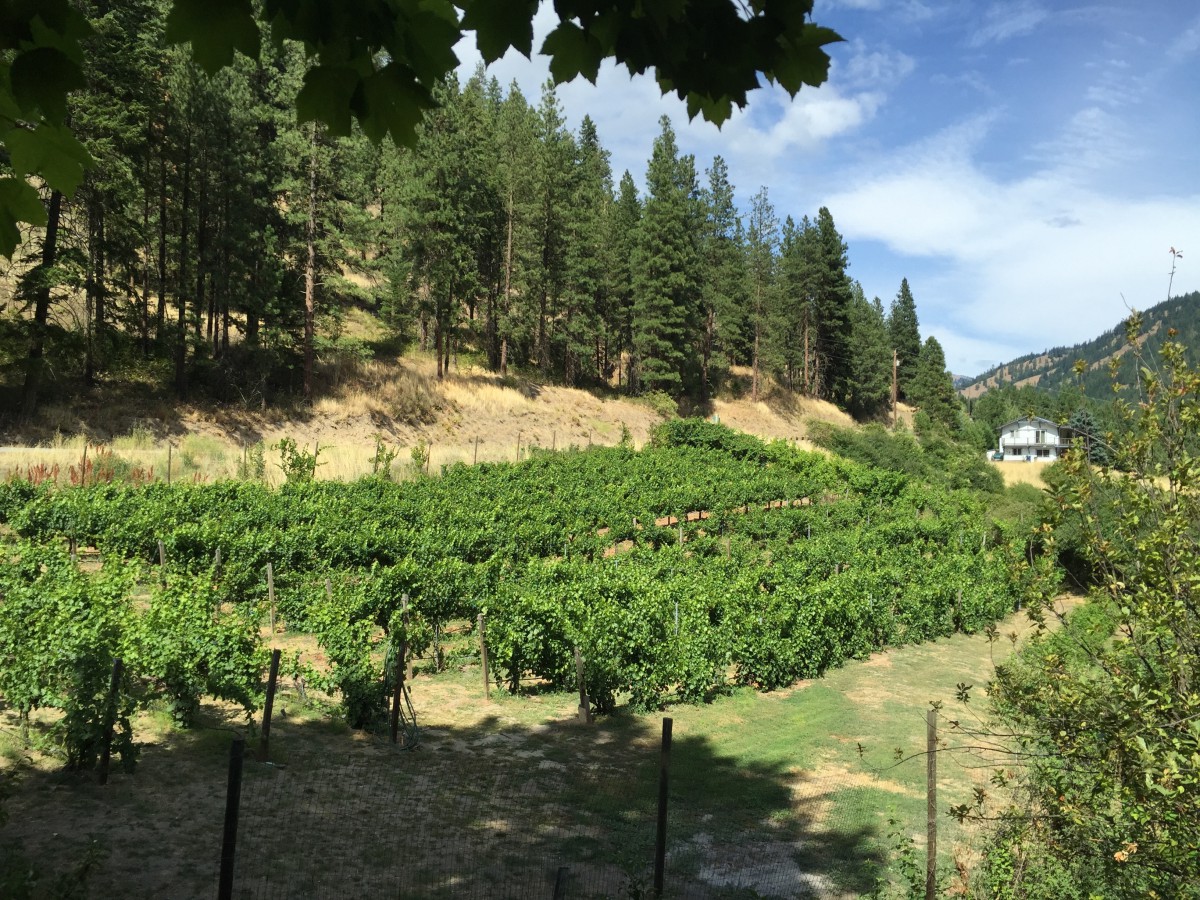
Vineyards, Eagle Creek Winery

We also had a wine tasting and tour at Eagle Creek Winery just outside the center of town. The heat and soil make the region a perfect place for growing grapes. We liked several of their wines and came away with six bottles.

scroll divider

We also attended a production of the play Into the Woods by the Leavenworth Summer Theater at their outdoor venue, Ski Hill Amphitheater. (No photography allowed there—sorry.)

Overall, the trip to Leavenworth was delightful. We hope to return on our own sometime. And now that we’re retired, it won’t even matter if we get snowed in.

What I Learned on My European Trip

My major reason for traveling is to learn about other people and their world. I learned a lot on our recent trip to Europe.

Build Your Fortress on High Ground

I knew that early people built their fortresses on high ground for two reasons:

  1. So they could see their enemy approaching
  2. So that they would defend their city by shooting down, not up, at their attackers

But it wasn’t until I saw with my own eyes so many castles built on high ground that I fully realized the truth of this dictum:

Castle 2Thanks to my husband for this photo, which well illustrates the advantage folks in the castle would have if invaders moved in, particularly if those invaders came by river.

European History, Culture, People

I didn’t know much about European history before this trip, and I learned a lot about how different cultures developed. I particularly enjoyed recognizing how people who we think today live near each other developed differently. Distances were much greater 500 years ago, and people who now live a short train ride apart developed different values, beliefs, and customs. Yet there are similarities, too, in language, religion, food, and culture.

I love “it’s a small world” stories, and this trip presented one after another.

Many Europeans Speak at Least Some English

In shops just about everywhere we stopped, someone spoke enough English for us to converse and do business.

My husband and I both caught a cold that ran through most of the people on our ship. In one German city we visited, we went into a pharmacy to get vitamins A and C to boost our immune systems. As soon as I asked the pharmacist if he had vitamins A and C, he said, in perfect English, “Oh, are you from the States?” He asked what I needed and why, then went over to a shelf and pointed to two packages. “This is what we take over here.” We left the pharmacy feeling we had gotten exactly what we wanted.

Most Europeans speak a second language because their schools start them early on studying another language in addition to their own. Although English isn’t usually their only option, some people we spoke to said that many choose English because it’s nearly universal. And it’s not unusual to come across someone who speaks at least a bit of three or four languages.

Our city guide in Budapest, Eszter (pronounced like the English name Esther), told us she speaks three languages. She also said that when she was in school during Russian rule of Hungary, students were required to study Russian. She and most others refused because it was the language of the oppressor, and their teacher let them sit in the back of the room and do homework while she worked up front with those who wanted to learn Russian. Eszter said that she now regrets not taking advantage of the opportunity to learn another language.

It is only here in the United States that we think learning a second language is unpatriotic. One of our fellow travelers said that his seven-year-old grandson attends a school in the U.S. where he’s learning Chinese along with English. I’ve always thought it extremely arrogant that we think everyone should learn our language while we make no effort to learn theirs.

Always Buy Travel Insurance That Includes Medical Coverage

I don’t know about other American health insurance, but Medicare is not in effect outside of the United States.

The old streets of many European cities are paved with very old, very uneven cobblestones. One of our shipmates, K., who is not particularly infirm, got wrong-footed and fell down, breaking a bone in her ankle. It can easily happen to anyone.

I did not ask K. about the details of payment for seeing a doctor and having her leg casted, but what happened to her did make me think about medical coverage. We recently booked a trip on a different cruise line. When I asked about medical insurance, the cruise line rep told me that they have two levels of travel insurance: one that includes medical coverage and one that doesn’t. We snapped up the one with medical coverage, even though it’s a bit more expensive. It’s comforting to know that if we get sick or injured and have to be helicoptered off the ship, we’re covered up to $10,000.
Three Things Thursday

It’s time once again for Three Things Thursday, the purpose of which is to “share three things from the previous week that made you smile or laugh or appreciate the awesome of your life.”

Trip Summary

We arrived back home from our European Viking River Cruise on Monday and are recuperating from the cold we both brought back and the jet lag.

Here are three memorable icons from the trip.

1. Ice Cream

The preferred form of ice cream on our travels was Italian gelato. We saw these sidewalk enticements everywhere we went.

ice cream

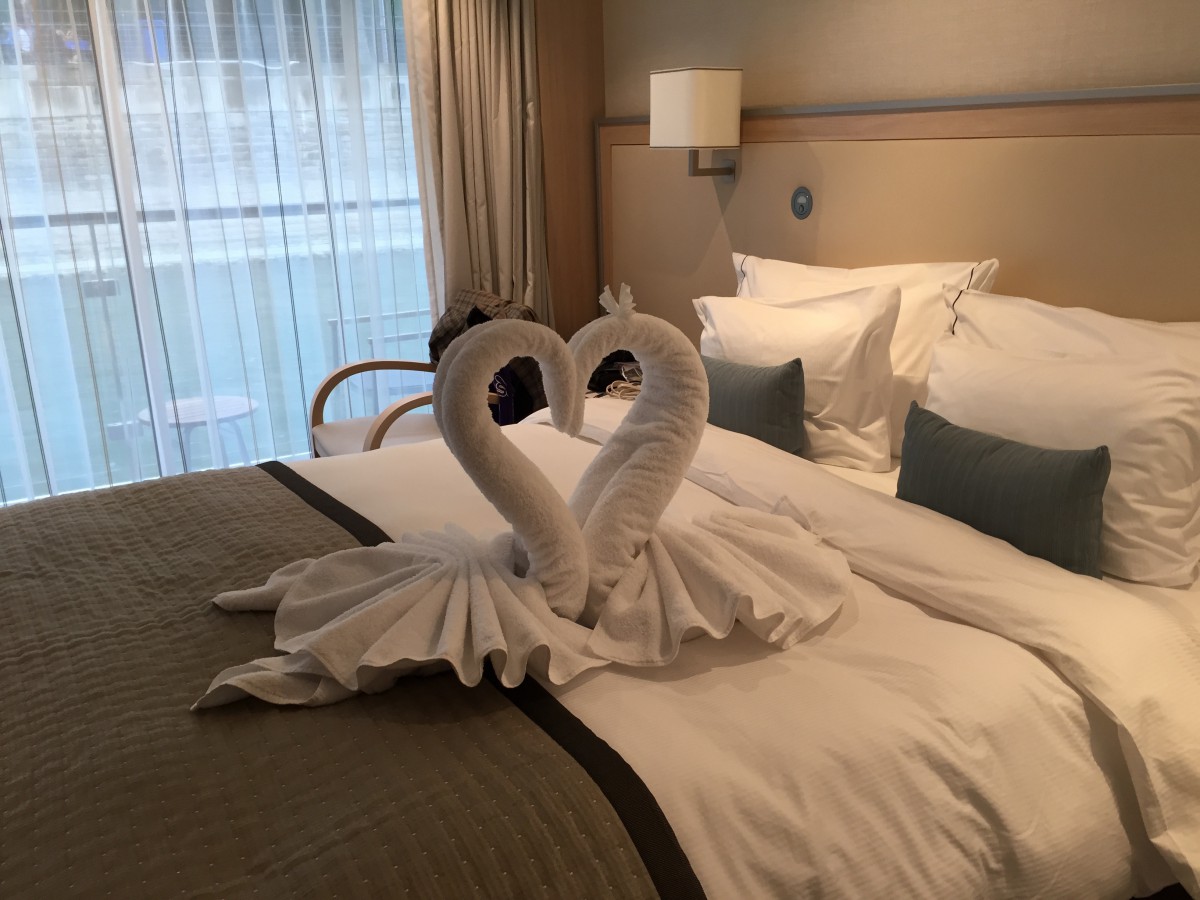
2. Towel Art

We found this in our stateroom one afternoon near the end of the voyage.

towel art

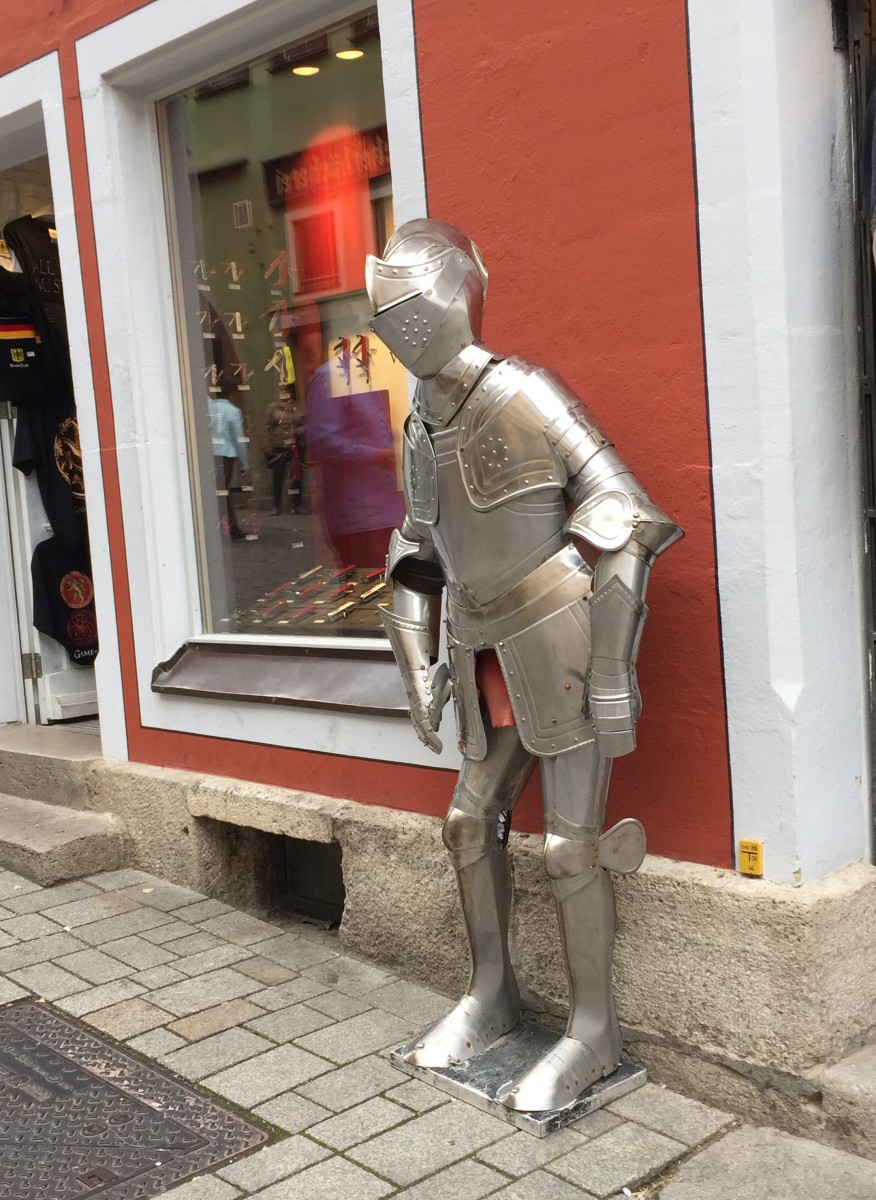
3. Getting Off the Plane

This is what we felt like after the 10-hour flight home.

armor

No, You Probably Can’t Check in Online for Your International Flight

We felt lucky that we could get a direct flight to Amsterdam via Delta Air Lines for our European trip. When Delta contacted us by email, my husband followed the link to the Delta web site and filled in preliminary information such as our address and passport numbers.

The day before we were to leave, he got another email telling him that we could check in online for the next day’s flight. Again he followed the link to the Delta web site, filled out all the forms, and printed our boarding passes.

I thought it all sounded too easy for an international flight. Nonetheless, we had boarding passes with assigned seats. When we got to the airport, there was a sign at the Delta counter saying that you could get in the “check baggage only” line if you had a boarding pass. I even asked the Delta rep standing at the sign if this applied to international flights, and she said yes.

So we stood in line. When we finally got our turn to check bags, the agent looked at our boarding passes and passports, and said, “Oh, you two are in trouble.” She pointed to the top of our boarding passes, where very tiny letters said “document verification required.”

Fortunately, she was very nice. She sent my husband over to the self-check-in kiosks and told him to scan both passports and print out new boarding passes. She put our bags aside and let me wait near the baggage check area while he did this. When he came back, the new boarding passes said, in the same very small letters, “documents verified.” She then checked our bags and we were on our way.

But what I want to know is this: Why did the online check-in process never indicate anywhere that we would have to scan our passports at the airport? In fact, why did the online process even allow us to print out boarding passes, since they weren’t valid boarding passes anyway and had to be replaced at the airport? Why did Delta put us through the whole online check-in process and lead us to believe we had checked in properly when we hadn’t?

Next time we’re flying out of the country, we’ll know better.

4 Out of 5 Stars to Viking River Cruises

I give Viking River Cruises four out of five stars for our Grand European Tour. The only thing that kept me from giving the experience a five-star rating was the unreliable internet access.

Here are the categories of the experience that were important to me:

Value

This trip was a great value. Many companies nickel-and-dime you for everything, especially meals. But, except for our days of arrival and departure, our trip cost included three meals a day. Of course we were always free to eat meals on shore, but that was a choice, not a necessity. Beer and wine were also included with meals.

Our additional expenses included goods and services you would have to pay for on just about every tour: liquor and soft drinks consumed outside of meals, laundry, local postage, optional excursions.

Educational Opportunities

In this area, also, our tour was a great overall value. We had a local guide who spoke English on a free guided tour at every location along the way. All the guides we had discussed the history, culture, art, architecture, and language of their region, and they knew a lot. They also pointed out the major local points of interest for tourists so that we could explore them more on our own during our free time. Discussions with our cruisemates revealed that everyone thought their guides did an outstanding job.

There were also many optional excursions available at additional cost, including the Mozart and Strauss evening concert we attended in Vienna. The variety of these optional activities throughout the cruise allowed people to choose aspects that particularly interested them. The prices of these excursions were reasonable, and the guides were as knowledgeable as those on the free city tours.

When we had to travel by bus, the local buses Viking employed were large, air-conditioned, and comfortable. Drivers were helpful with people who needed a hand getting onto or off of the bus.

Staff

I cannot say enough good things about how friendly and capable the Viking staff was. The ship’s hotel manager, concierge, program director, and reception desk staff all went out of their way to interact with passengers and to help in any way they could. The dining and housekeeping staffs were also attentive and professional.

Just about everyone working on the ship—at least those who interacted directly with passengers—spoke English. It is arrogant of us Americans to expect everyone to speak our language, but I appreciated their ability to speak English because it allowed me to talk with some of them a bit about their own countries, which included Serbia, Romania, the Philippines, Austria, and Germany.

Food

The food was outstanding. After just a few days on board, passengers were joking about how we all planned the rest of our day around meals. There were several dining options available: open-seating sit-down dining, with both a buffet and menu, in the restaurant on the middle deck; lighter fare in the lounge and the enclosed terrace on the upper deck.

At dinner each evening the restaurant featured dishes that originated in the area we were visiting, such as goulash during our time in Budapest. Open-seating in the dining room allowed us to sit with lots of different people over the course of the trip.

Internet Access

This is the only area that caused me to give the trip an overall rating of four stars instead of five.

I expected not to have an internet connection when the ship was moving, but I also expected the connection to be more reliable than it was when we were docked. Many times my computer (Apple MacBook Air) indicated that it was connected to the on-board wi-fi network, but Apple Mail could not connect to download my email. I had intended to publish a few blog posts during the trip, but I gave up that intention early on when I discovered how unreliable internet service was.

scroll divider

Overall, this was a wonderful trip. I now recommend Viking Cruises whole-heartedly to anyone who will listen to me rave.

Home Again, Home Again

Today was homecoming day for us, via a 10-hour Delta direct flight from Amsterdam to Sea-Tac (Seattle-Tacoma) International Airport. We were on an Airbus 330, which has entertainment screens for each passenger (on the back of the seat in front of you). This entertainment system provides music, games, and movies.

On the flight out I had planned to do a lot of reading and had packed my briefcase with everything I thought I’d need. As a result, my briefcase was too heavy for me to carry any distance, and my husband F. valiantly volunteered to tote it around for me. For the flight home I had learned my lesson and had packed little more than my laptop and my iPad in the case. I still hoped to do some reading, but this time I knew that I’d be able to plug my iPad into a USB port in front of me when it began to run low.

However, both F. and I decided to check out the entertainment system, which we had resisted on the flight out. Among the movies F. discovered The Equalizer starring Denzel Washington. I usually go to see any movie that Denzel appears in. I had wanted to see this one when it was out in theaters, despite the violence, but never got there. So we both tucked into this one.

After The Equalizer, we discovered the whole Taken series, starring Liam Neeson, available. We had seen the original Taken, but not 2 and 3, so we both went through those. It’s definitely time for this series to end, as Liam has noticeably slowed down in the action sequences. Next we watched The Drop, written by one of my favorite mystery writers, Dennis Lehane. This was the best of all the movies, as it had at least a bit of character depth and an intriguing twist at the end.

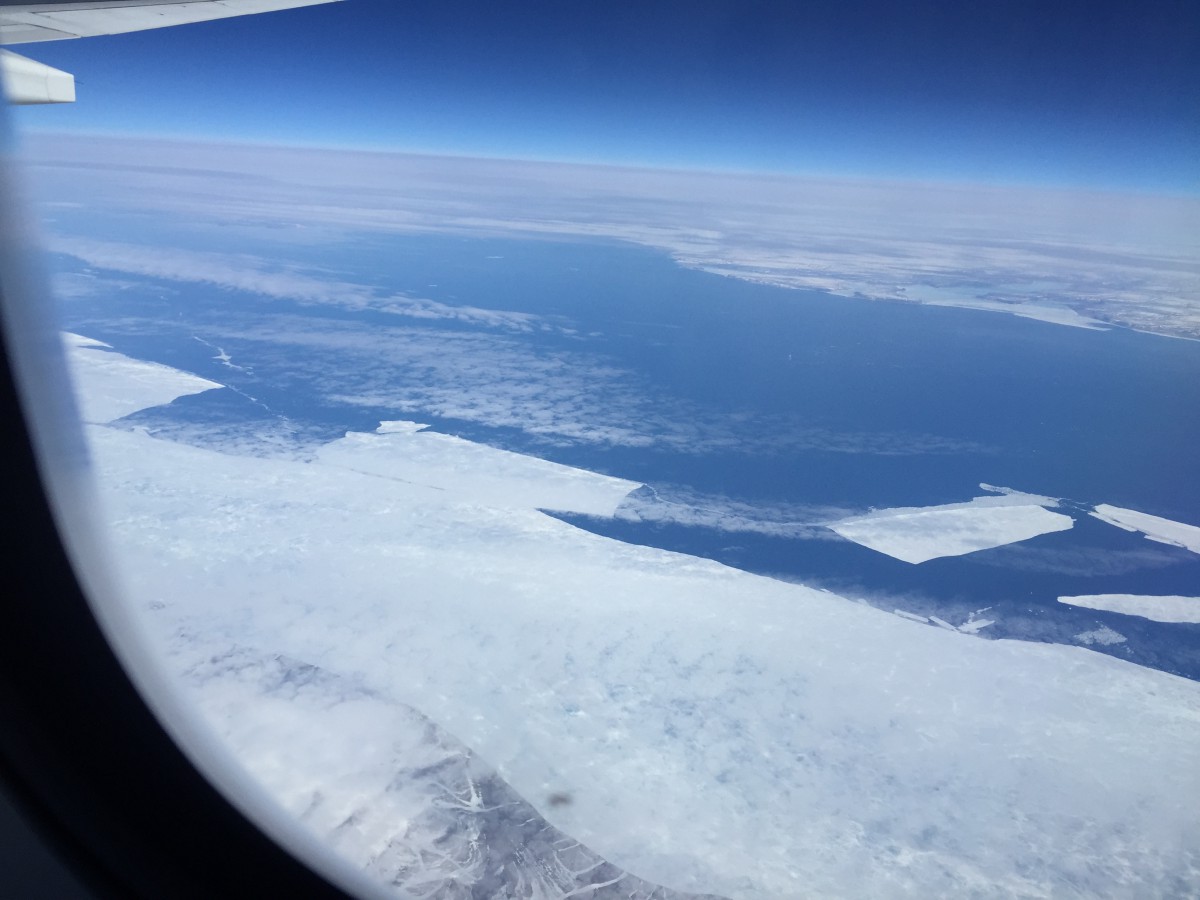
One other nifty feature of the Airbus 330’s video system is the section labeled “this flight,” which shows you a world map with the plane’s projected flight path and current location. Somewhere over the cold North Atlantic I took a break from my movies long enough to raise my window shade and snap this photo:

Icy North Atlantic

The only thing worse than a long plane flight is a long plane flight with whining, crying children. One row ahead of us in the middle four-seat section of plane was a group of four children who looked about 12, 10, 8, and 6. There was no sound at all from them for the entire flight as they, like us, sat enthralled by their personal entertainment systems. It must have been kid nirvana: endless movies, music, and games interrupted only by the occasional delivery of meals, snacks, and beverages.

I didn’t get any sleep on the flight, but I didn’t expect to. Despite the entertainment, it’s been a long day for us. We had to get up at 4:30 AM to have our suitcases out by 5:15, and our bus left the boat for the airport at 6:15. We got home by late afternoon and are now just about ready to hit the hay for several hours.

Unlimited mindless entertainment stunts human growth, but sometimes a limited dose of it is exactly what the circumstances require. Just ask those four kids if you don’t want to take my word for it.