Poverty Bay Wine Festival & Wally’s Chowder House

Yesterday we attended the Poverty Bay Wine Festival in Des Moines, WA, with our daughter, K., and her friend, D. This was the 11th year for the annual festival. K. and D. have attended for the past five or six years, but it was our second visit. The event was held at the newly remodeled Des Moines Beach Park Auditorium in Des Moines Beach Park.

This wine festival is the main fund-raising event of the year of the Des Moines-Normandy Park Rotary Club. The club donates 100% of the net profits to charitable projects, both local and international. International projects that benefit include the following:

  • Shelter Box disaster relief
  • Nepal ICU Clinic
  • Philippine Medical Clinic
  • Bio-Sand water filter project

And here are some—there are many more—of the local community projects that the Rotary Club’s wine festival supports:

  • Des Moines Food Bank
  • Des Moines Park and Recreation Youth Scholarships
  • Rotary First Harvest Food Program
  • high school and community college scholarships
  • dictionaries given to every third grader in Des Moines
  • middle school after-school program and essay contest

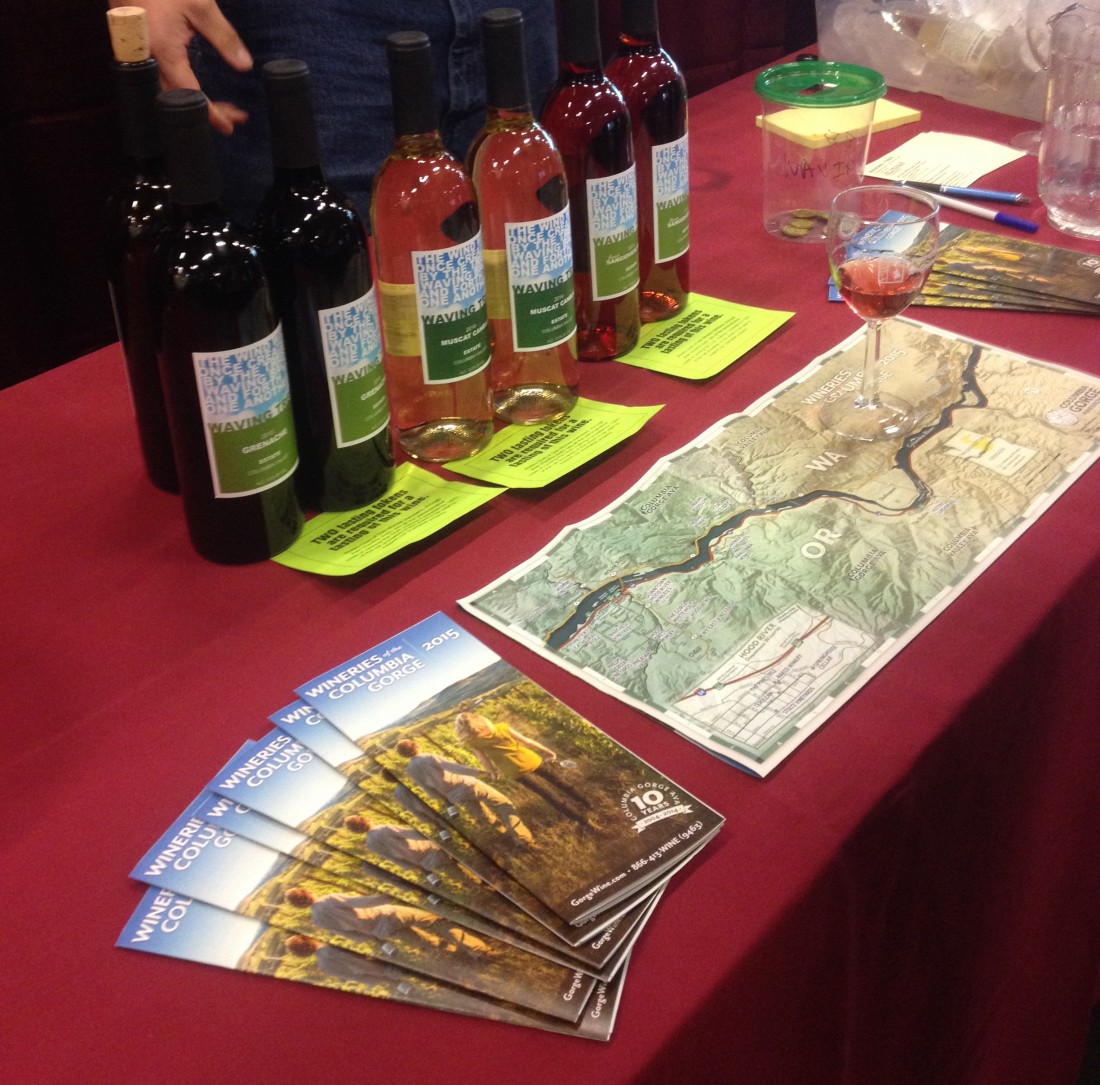
Twenty-two Washington wineries participated, most offering three wines for tasting. And for my husband, who prefers a good beer, a brewery from Kent, WA, had two microbrews available.

I must admit that my wine palate is not very sophisticated: I find a wine that I like, then I drink it. So you won’t find descriptions such as “offers a taste of blackberries, with overtones of lilac and vanilla” here. I did find four wines that I liked, and, since the proceeds go to so many good causes, we came away with a case, three bottles each of these four:

  • Waving Tree Winery’s Sweet Sangiovese Rose and Muscat Canelli
  • Finn Hill Winery’s Riesling and Semillon Ice Wine

(Thanks to my daughter for the use of her photo atop this post.)

After the wine festival we went for an early dinner to Wally’s Chowder House Broiler:

22531 Marine View Dr.
Des Moines, WA 98198
(206) 878–8140
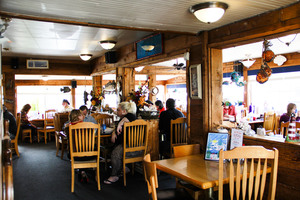
Wally's Chowder House interior
Photo from Wally’s Chowder House web site.

When we got there, many people were already lined up outside. We had about a 40-minute wait, which I took as a good sign because it indicates that people like to eat there. Some people also came in to pick up to-go orders while we waited, another good sign. The restaurant is currently building an addition to increase its dining space, so maybe when we go back we won’t have to wait so long. (But even if we do, the wait is worth it.)

The food was good, and we definitely overate. Four of us shared an appetizer of steamed clams, then my husband and I had clam chowder along with one of the specials, a 9-ounce Maine lobster tail. Hubby and I also shared blackberry pie (although it was really more like cobbler, baked in a dish) with ice cream.

We came away happy. Wally’s Chowder House has ratings of 4.5 out of 5 stars on Yelp, Trip Advisor, Facebook, and Urban Spoon.

A Pronunciation Lesson

People like us, from the Midwest, know that the city in Iowa named Des Moines is pronounced deMOIN. However, folks do things a little differently here in the Pacific Northwest. The town of the same name here in Washington State is pronounced deMOINES, giving full credit to that final s.

Lunch at Pomodoro Italian Restaurant

This month’s Lunch Bunch trip took us to Pomodoro Italian Restaurant, located in Tacoma’s historic Proctor District:

3819 N. 26th, Tacoma, WA 98407
(253) 752–1111

Since we try to eat a low-carb diet, I wondered if I would find anything that allowed me to stick to my diet amongst all the pasta and pizza. I was glad to find several appealing salads on the lunch menu. I settled for this one, without the rice noodles:

Pomodoro Signature Salad

Spring mix greens tossed with baked chicken, Mandarin oranges, dried cranberries, gorgonzola, raspberry vinaigrette and topped with rice noodles

Several of my companions had the day’s luncheon special, prawns sauteed in garlic butter served over linguine, and praised it highly.

I also passed on dessert (humble brag), but the three other people with whom I shared a table had the spumoni. This received six thumbs up, plus a few more at adjoining tables. People said it was much richer and creamier than your usual spumoni.

The service was good. My only complaint about this restaurant is that, although small, it’s loud. The four of us at our table had trouble conversing across the table.

I’m looking forward to going back to Pomodoro. They have salted caramel cheesecake on the dessert menu. Since I was so good this time, I intend to splurge next time.

Some Artwork of Tacoma, WA

Once again it’s time for the blog challenge Three Things Thursday, the purpose of which is to “share three things from the previous week that made you smile or laugh or appreciate the awesome of your life.”

three-things-thursday-participant

Here’s some of the artwork around our new hometown of Tacoma, WA, USA.

Thanks again to my husband for providing the photos. And this week he also did most of the research as well. What a guy!

1. Sarah Bernhardt Statue

Sarah Bernhardt Statue, Tacoma, WA

The famed Sarah Bernhardt performed in Camille at The Savoy Theater on May 10, 1906. The building that housed the former Savoy Theater is now known as the historic Passages Building, located at 708 Broadway, Tacoma.

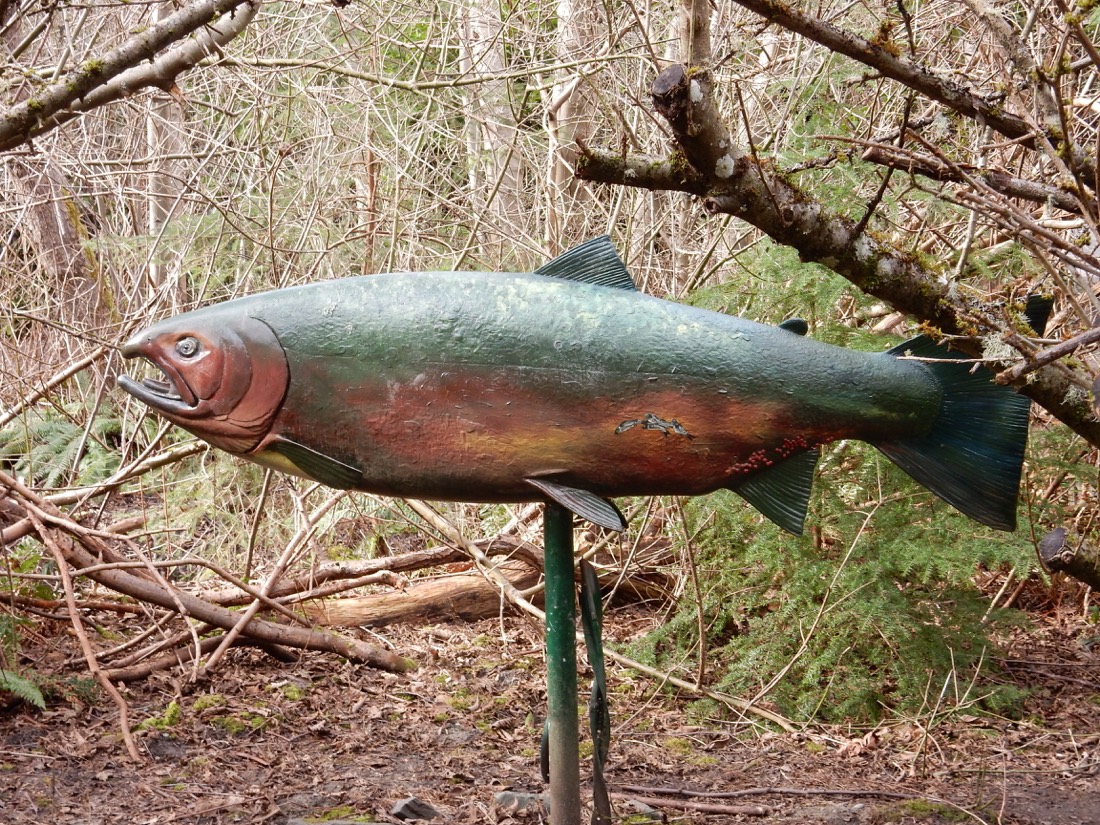
2. Salmon Sculpture at Puget Gardens

Puget Creek Salmon Art

This 7-foot fiberglass sculpture of a spawning coho salmon resides in Puget Gulch, just below Tacoma’s Puget Park. The sculpture was made by students from the Tacoma School of the Arts (SOTA) as part of a public art effort called Soul Salmon 2001.

The sculpture, worth about $10,000, gained some notoriety in 2005 when it was stolen and then found a few days later in the laundry room of a house. The owner of the house said he had gotten the sculpture in exchange for some old bicycle wheels.

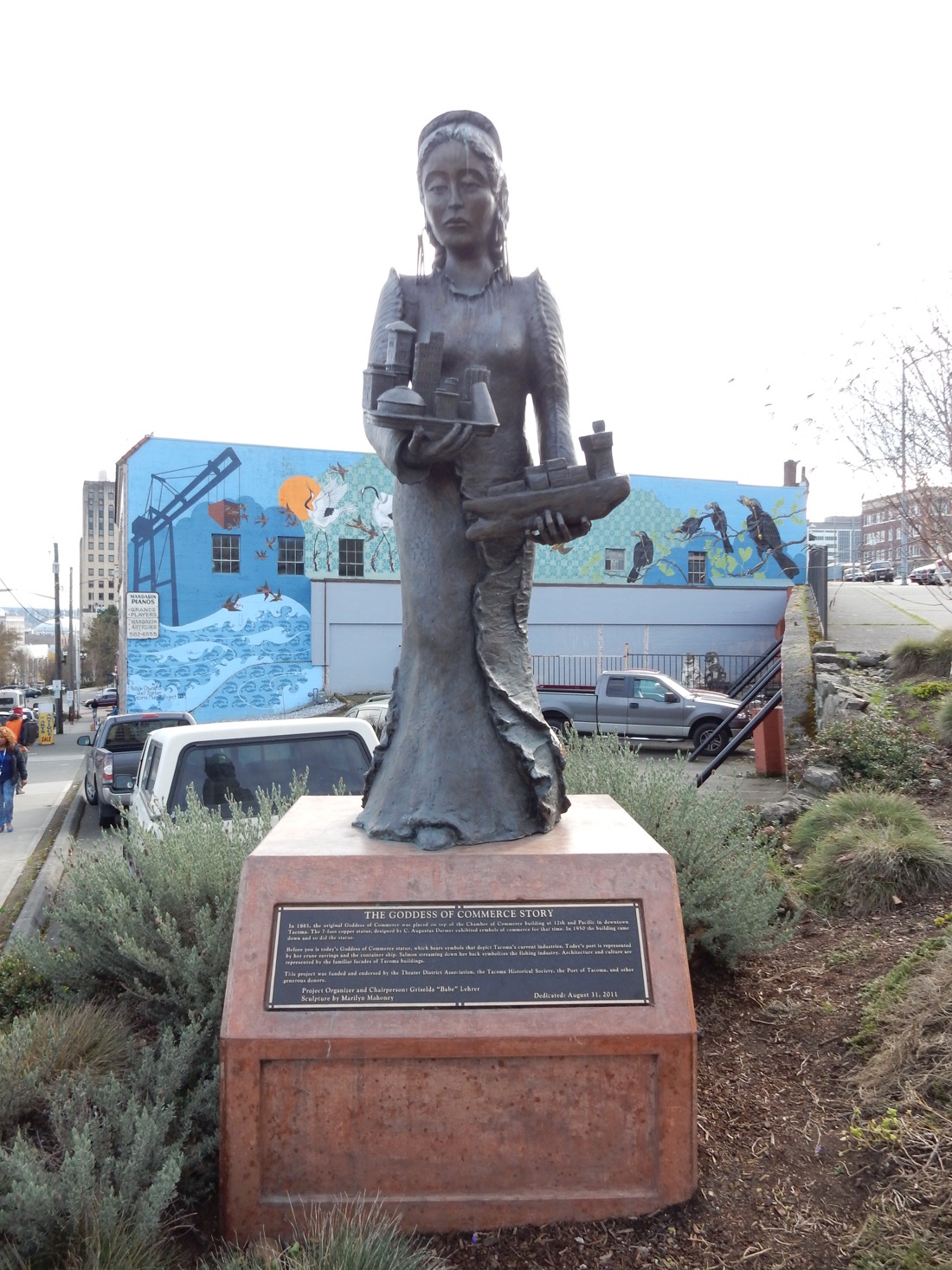
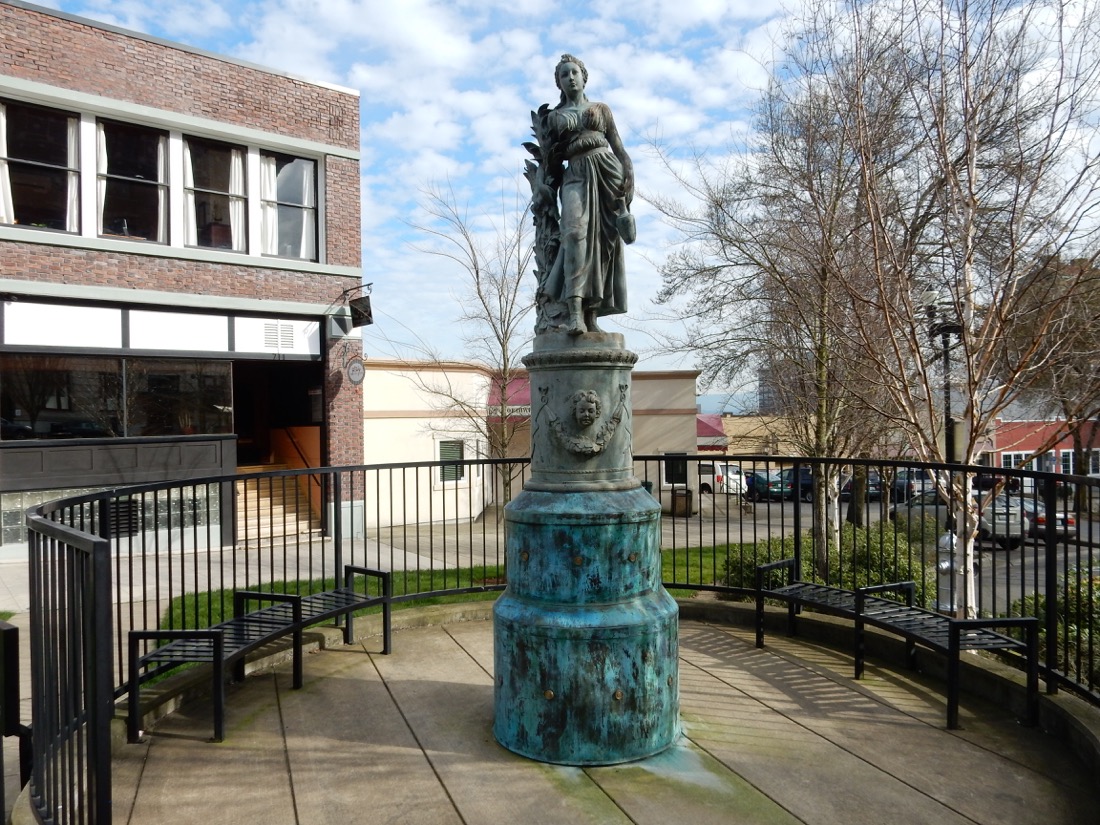
3. Goddess of Commerce

Goddess of Commerce
Goddess of Commerce Statue, Tacoma, WA

This statue, a modern interpretation of one from the 1880s that stood on top of Tacoma’s Chamber of Commerce Building, was dedicated on August 31, 2011. The creation of sculptor Marilyn Mahoney, this statue stands in the city’s theater district, at the intersection of 6th and St. Helens avenues. It was facilitated by the non-profit Tacoma Historical Society. The original Goddess of Commerce statue was hauled to a scrap yard and melted down when the Chamber of Commerce Building was demolished in 1950.

Here’s the dedication plaque affixed to the new statue (click on image to see a larger view):

Plaque: The Goddess of Commerce Story

My Circle of Five Contains Six

The good folks at WordPress provide a daily prompt to give bloggers something to write about.

This recent one particularly spoke to me:

A writer once said, “You are the average of the five people you spend the most time with.” If this is true, which five people would you like to spend your time with?

To me, this means the same as “you are the company that you keep.” This prompt spoke to me because several years ago I decided that it was important for me to surround myself with only good people. More recently, the 2,100-mile relocation from St. Louis, MO, to Tacoma, WA, has allowed me to make friends deliberately and wisely.

But this topic especially appeals to me because it offers the possibility of a hypothetical circle that isn’t restricted to people who all existed in the same time and place or whom I actually knew. So I thought of the people I’d include in the three main areas of my life: love, friendship, and writing.

Love

  1. My Grandma, whose unconditional love of me taught me how powerful love can be. When I was a young child, she provided the love and stability that I desperately needed to maintain a sense of identity and worth. Even though she died nearly 40 years ago, I still think of her daily. What I remember most is her beautiful smile and the way she beamed whenever she saw me.
  2. My wonderful husband of almost 44 years, whose love and devotion remain steady. And yes, I do realize how extremely lucky I am to love and be loved by him. Sometimes I feel that he’s more than I deserve, but I plan to keep him anyway (I’m selfish like that).

Friendship

  1. My friend Anne, who died much too young (age 60) almost 14 years ago. She was a librarian who ran the book club at my local library, and that’s where I met her. She was intelligent and witty, and, like my Grandma, she had a beautiful smile. I thought I loved books, but she loved them even more, as became evident from all the work she put into selecting books for book club and preparing for meetings. I still think of her often.
  2. My friend Frayne, who also died much too young (age 54) 13 years ago. I also met her at a book club, at the local Borders store. She was kind and considerate, and she taught me how to hug and really mean it. I also think of her nearly every day.

These two women are still the touchstone that defines friendship for me.

Writing

Here’s where the hypothetical part of my circle comes in.

  1. Emily Dickinson. I’m not a poet (not really, despite my recent participation in the Writing 201: Poetry class), but I love the way Emily Dickinson so succinctly and seemingly easily uses imagery to convey some of life’s most profound secrets. I wish I could think so concretely and so universally at the same time. Sometimes when I read one of her poems and catch the depth of meaning, my breath sticks in my chest. I’d love to have a mind that can write like that.
  2. Anne Tyler. I like lots of authors’ works, but I particularly like Anne Tyler for her ability to capture and celebrate the quirkiness of human existence in well-drawn characters. I love how she can make the ordinary seem so extraordinary.

I tried hard, but I can’t decide which one of these six people to banish in order to comply with the prompt. So the prompt will just have to comply with me. Six people it is, and fine specimens they all are.

What about you? Whom would you include in your circle of five (or six)?

Blog a Day Challenge: February Report

January was all about convincing myself that I could indeed find something to write about and produce a blog post every day.

In February I turned my gaze outward and looked at other blogs and bloggers instead of just my blog/myself as blogger. I found a number of blogs that I learned a lot from. I also began reading more articles online about how and why to blog.

Here are my stats for February:

Number of posts written: 31

Shortest post: 215

Longest post: 1,880

Total words written: 20, 455

Average post length: 660

Distribution of posts across my three blogs:

The total of posts here may not equal the number of posts written last month because I occasionally publish the same post on more than one blog. However, I have included each post only once in my total word count.

What I Learned in February

  • Despite February’s being three days shorter than January, I wrote the same number of posts, 31, this month as last. However, my total word count in February was 1,340 more than in January. My average post length went up, from 617 in January to 660 in February. And my longest post in February was 520 words longer than its counterpart in January.
  • One thing I was surprised to learn in my reading about blogging is that some people advocate writing posts longer than the 500–750 words I had long ago read was the optimal post length. So instead of trying to limit myself to 500–750 words, I tried to write longer rather than shorter in February. In January I wrote only four posts of 1,000 words or longer, whereas in February I wrote six posts of 1,000 words or more. But I’m still not convinced that more than 1,000 words is an optimal post length. I’m more comfortable with posts of about 800 words. Although there will inevitably be shorter posts, I’m going to work on writing more posts of about 800 words from now on. And I’m going to think of posts of more than 1,000 words as occasional occurrences, when the subject warrants, rather than as ideals to aim for.

Last month’s featured posts:

1. An Ode to My Bracelet, in Memory of Frayne

Over the last two weeks of February I participated in the WordPress Writing 201: Poetry course. I learned a heck of a lot, even though grinding out a poem that fulfilled three specified criteria didn’t always produce top-quality results. But I’m happy enough with this one to share it.

2. What Your Favorite Books Tell You About Your Writing

Most writers are also avid readers, because the only way to learn about good writing is to read a lot of writing by others. This exercise helps writers to discover what their own areas of passion are by analyzing the books that appeal to them the most. I found it an invaluable discovery.

What advice do you have for me about blogging? I’d especially like to hear your thoughts on the best length for a post.

WordPress Writing 201: Poetry Class, Day 10

It’s the final day of this course, Day 10, which offers the following challenges:

  • Prompt: future
  • Form: sonnet
  • Device: chiasmus

Sonnet

A sonnet is normally composed of 14 lines of verse.

There are several ways you can split your sonnet into stanzas (if you wish to), though the most common ones are 8–6 and 4–4–3–3.

Likewise, if you decide to use rhyme in your sonnet, you can choose between various rhyming schemes, like ABAB BCBC CDCD EE, ABAB CDCD EFEF GG, or ABBA ABBA CDC DCD, among others.

At their best, something happens between the first and last verse, and especially between the first eight and final six lines. You want your reader to have experienced something more than just a brief sonic pleasure. You want to present a fully-formed thought.

Chiasmus

At its simplest, a chiasmus is essentially a reversal, an inverted crossing (it got its name from the greek letter chi – X)… From a fairly straightforward reordering of words — where A and B are repeated as B and A — a chiasmus can develop into more complex structures: instead of words, phrases. Instead of phrases, ideas or concepts. Chiasmus is effective in poems because it’s a form of repetition — and by now we all now how crucial repetition is for poetry. But the reversal injects the repeated words with freshness, and allows us to play with (and radically change) the meaning of a line.

Writing Process

I had seen today’s assignment last night, so when I came across this article, I knew it had to be my future subject.

A Brave New World?

In an article in The Guardian a doctor announces,
“Full-body transplants could take place in just two years.”
Italian surgeon Sergio Canavero says he should be able
To graft a living person’s head onto a donated body.

This procedure could prolong the lives of people with terminal illness,
Canavero says, and he’s developing a program
To train neurosurgeons to do the complex surgery
Necessary to make the procedure work.

Forget the complex surgery. What would it be like
To wake up inside a brand new body? Would the brain
Think it lived inside an alien creature?

And what about the consciousness that once belonged to the grafted brain?
Would it still retain its sense of identity?
The brain does not = consciousness, nor does consciousness = the brain.

WordPress Writing 201: Poetry Class, Day 9

Right up front, let me admit that today, Day 9, is the one day I allowed myself to bail on, as I’ll explain in the section labeled Writing Process below.

Today’s parameters are:

  • Prompt: landscape
  • Form: found poetry
  • Device: enumeratio

Found Poetry

Like a blackmail letter in a sordid crime novel, a found poem is made up of words and letters others have created. It’s up to you, the poet, to find them (hence the name), extract them, and rejig them into something else: your poem.

Enumeratio

it basically means constructing a list, a successive enumeration (duh!) of multiple elements in the same series.

Writing Process

I was initially completely flummoxed on how to go about using found poetry on a computer screen or on a blog. What is the digital equivalent of cutting words out of the newspaper and pasting them onto a blank sheet of paper.

So I used the suggested tool poetweet, which allows you to fill in your Twitter name and then creates a poem (I chose a sonnet) from your tweets. Here’s what I got:

Mail Online

Residue of design.” – John Milton
Cities Grew Much Like Modern Ones
With “that dreadful Terry Eagleton”
View Us “As a Joke” | Mother Jones

Of Rooting for Love – The Atlantic
Especially for introverts – CNET
Writing Is Therapeutic |
Genre help save the planet?

Avoid frailty by rebuilding muscle
Organ Transplants, Experts Estimate
Fiction e-book | Cornell Chronicle

Dark of the Moon by John Sandford
She doesn’t need from a director
Wolf Meta: The Evolution of a Word

Well, OK, but what am I supposed to do with that?

As I was trying to devise some way to handle today’s assignment, a minor crisis occurred here at home—nothing dire, but quite time-consuming. By the time I finished dealing with that, it was time for dinner.

I took this occurrence as a sign that I just wasn’t cut out for this particular exercise in the first place. But I did learn what enumeratio is.

Three Things Thursday

Once again it’s time for the blog challenge Three Things Thursday, the purpose of which is to “share three things from the previous week that made you smile or laugh or appreciate the awesome of your life.”

Spring in Tacoma, WA

The record-breaking warm temperatures we had a few days back induced an early spring. Early-blooming trees, shrubs, and flowers are on display all over.

Here are a few examples. Once again, thanks to my husband and his telephoto lens for these photos.

1. Rhododendron

rhododendron


This is the Washington State Flower. Soon these will be abloom in fantastic colors everywhere. This light-colored one seems to be one of the earliest.

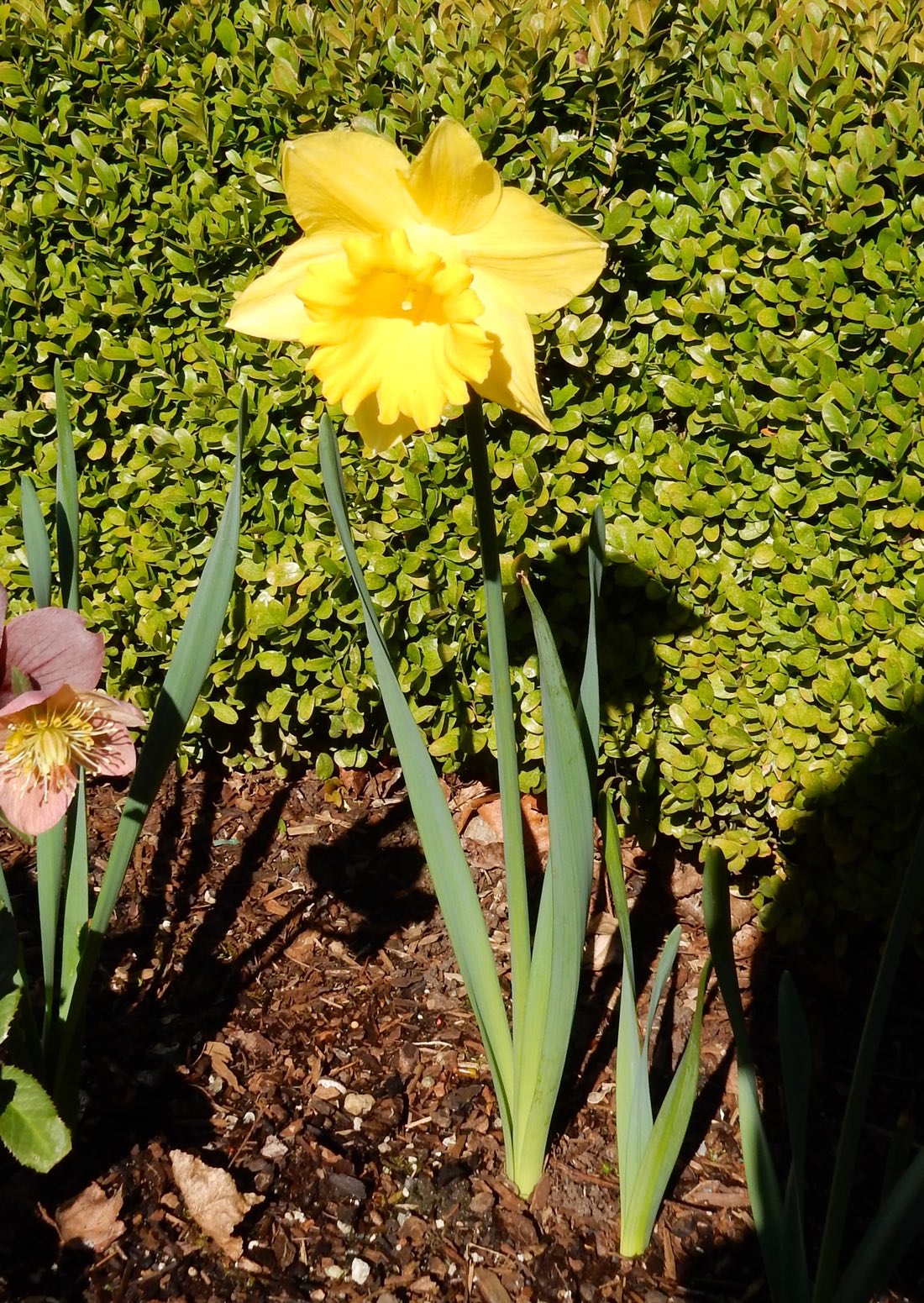
2. Daffodil

Daffodil

I never get tired of these, probably because they’re one of the first truly colorful displays each spring.

3. Salmonberry ?

salmonberry

We think this might be salmonberry, but we’re not sure. Do you know what it is?

Bonus: Some Kind of Weed

weed

We’re also not sure what this is, but it’s just too interesting to leave out.

Since we’re new to the area, there’s a lot we don’t know about the local flora. If you have more information about any of these plants, please let us know in the comments.

Happy spring!

WordPress Writing 201: Poetry Class, Day 8

Today’s Day 8 assignment involves:

  • Prompt: drawer
  • Form: ode
  • Device: apostrophe

Ode

An ode is a laudatory poem celebrating a person, an object, a place, etc. It can come in any form these days, having shed its ancient (and much stricter) formal requirements.

At their best, odes are both a compelling portrait of something and an investigation (tacit or explicit) of the poet’s own relation to that thing.

For your poem today, focus on details — the things that make your chosen object unique — but also on the effect it produces on others (you or someone else).

Apostrophe

apostrophe (a-POS-truh-fee) … occurs when the speaker in the poem addresses another person or an object (usually personified) directly.

You can write a poem that is made up entirely of one extended apostrophe, or switch back and forth between addressing your reader and addressing someone (or something) else.

What tone and flavor will you choose for your apostrophe? Will it be plaintive, nostalgic, angry, admiring? The way you shape your address will greatly influence the feel of your poem.

Writing Process

One way to go about composing your ode would be, first, to make a list of the qualities and details you’d like to highlight, and then try to work them into a poem, crossing off those you’ve covered. Another: write as if you’re shooting a movie, following the subject of your ode from top to bottom, from left to right, etc.

My first task is to choose an object to center on. I chose the inscribed bracelet that I put on every morning because of its association with a friend of mine and also because I take it out of the drawer of my nightstand to put it on (clever incorporation of the prompt drawer).

bracelet

(The photo is the best I could do at the office with my phone.)

Here are the qualities and details of the bracelet that I’d like to highlight:

  • gold
  • inscription
  • scratched from long usage

An Ode to My Bracelet, in Memory of Frayne

Every morning after I’m showered and dressed
I open my nightstand drawer,
And take out my jewelry: a watch, three rings,
And you, my beloved gold bracelet.

You’re golden, just like Frayne,
My friend in whose memory I wear you.
She wore your sister in silver
Because she believed the inscription.

“Forever is now” she wanted to stress.
Her cancer advancing, she wanted to
Appreciate each day that she had left
And live it to the fullest.

She did. And now the scratches on you
Remind me of how very many days
I’ve worn you since…
Forever. Now. Always.

WordPress Writing 201: Poetry Class, Day 7

Here’s the assignment for Day 7:

  • Prompt: fingers
  • Form: prose poetry
  • Device: assonance

Prose Poetry

A prose poem is any piece of verse written using the normal typography of prose, while still maintaining elements of poetry, like rhythm, imagery, etc.

The words may be arranged typographically like any piece of prose, but the sounds, the rhythms, and the imagery all pull us in the direction of poetry.

Since you can’t use the page (or screen) the same way you do with regular verse — you simply write to the end of each line — the power of the language needs to come through via other channels: repetition, well-chosen consonants, striking similes and metaphors, or any other device you feel might tip the scale toward poetry.

Assonance

the strategic repetition of vowels in close proximity to each other.

Writing Process

I can’t document why I wrote about this topic because it came to me unawares, as so often happens when I read or think about something, then leave it to percolate while I move on to something else.

But here’s an interesting aside: As a result of this course, I’m beginning to think sometimes in rhyming couplets. I thought prose poetry would be relatively easy to write because of the lack of constricting form. But the rhyming couplets keep coming out to play, making the writing sound more like traditional poetry than prose poetry.

Go figure.

Remembrances

This photo album in my lap contains memories from times past. As my fingers turn the pages I focus on the faces of those whom I’ll never see again anywhere but here.

My father is here. The fading photos mirror my fading memories of someone who died just before I turned twelve. The earliest photos, from before I was born, show him happy, handsome in his Navy uniform. Then a few show him holding me, a tiny baby. In several more I’m two or three. My father appears in only black and white, the fate of someone who died before the common use of color photography.

Grandma T., who helped raise me, is here as well. In black and white she and Grandpa stand outside the farmhouse in upstate New York, where I spent the happiest two years of my childhood life. Grandpa died early, but Grandma lived long enough to appear in color before she disappears.

My in-laws are here, too, the ones who showed me that marriage could be a bond forged in loving harmony. Their love and acceptance shaped the adult this adolescent me grew up to be and altered my view of family. They’re preserved in color photography.

And friends appear here. Anne and Frayne, the two who, for me, remain the touchstone of my definition of friend. Both lost within ten months, but here, in color, they continue to smile at me.

My fingers close this book of the people who’ve turned my world from black and white into colorful remembrances of life.