WordPress Writing 201: Poetry Class, Day 6

The second half of our poetry writing course begins with this Day 6 assignment:

  • Prompt: hero or heroine
  • Form: ballad
  • Device: anaphora/epistrophe

Ballad

Ballads are dramatic, emotionally charged poems that tell a story, often about bigger-than-life characters and situations. They can be long, short, rhymed, or unrhymed — by now there are no strict rules — though it’s still common for ballads to have a refrain.

A ballad has something removed from daily life about it — though everyday topics can definitely be given the ballad treatment. The secret is to find the drama, the struggle, the heightened emotions of a given situation and use them to tell a story.

anaphora/epistrophe

anaphora: repetition of the same word (or cluster of words) at the beginning of multiple lines of verse

epistrophe: repetition of the same word (or cluster of words) at the end of multiple lines of verse

symploce: use of both an anaphora and an epistrophe in successive lines of poetry

Writing Process

The first task is to choose a hero (I’m using hero as a gender-neutral term here) to feature. I started out wanting to celebrate firefighters, but I had trouble coming up with a narrative progression to do that. One solution to that problem would have been to create a single, composite firefighter, a larger-than-life figure like Johnny Appleseed or Paul Bunyan.

However, as I contemplated that approach, I realized I know a lot about one of my personal heroes, Elizabeth Blackwell, the first woman to receive a medical degree in the United States in 1849. By opening the way for women to pursue careers in medicine and other professions, she helped to change society’s views about both what women could do and should do.

So Dr. Elizabeth Blackwell it is.

The second task is to note the key narrative points in her story:

  • Decided to defy the taboo against women attending medical school
  • Expanded the Victorian notion of what was proper for women by emphasizing medicine as a natural extension of a woman’s world of home and children
  • Was careful to avoid suggestions that she wanted to overturn woman’s traditional role
  • Helped other women enter and complete medical studies
  • Established the first hospital to train women physicians after graduation
  • Contributed to societal reform by emphasizing the necessity of educating all women about nutrition and hygiene

In constructing the ballad, I’m going to start with the refrain:

She emphasized education,
She emphasized aspiration,
She emphasized determination,
Her life demonstrates all three.

Now to build the poem around this refrain.

I’m almost too embarrassed to post the result here. Parts of it sound terribly forced, and it needs several more stanzas to do justice to its namesake. But I’ve spent the better part of the day on it, and it’s time to me give up and hit the “publish” button.

The Ballad of Elizabeth Blackwell

Crusader Elizabeth Blackwell, the first U. S. female M. D.,
Lead the way in social reform by shifting the cultural norm
Of what a woman should and could be
In the mid-nineteenth century.

She emphasized education,
She emphasized aspiration,
She emphasized determination,
Her life demonstrates all three.

Only men could enroll in medical school
When Elizabeth Blackwell applied.
Her future classmates thought it a joke
But when she arrived their laughter died.

She emphasized education,
She emphasized aspiration,
She emphasized determination,
Her life demonstrates all three.

She graduated first in her class in 1849,
The first woman to earn a medical degree
In the U. S., where spinster or wife and mother
Were all women were told they could be.

She emphasized education,
She emphasized aspiration,
She emphasized determination,
Her life demonstrates all three.

To avoid dissent she carefully towed the line
Of expanding, not changing, traditional roles.
She could be a physician and still maintain
A woman’s meek, spiritual, nurturing soul.

She emphasized education,
She emphasized aspiration,
She emphasized determination,
Her life demonstrates all three.

When other women earned medical degrees
And found no opportunities for on-the-job experience,
Elizabeth founded her own hospital
And trained them there, her efforts immense.

WordPress Writing 201: Poetry Class, Day 5

The assignment for Day 5 includes the following:

  • Prompt: fog
  • Form: elegy
  • Device: metaphor

Elegy

Originally requiring specific meters, nowadays elegies come in all shapes and sizes, though they are united by their (often melancholic) focus on loss and longing.

As much as it can mourn something that’s gone forever, it can also celebrate it.

Elegiac couplet: a hexameter (six syllable) line followed by a pentameter (five syllable) line. No rhyme required.

Metaphor

A comparison of two concepts not usually thought of together, without the use of like or as.

Writing Process

I intended to write my elegy in elegiac couplets. I gave it a try. I really did. But those syllables just wouldn’t fall correctly into place.

I did, however, manage to work in the concept of fear. There are also a couple of metaphors here: fear as fog and the window of my mind.

The Fog of Uncertainty

“It’s diverticulitis, just as we thought,” the doctor says.
“But there’s also a spot on your pancreas.
We have to find out what that could be, and so
We’ve scheduled an endoscopic biopsy for next week.”

Spot. Biopsy. Fear washes over me,
Fogging my normally clear, intellectual mind.
Pure animal fear, that shatters the fragile pane
Between logical restraint and primal despair.

The fog hangs on for a week while I await
The day of the biopsy, then thickens for seven more days
While I await the results. “Benign,” the doctor says.
The fog pulls back, retreats, disappears. I am free!

WordPress Writing 201: Poetry Class, Day 4

The Day 4 assignment offers these challenges:

  • Prompt: animal
  • Form: concrete poetry
  • Device: enjambment

Concrete Poetry

Also known as shape poetry, the idea here is to arrange your words on the screen (or the page) so that they create a shape or an image. The meaning of the image can be obvious at first glance, or require some guesswork after reading the poem.

Enjambment

when a grammatical sentence stretches from one line of verse to the next.

Writing Process

I was glad to see enjambment as today’s device because it’s just about inevitable when you’re playing with a demanding form. In fact, I used this device in a couple of lines of yesterday’s acrostic because I needed the second line to begin with a particular letter:

Unless the day is sunny and clear, when
Nothing her beauty shrouds.

Grammatically and conceptually the second line here should begin with when, but the form required me to fudge a bit. And I expect the same thing will happen with today’s poem when I need to sculpt the line length to create the visual pattern I want.

The Giant Pacific Octopus

The giant Pacific octopus, one of nature’s most intelligent creatures,
Lives an average of three to five years in the wild before she
Reproduces. Then she holds on to the male’s sperm packet
And hunts for a suitable cave wherein to lay her
One-hundred-twenty thousand to four-hundred
Thousand eggs, which she lovingly tends.
She attaches her eggs to the walls
Of the cave, then splays her
Eight arms to seal it.
For six months she
Bathes the eggs,
Never eating,
Until she
Finally
Dies.

Then
Her offspring
Swim out into a
Brave new world, like
Tiny  grains  of  rice,  to
Grow and become the legacy
Of their mother’s self-sacrifice.

The Seahawks

The Seahawks
Became in 1975 the
Name of the new Seattle
National Football League team.
This name was chosen from more
Than one-thousand-seven-
Hundred entries
By fans.

This second one looked more like a football in my word processor than it does here.

OK, this one’s corny.
It uses the form
Of the day but contains
Not very much poetry.

3 Things Thursday

Here’s my weekly installment for the blog challenge Three Things Thursday, the purpose of which is to “share three things from the previous week that made you smile or laugh or appreciate the awesomeness of your life.”

three-things-thursday-participant

1. Valentine’s Day

My wonderful husband of almost 44 years scored sime big hits this Valentine’s Day. First, he arranged for us to have lunch at the Cliff House, a fancy restaurant here in Tacoma that we hadn’t been to before. The food was delicious and the view spectacular. Second, from the restaurant it was just a short trip down the road to the historic Browns Point Lighthouse, somewhere I’d never been before (though he had). We had beautiful weather, a fine day for taking photos. Third, he got me a stunning bouquet of red roses and purple carnations (purple being my favorite color).

Yes, my life is truly awesome.

2. WordPress Course Writing 201: Poetry

The good folks at WordPress, the blogging platform, are offering a free, two-week course in poetry writing. The course consists of 10 assignments, one for each weekday. Each assignment includes three parameters for a poem: a prompt (a topic such as water, trust), a poetic form (such as haiku, limerick), and a poetic device (such as simile, alliteration). These three items are only suggestions, though. We are free to write whatever poem we feel inspired to create. We post our work on our own blogs, then post a link to our piece on the WordPress page for that day’s assignment.

Since I’m strictly a nonfiction writer, I saw this course as an opportunity to stretch my writing self. And although I’ve only completed three assignments so far, I’m enjoying it tremendously. Despite the freedom to write whatever we want, I’m planning to stick to each day’s three parameters. Writing to fit those parameters, especially form, requires me to focus on my material and to play with language—something I haven’t done in a long time.

3. The Weather

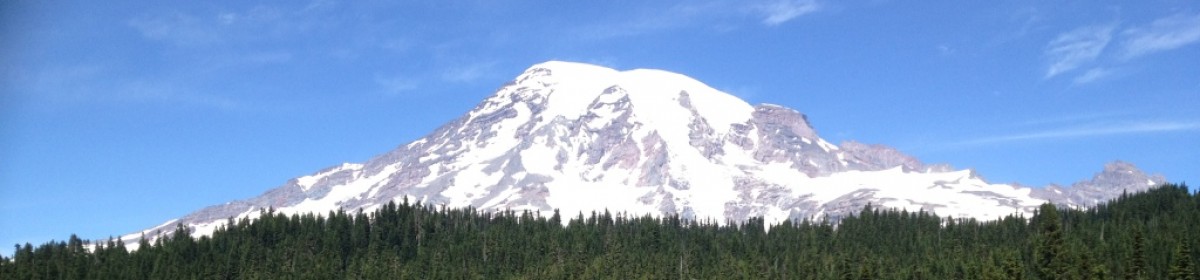
My husband and I both grew up in New England, and we still have many family members and friends in the Northeast. While they have been experiencing snow upon snow upon snow along with bitter cold temperatures, we out here in the great Pacific Northwest have had record-breaking high temperatures and atypically sunny days. My personal weather gauge is Mount Rainier: If I can see it from Tacoma, it’s a good weather day. The past week gave us several beautiful days. Here’s what my mountain looked like on Friday the 13th:

Cliff House mtn view

Not bad, huh?

WordPress Writing 201: Poetry Class, Day 3

The assignment for Day 3 offers these three parameters:

  • Prompt: trust
  • Form: acrostic
  • Device: internal rhyme

Acrostic

Acrostics have been around for millennia: they’re a creative way to give order and convey multiple meanings at once while staying fairly subtle.

There have been two prevalent ways to create acrostics. In one, you follow the sequence of the alphabet, beginning each verse in your poem with a different one from A to Z (or to whatever letter you choose to reach — you’re not obliged to cover the entire ABC). This type of acrostic emphasizes the idea of seriality, of accumulation, or of a preset order.

The other type of acrostic is one in which the first (or last) letter of each verse together spell out a message: a short sentence, a word, a name (for example, medieval poets loved writing love poems with acrostics spelling out their beloved’s name).

Some interesting ways to use acrostics include writing a poem that asks a question to which the answer is the spelled-out word; one in which the “hidden” message contradicts or otherwise complicates the content of the poem.

Writing Process

I’ll start with a simple acrostic, a poem that spells out its subject matter.

Mount Rainier’s white head appears
Out of her bed of clouds.
Unless the day is sunny and clear, when
Nothing her beauty shrouds.

To see her in her majesty
And mystery
I find to be
Necessity.

This includes the acrostic form and the device of internal rhyme, but not the concept of trust. It also sounds a bit pretentious. I would probably never use the word shrouds, except when it’s necessary to rhyme with clouds.

But look: The first line in my second stanza must start with t. There’s an opening for trust:

Mount Rainier’s white head appears
Out of her bed of clouds.
Unless the day is sunny and clear, when
Nothing her beauty shrouds.

Trusting in her majesty
And mystery
I find to be
Necessity.

There’s still that pesky shrouds, but the more I read this poem, the less that word bothers me. I’m trying to convey the image of stateliness and reverence, and this old-fashioned word contributes to that imagery.

What do you think? I’d love to hear your comments.

WordPress Writing 201: Poetry Class, Day 2

Here’s the assignment for Day 2:

  • Prompt: journey
  • Form: limerick
  • Device: alliteration

limerick

Limericks are traditionally composed of five lines of verse. The traditional rhyming scheme of a limerick is a a b b a — the first two lines rhyme, then the next two, and the final verse rhymes with the first couplet.

Write a limerick — or two or five, if you wish to create a narrative cycle — and inject this form with something personal and surprising. Break the pattern if you need to — and if it serves the purpose of your poem.

alliteration

Use of the same consonant multiple times in proximity.

Writing Process

I managed to come up with two different starts. In both cases the first four lines came fairly quickly, but that final line, with its rhyme to the initial couplet, eluded me. I ended up with these, which should be read as separate, not part of a narrative cycle (although the concept of a narrative cycle intrigues me):

For two thousand miles I drove,
Ever forward I strove,
To reach my new home
From one I’d outgrown,
In a new place I knew I would love.

Writing all over the place,
Trying this memoir to ace.
“Slow down,” said my brain
In a constant refrain.
“Life writing should not be a race.”

But then there came the challenge of alliteration. I tend to use frequent alliteration in my writing. I usually don’t consciously write it, but I do notice it when it appears on the page or the screen. But where was it when I needed it?

So I put this project aside and moved on to another one. And, as so often happens, I found an alliterative line in something else I wrote:

Why in the world would …?

What happens if I start with this as a final line and write the previous four lines around it? So I completed the line, compounding the alliteration:

Why in the world would I wait?

Now for the rest of the limerick, incorporating the concept of a journey.

Rhyming words (for the opening couplet):

  • hate
  • date
  • late
  • fate
  • mate
  • straight
  • trait
  • gate
  • great
  • grate
  • state
  • rate
  • bait

Life’s journey is not always straight
Because of our fickle friend, fate.
But a journey circuitous
Is uplifting, not ruinous.
So why in the world would I wait?

And notice the alliteration in the second line!

WordPress Writing 201: Poetry Class, Day 1

Today begins WordPress Writing 201: Poetry Class. How great it is to have such a resource available for FREE!

I write strictly nonfiction, so this class is a big stretch for me. But I’m determined to work on my writing this year, and what better way to do that than to dabble in something WAY out of my comfort zone? The course offers an assignment every weekday for two weeks. Each daily post includes a prompt (topic), a poetic form, and a poetic device. We are instructed to use whatever—or nothing—we find inspirational in these suggestions.

I’ll be working on these daily assignments and hope to publish the results of my attempts here. I’ll probably follow the suggestions in each daily prompt fairly closely, since my purpose here is to practice with types of writing outside of my usual work.

Thanks for playing along with me. I’d love to hear your comments. Since I’m not a poet by nature, I could really use some constructive criticism.

So please leave a comment if you’ve found your way here.

And here’s my attempt for Day One

  • Prompt: water
  • Form: haiku “three lines containing five, seven, and five syllables, respectively”
  • Device: simile

Waves roll in to shore
Like nature’s breath from the wind
Unceasing, always

Wow, that wasn’t as hard as I thought it would be. I’m stoked!

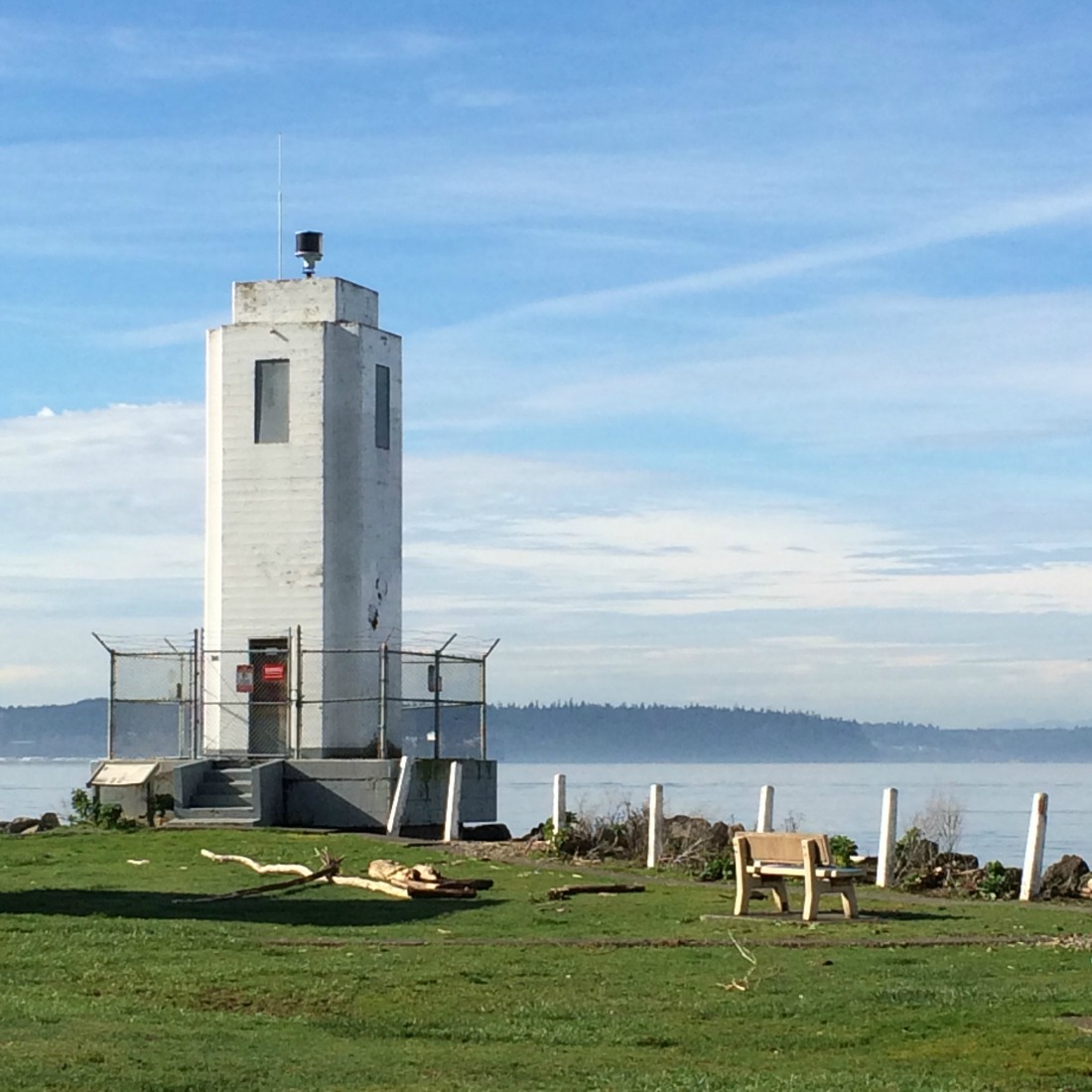
Historic Browns Point Lighthouse

After our Friday lunch at the Cliff House, it was just a short way down the road to Browns Point Lighthouse Park:

201 Tulalip St. N.E.
Tacoma, WA 98422
(253) 927–2536

And yes, that is the correct spelling, without an apostrophe. At some point the apostrophe was dropped, although I couldn’t find out exactly when or why.

Browns Point Community

Browns Point Lighthouse Park comprises 4.03 acres and offers waterfront access. The U. S. Coast Guard owns and maintains the lighthouse itself, but the surrounding land and buildings are under the joint care of Metro Parks Tacoma and the Points Northeast Historical Society.

BP Lighthouse

A light was first erected on a post at the location now known as Browns Point on December 12, 1887, two years before Washington became a state. The first White residents of Browns Point were the lighthouse keeper, Oscar Brown, and his wife, Annie, who arrived in 1903. The original lighthouse was a wooden structure built in 1903 that featured both a lamp and a bell used for fog warnings. Oscar and Annie Brown tended the lighthouse until 1939. More on the history of Browns Point Lighthouse is available here.

Browns Point Lighthouse Plaque
Click on photo to enlarge


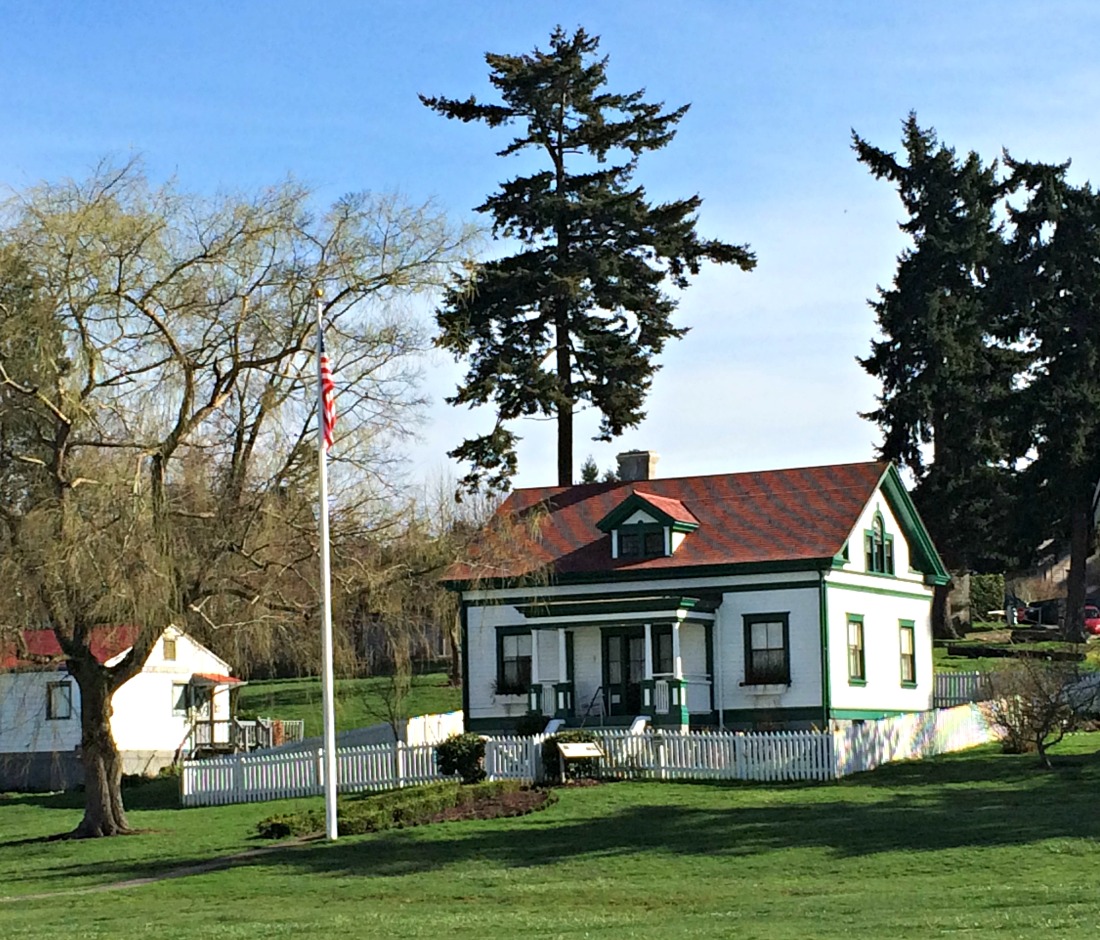
The original wooden lighthouse was replaced by the current structure in 1933. The keeper’s cottage, originally built for the Browns in 1903, has been fully renovated. The three-bedroom cottage of 2,000 square feet sleeps up to six people, has a full kitchen, and offers cable television, internet, and wi-fi service. It is available for rental. Furnished with antique furniture, the cottage is a living museum, and renters become honorary lightkeepers responsible for duties such as raising and lowering the flag daily, watering flower boxes, and welcoming visitors to an open house on Saturday afternoons between April and November.

lightkeeper's cottage
Browns Point Lightkeeper’s Cottage

Cliff House Restaurant

Val DayMy husband F. and I often try to celebrate Valentine’s Day a day early to avoid the restaurant rush. This year F. made a lunch reservation at the Cliff House in Northeast Tacoma:

6300 Marine View Dr, Tacoma, WA 98422
(253) 927–0400

According to the restaurant’s web site, “Since 1925 the Cliff House has been a landmark in the Pacific Northwest.” The Cliff House sits high on a bluff overlooking Commencement Bay and offers lovely views of Mount Rainier, Puget Sound, and the skyline of downtown Tacoma.

One of our neighbors, a native Tacoman, told us that a few years ago the restaurant got quite run down, then was closed for a while before finally reopening with its current decor. This article of March 23, 2012, from our local Tacoma paper, The News Tribune, explains the problems and hails the current decor and food. In another article dated March 31, 2012, the same reviewer goes into more detail about the menu: “The food is precisely what you’d expect from a restaurant with a legacy as the go-to restaurant for celebrations for every generation.”

Like The News Tribune reviewer, we enjoyed the “this-is-why-we-live-here views” from the Cliff House’s upstairs dining room. Here’s the view of Mount Rainier we saw from our table, with Tacoma’s industrial waterfront in the foreground:

Cliff House mtn view

F. and I shared an appetizer of steamed clams, always one of our favorites. We both ordered the grilled salmon, which came with a cucumber-dill yogurt topping that contained small half-slices of cucumber. The salmon was grilled just right: cooked through but not dried out. The whole meal was delicious.

I didn’t discover the historic photos depicting Tacoma’s past until I went to the restroom after lunch. As a newcomer to Tacoma, I always love seeing such old photos to learn about the city’s history. F. and I were both particularly interested in a photo showing people boarding the ferry in Point Defiance Park, since we live very close to the park and often walk past the ferry landing.

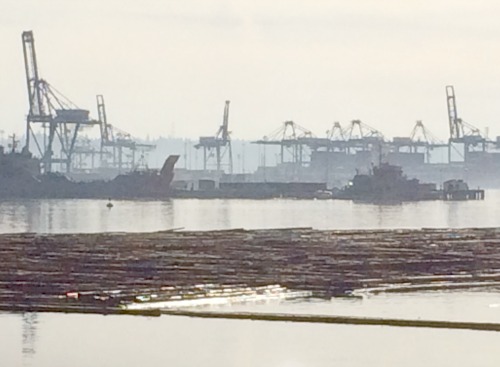
An added benefit of this Valentine lunch trip is that it took me closer to the Port of Tacoma than I had ever been. It’s an impressive sight, but I wasn’t able to get any photos because there isn’t any good place to pull over along the road. We were, however, able to get this shot of logs being floated to one of the local lumber yards:

logs

Logs are ubiquitous here in the Pacific Northwest. Another fact I noticed on the drive to the Cliff House that I wasn’t able to document photographically is how logs get stacked. I guess I just noticed this because driving by a stack of logs allowed me to see the stack from the end rather than from the side, looking at the length of the log. The end of the stack clearly reveals that a few rows of the larger end alternate with a few rows of the smaller end. The result is that the stack lies relatively flat. It had never occurred to me to wonder about that before.

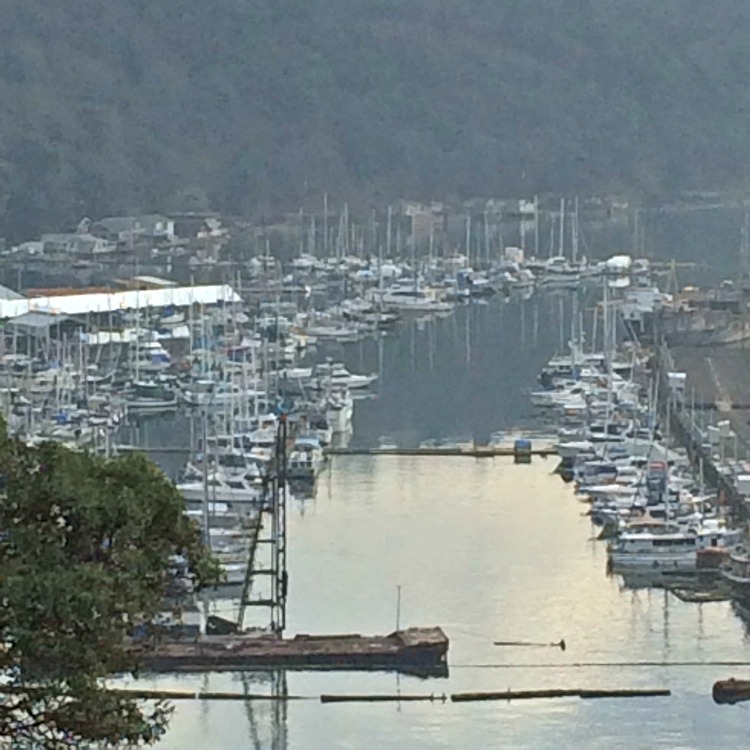
In addition to logs, boats are also all over the place around Puget Sound, such as in this marina visible from the Cliff House parking lot:

marina

My wonderful husband earns 5 Valentine hearts out of a possible 5 for arranging this Valentine luncheon trip.

3 Things Thursday

Once again it’s time for the blog challenge Three Things Thursday, the purpose of which is to “share three things from the previous week that made you smile or laugh or appreciate the awesome of your life.”

There’s some awesome art work on public display in our neighborhood. Here are three examples.

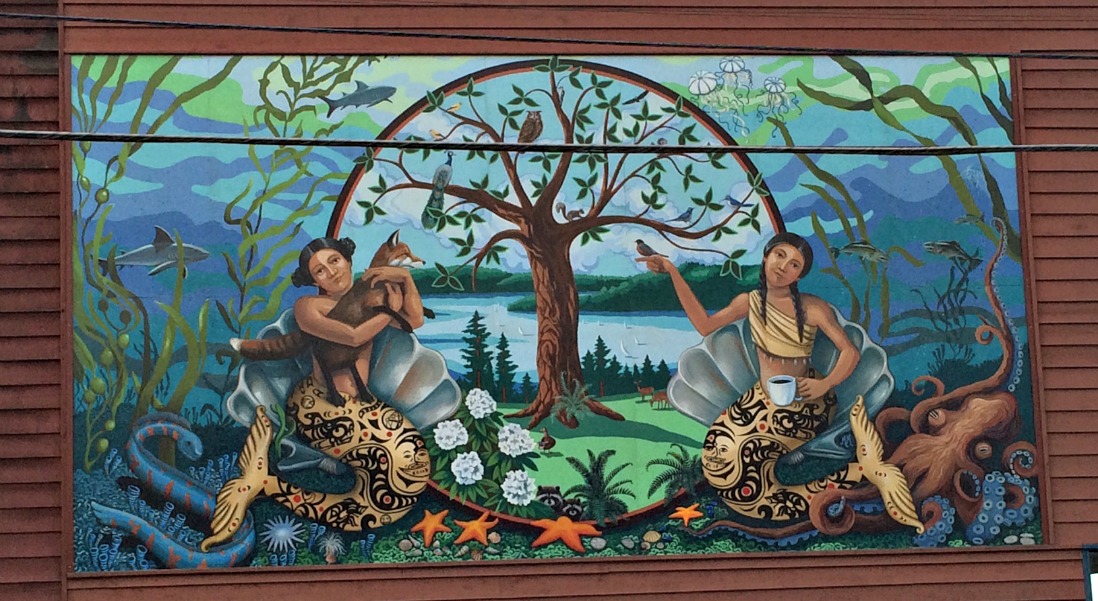
1. Antique Sandwich Co.

Antique Sandwich Co

One of the most interesting places nearby is the Antique Sandwich Co., founded as a family business in 1973.

5102 N Pearl St, Tacoma, WA 98407
(253) 752–4069

The restaurant serves breakfast, lunch, and dinner, and offers a varied menu that includes granola, cinnamon rolls, sandwiches, soups, lasagna, quiche, pies, cakes, and a big selection of teas and coffees. They also host frequent musical performances.

The mural pictured here graces the N. 51st Street side of the shop’s antique building.

2. Don’s Ruston Market

Don's

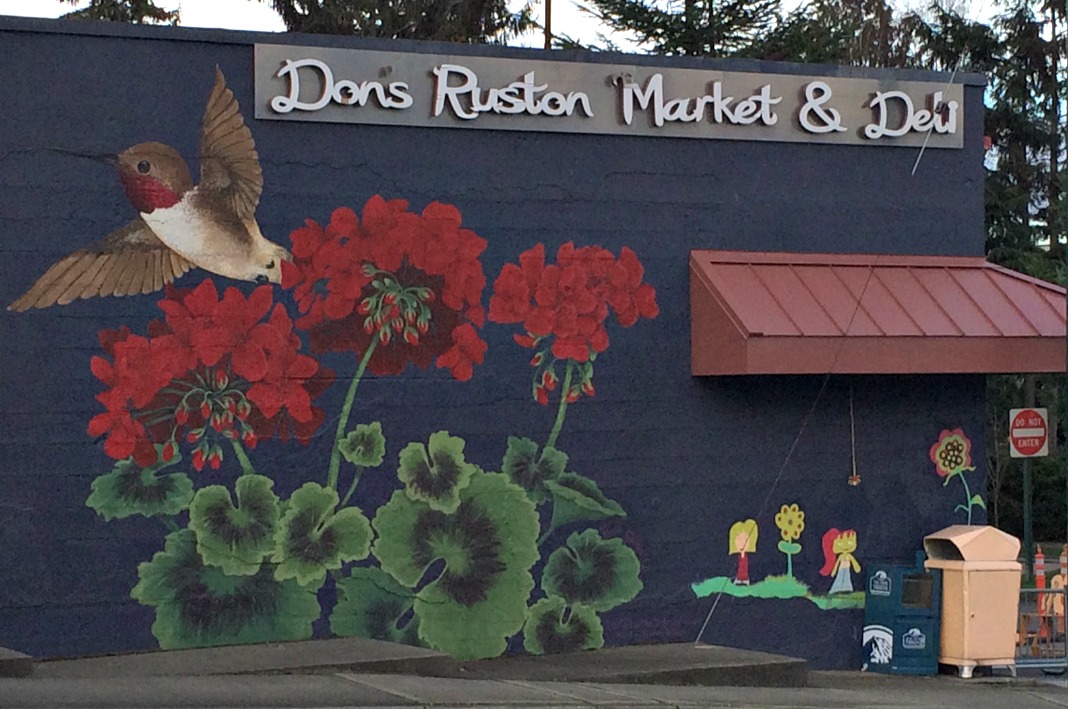
Just a few blocks down N. 51st Street from the Antique Sandwich Co. is Don’s Ruston Market and Deli.

5102 N Winnifred St, Ruston, WA 98407
(253) 759–8151

Don’s has graced its corner in the little city of Ruston for more than 30 years. It offers seasonal kayak rentals, but its main attraction is the antique soda fountain that features a lengthy list of milkshakes and sodas. For more information, check out this article from our local Tacoma newspaper, The News Tribune.

This photo shows the decorative mural on the N. 51st Street side of the store. The mural is actually much bigger (it extends further off the left side of the photo), but I couldn’t get the whole thing because a van was parked on the street.

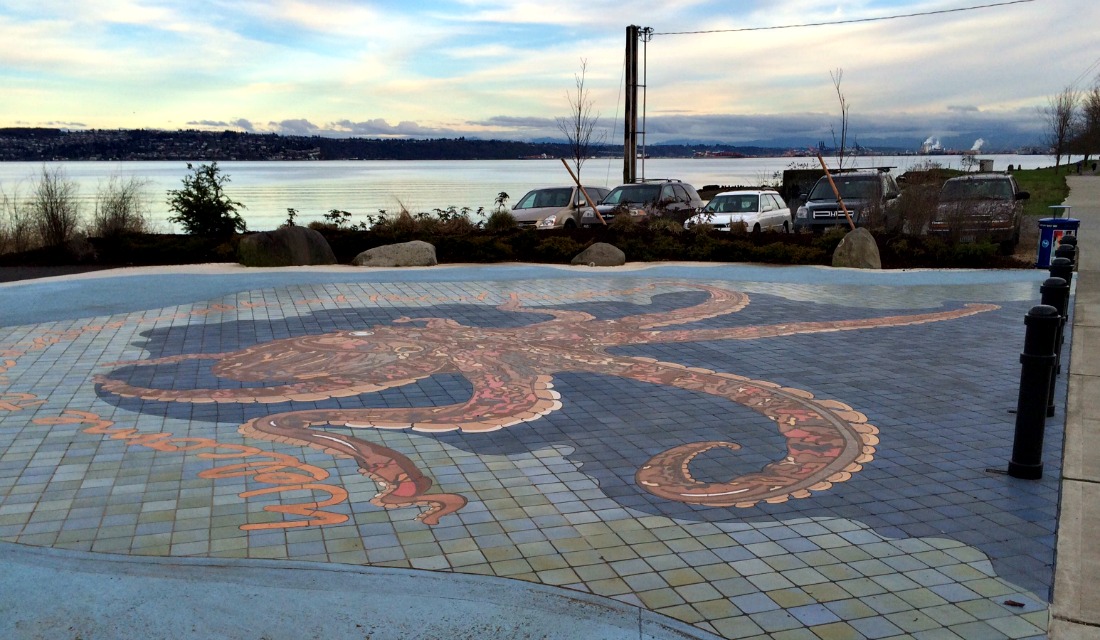
3. Octopus on The Waterwalk at Point Ruston

octopus

About three steep blocks down N. 51st Street from Don’s Ruston Market is the new development of Point Ruston, currently under construction. When finished, the development will include apartments, condos, restaurants, retail shops, and a movie theater.

5005 Ruston Way, Tacoma, WA 98407
(253) 759–6400

The Waterwalk is a park that stretches along the edge of Commencement Bay at Point Ruston and eventually connects to a walkway into nearby Point Defiance Park. This octopus graces an entrance into the park off Ruston Way. There are other art spots along the walkway featuring fish, jellyfish, and squids. I photographed the octopus because the Giant Pacific Octopus, prolific in this area, is one of my favorite animals.