Scotch Broom

Along the banks of highways all over the Pacific Northwest, you’ll see these bright yellow flowers. But don’t be fooled by their pretty color: They grow on a plant called Scotch broom, Cytisus scoparius, a member of the pea family, which is not a decorative plant but an invasive, noxious weed.

Scotch broom is native to Britain and central Europe. It was introduced in North America in the 1860s as a garden ornamental and was planted along roadsides and open banks to prevent soil erosion. But because Scotch broom can tolerate a wide range of soil and moisture conditions, it quickly became invasive. Invasive species create monocultures, dense areas of growth that displace native and beneficial plants and cause loss of grassland, such as pastures, and open forest habitat. These monocultures impede movement of wildlife and increase both the frequency and intensity of fires.

Scotch broom is a fast-growing deciduous shrub from five to 10 feet tall. Each shrub may live as long as 30 years. An excerpt from the book Weed Control in Natural Areas in the Western United States lists the weed’s range as:

The entire Atlantic and Pacific coasts from Alaska to British Columbia to California, and from Nova Scotia through Georgia.
Also Idaho, Montana and Utah, as well as one Hawaiian island.

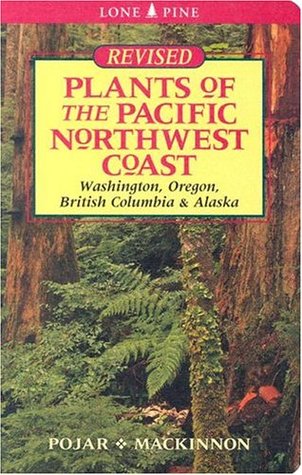
According to Jim Pojar and Andy MacKinnon in Plants of the Pacific Northwest Coast, revised edition:

‘Broom’ is derived from the Anglo-Saxon brom meaning ‘foliage.’ The word was applied to shrubs that were used for making ‘besoms,’ which are bunches of twigs us as brooms.

Scotch broomPeak flowering time for Scotch broom is from March or April until June, but some blooms may appear sporadically during the year. The plants often drop their leaves during dry summer months and may be leafless for most of the year. Seeds are produced in seedpods at the end of the summer. When mature, the pods split open and eject seeds up to 20 feet. According to the Washington State Noxious Weed Control Board, each plant can produce thousands of seeds each year, and the seeds can survive in soil for more than 30 years, with some estimates as high as 80 years. This enormous production and long life of its seeds is another reason why Scotch broom is so invasive.

Washington State University Extension warns that, if eaten, all parts of the plants are toxic to livestock, horses, and humans.

The yellow flowers may look pretty, but they represent vegetation devastation. A 2011 article in The Olympian, the newspaper in Washington’s capital of Olympia, reports that Scotch broom causes around $100 million in agricultural and forestry losses each year in Oregon and Washington.
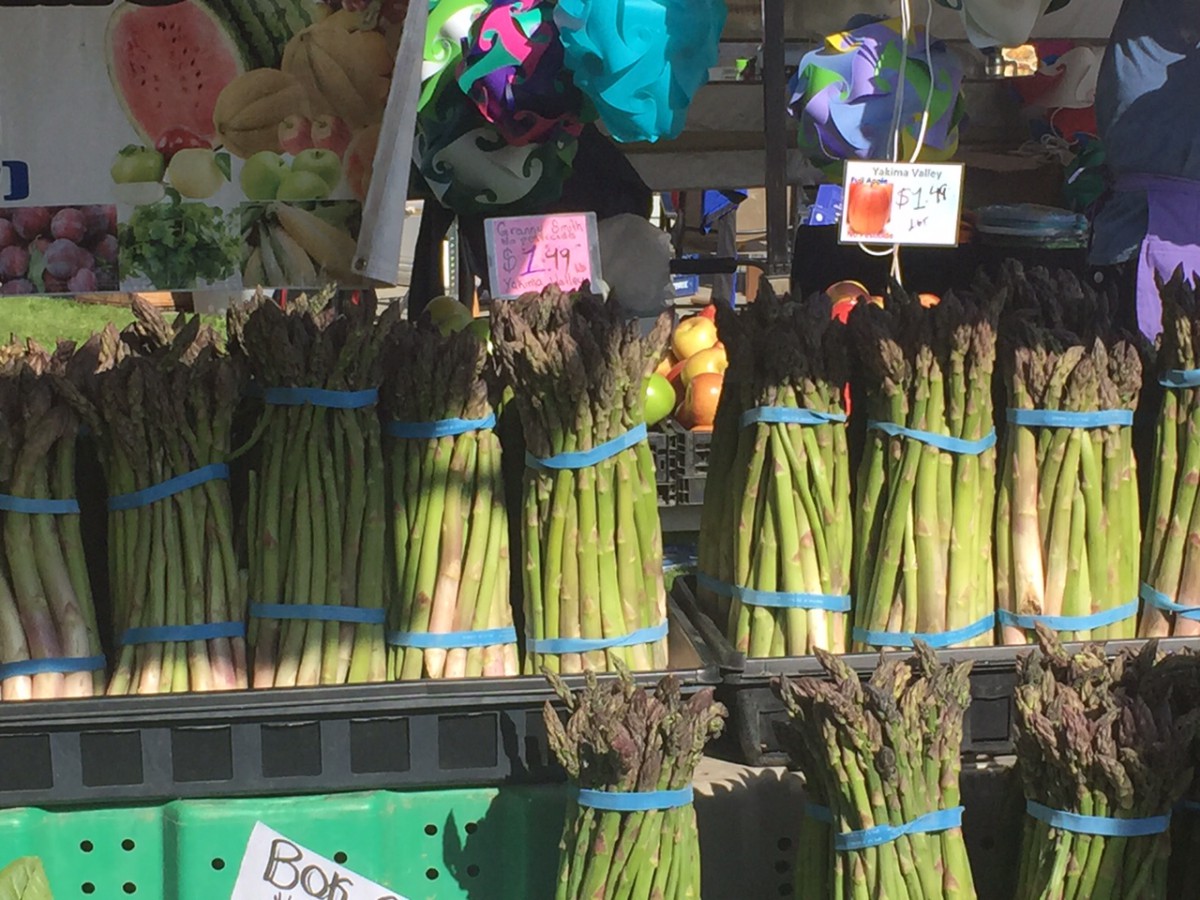
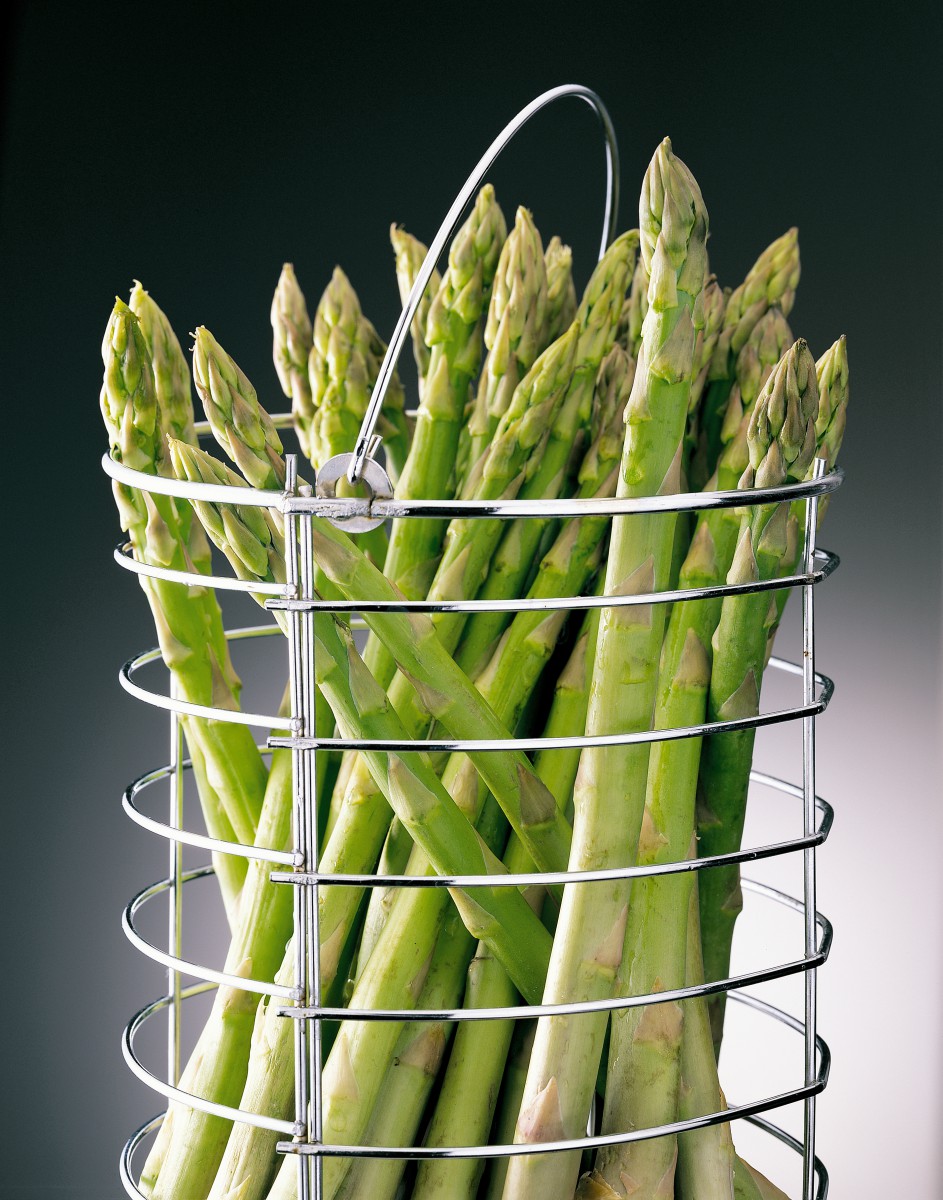
May is U.K. National Asparagus Month

May is National Asparagus Month in the U.K., but since asparagus is one of my favorite foods, I intend to celebrate it here in the U.S. as well. The celebration is sponsored by British Asparagus Growers.

The British Asparagus web site features more than 80 recipes “developed by a dozen celebrity chefs and accomplished food writers.” There’s also a long list of the health benefits of eating asparagus.

In the United States, the Michigan Asparagus Advisory Board has an informative web site. The purpose of this site is to promote asparagus grown in Michigan, but there’s a lot of general information about the vegetable as well. Here are a few of their facts about asparagus that I found most interesting:

  • Asparagus is a member of the Lily family.
  • Under ideal conditions, an asparagus spear can grow 10″ in a 24-hour period.
  • The larger the diameter, the better the quality!

This site calls asparagus “one of the most nutritionally well-balanced vegetables in existence” and “the leading supplier among vegetables of folic acid,” a fact that will appeal to pregnant women. Asparagus is also low in calories and very low in sodium. Check the nutrition page for a complete list of this vegetable’s nutrient value.

asparagus upright for cooking
Photograph from British Asparagus

You’ll also find instructions for several different ways of cooking asparagus here, including how to steam the spears in an upright position in a double boiler or tall pan. This method helps to prevent the tips from getting overcooked before the stalks are fully cooked. There are tips on how to store asparagus, including directions for canning and freezing. And, of course, there’s a collection of recipes for appetizers, soups, salads, side dishes, and entrees. And check the FAQ page for an explanation of why your urine smells funny after you eat asparagus.

The California Asparagus Commission also has lots to say to promote its product. Its recipe collection includes a special section of recipes for kids. The cooking section contains directions for stir-frying, grilling, and roasting as well as the more common methods of boiling, steaming, and microwaving. The FAQ page explains how white asparagus differs from the green variety and why the green spears are a bit more nutritious than the white ones. Also according to the FAQ page, “California, Washington and Michigan are considered the major asparagus growing states.”

A couple of weeks ago we bought red asparagus at the farmers’ market. The sign said the red variety is more tender and less fibrous than the green kind. We steamed it up, and I did think it was a bit less fibrous. But I was surprised to find that when I sliced the stalk, it was green inside, with just a very thin red outer layer. I tried looking for information about red asparagus, but all I could find was references to herbal supplements made from red asparagus root, which is a different plant.

In the past I’ve also seen purple asparagus. On the web site of Aspara Pacific Ltd., an asparagus breeding company in New Zealand, I found this information:

Pacific Purple is a new “super-sweet” asparagus variety. Its distinctive dark purple spears have gained immediate acceptance in markets in Europe, Asia and north America. Pacific Purple tastes sweeter, has less fibre and more anti-oxidants than green asparagus.

Bred by Aspara Pacific, Pacific Purple produces a very high quality spear that is dark purple in colour from tip to butt. The spears have a slightly larger diameter than most green varieties.

Dual Purpose- Very tender spears and high sugar content means Pacific Purple can be grown as a dual-purpose variety for purple or for super-sweet white asparagus.

The Romans had a saying, “Quick as asparagus,” which meant essentially “very quick.” No matter how you prepare this spring vegetable, it will be deliciously ready in two shakes of a lamb’s tail.

Blog a Day Challenge: April Report

In April I continued to look for information about blogging. I found this article: 16 Top Tips from Blogging Experts for Beginners. I’m not interested in ways to increase branding, marketing, building an email list, or SEO (search engine optimization). My focus is on writing for personal discovery, so I chose only a few of these tips to work on:

3. Write for yourself first.

8. Be consistent (that is, publish more than once a week).

10. Be true to your voice. “People don’t care to follow sites so much as they care to follow people.”

11. Give it time. “Plan to invest in blogging for a long time before you see a return.”

14. Be yourself. “Emotion and storytelling have been part of how we communicate with each other and inspire action for thousands of years.”

15. Keep it short. “You generally need about 300 words minimum to get indexed by search engines.” But the expert quoted here suggests presenting a single idea in a post and keeping the required reading time to a couple of minutes.

16. Make it worth referencing. “When writing a post, I get into a mindset to answer just this 1 question with a Yes: ‘Would anyone email this article to a friend?’”

I’m certainly hitting #8, since I publish every day. I’m also acing #11, since I’m putting in a whole year of blogging every day.

I also took #15 to heart. At the end of February I decided not to worry about post length in March, and I continued that approach throughout April. I didn’t aim for long posts but wrote as many words as I needed to cover the day’s topic. But I did concentrate on focusing my topics to keep each post to a single idea. I appreciated the permission #15 gave me to choose well-defined topics that didn’t require long development.

However, I also started writing longer posts that I often couldn’t finish for posting in a single day . I know one general way to handle this problem is to break the topic into two posts and publish Part 1 on one day and Part 2 on the next. But when I started using writing as a method of discovery, I needed to finish the entire piece, then edit and polish it before publishing. I couldn’t just write, then stop and publish what I’d written so far that day, and pick up again the next day where I’d left off.

Many days I found myself part way through a longer think piece and realized that I wasn’t going to finish. Then I’d have to scramble to find something short and sweet that I could whip up and publish to fulfill my challenge of writing a blog post a day. The challenge had made me trip over my own writing feet. The result was more lists and link round-ups than I’d like, but they fulfilled the challenge and allowed me to work the next day on finishing a longer, more complex post.

In April I also tried to take #3, #10, and #14 to heart by incorporating more personal storytelling into posts. (In fact, the use of personal stories is what produced those longer posts that I kept tripping over.) I continue to search for the elusive characteristic of voice. Breaking out of academia-speak is hard, and I’m glad I have eight more months to work at it.

Here are my statistics for last month:

Number of posts written: 30

Shortest post: 135

Longest post: 1,600

Total words written: 22,090

Average post length: 736

My total word count was down from March, but only by about 450 words, which I attribute to April having one less day (therefore one less post) than March. The average post length in April was about 20 fewer words than in March. The number of long posts (1,000 words or more) decreased by one. I find it informative that I ended up with such similar statistics in two months (March and April) when I stopped stressing out over word count.

Distribution of posts across my three blogs:

The total of posts here may not equal the number of posts written last month because I occasionally publish the same post on more than one blog. However, I have included each post only once in my total word count.

When I undertook this challenge, I thought I would publish the bulk of my work on Change of Perspective and Notes in the Margin, with fewer on Retreading for Retirement. However, that focus has changed radically as Retirement became the repository for my more personal writing. And since I’ve tried to include personal storytelling, I’ve ended up with many more personal posts than I had expected. This trend will probably continue.

Last month’s featured posts:

The 2 Lessons I’ve Learned So Far from My Blog Challenge

This post is the result of trying to write deeper.

Writing in Flow

Here I’ve told the story of my experience to explain and illustrate a psychological topic.

scroll divider

I’d love to see your comments.

Three Things Thursday

Once again it’s time for the blog challenge Three Things Thursday, the purpose of which is to “share three things from the previous week that made you smile or laugh or appreciate the awesome of your life.”

three-things-thursday-participant

Three Things Emblematic of Tacoma

emblematic:

representing something (such as an idea, state, or emotion) that cannot be seen by itself.

Source

I’ve been in my new hometown of Tacoma, WA, for two years now and still enjoy exploring the city and learning about new aspects of it. Today I feature three things that are emblematic of Tacoma.

1. Museum of Glass

museum of glass

Museum of Glass
1801 Dock St, Tacoma, WA 98402
(253) 284–4750

the Museum’s stainless steel cone serves as a beacon to a stunning contemporary art museum as well as a symbol for the restoration of a waterway and the revitalization of a city.

The idea for the Museum of Glass arose in August of 1992 from a conversation between Phil Phibbs, who had recently retired as president of the University of Puget Sound, and Dale Chihuly, a world-renown glass artist who had grown up near and attended the university.

A few weeks later Dr. Phibbs brought his idea for a glass museum to the Executive Council for a Greater Tacoma, a group of business and governmental leaders. He was invited to stay for the next presentation, a plan for redevelopment of the Thea Foss Waterway, a strip of empty industrial land next to a body of polluted water in downtown Tacoma. The Council agreed that the proposed glass museum would be an appropriate anchor tenant for the proposed redevelopment.

“In September 1997, Canadian architect Arthur Erickson unveiled the Museum’s design concept, which included an iconic, tilted cone.” Construction began in June of 2000, and the Museum of Glass, with its adjoining Chihuly Bridge of Glass, opened on July 6, 2002. The museum features work of glass artists from all over the world.

Located within the 90-foot tall steel cone, the Hot Shop Amphitheater allows visitors to watch as artists create art pieces from molten glass. The museum features displays in its indoor galleries, art installations on its outdoor plazas, and an extensive  list of educational programs.

2. Tacoma Dome

Tacoma Dome

Tacoma Dome
2727 E D St, Tacoma, WA 98421
(253) 272–3663

The Tacoma Dome, owned and operated by the City of Tacoma, is the largest arena in the world with a wooden dome. Construction began on July 1, 1981, and the Dome opened on April 21, 1983. It is 530 feet (160 m) in diameter and 152 feet (46 m) tall, and can seat up to 23,000. Most of the arena’s seating is not fixed, so that the space can be configured for many different types of events. It’s not unusual to see bleachers standing in the parking lot when driving by the Dome on I 5

The Tacoma Dome’s roof was built with 1.6 million board feet and weighs 1,444,000 pounds. 24,541,382 cubic feet of concrete was used in the construction of the Tacoma Dome. This is enough to build a sidewalk 70 miles long. The Tacoma Dome is 530 feet in diameter and 152 feet tall.

The Tacoma Dome’s aluminum super-grid is one of the world’s largest at 384’ x 160‘. The total cable length is approximately 47,661’ or just over nine miles. There are over 275 support points on the Dome and the grid includes an estimated 2.5 miles of welding.

The Tacoma Dome hosted the 1990 Goodwill Games, the 1988 and 1989 NCAA Women’s Basketball Final Four, and the 1987 United States Figure Skating Championships. The Seattle Sonics National Basketball Association team held its home games of the 1994–1995 season during renovation of Key Arena in Seattle.

Throughout the year the Tacoma Dome hosts many kinds of civic events and gatherings, including music concerts, trade shows, fairs, sporting events, and local high school and college graduations.

3. Mount Rainier

Mount Rainier
Mount Rainier photographed on Jan. 25, 2015

Mount Rainier National Park

I’ve saved the best for last. You’ll see a lot of different photos of Mount Rainier on this blog because I love it so much.

The mountain is about 70 miles southeast of Tacoma, but on a clear day it looks as if you could reach out and touch it. The mountain is so emblematic of Tacoma that a lot of companies use it in their logo. See, for example, Tacoma’s local daily newspaper, The News Tribune.

Mount Rainier reaches 14,410 feet above sea level.

An active volcano, Mount Rainier is the most glaciated peak in the contiguous U.S.A., spawning six major rivers. Subalpine wildflower meadows ring the icy volcano while ancient forest cloaks Mount Rainier’s lower slopes. Wildlife abounds in the park’s ecosystems.

The National Park Service website offers lots of information about both the animals and the vegetation surrounding Mount Rainier. It even has webcams. The park is open all year, although much of it is inaccessible to traffic during the winter (which usually starts early and ends late). Be sure to check the website for weather conditions, including the need for tire chains, when planning your visit.

Between 1.5 and 2 million people visit Mount Rainier National Park every year. We in Tacoma are lucky enough to be able to see the mountain frequently throughout the year.

As Cognition Slips, Financial Skills Are Often the First to Go – NYTimes.com

Studies show that the ability to perform simple math problems, as well as handling financial matters, are typically one of the first set of skills to decline in diseases of the mind, like Alzheimer’s, . . . Research has also shown that even cognitively normal people may reach a point where financial decision-making becomes more challenging.

via As Cognition Slips, Financial Skills Are Often the First to Go – NYTimes.com.

This article contains a list of early signs of financial decline in the elderly.

Synchronicity: Road Trip and a List

Definition of SYNCHRONICITY:

2: the coincidental occurrence of events and especially psychic events (as similar thoughts in widely separated persons or a mental image of an unexpected event before it happens) that seem related but are not explained by conventional mechanisms of causality —used especially in the psychology of C. G. Jung

Source: Merriam-Webster Dictionary

If this definition is too “woo-woo” for you, just think of synchronicity as a meaningful coincidence that allows us to think of two seemingly unrelated objects, concepts, or events in conjunction with each other. Any writer will tell you that putting two things together in this way is a valuable source of creative insight.

Which leads me to today’s post. Recently this article, According To Science, This Is The Perfect And Best Road Trip You Can Possibly Take, came up on Facebook. I didn’t think much of it until, shortly thereafter, this WordPress Daily Prompt, The Satisfaction of a List, landed in my inbox.

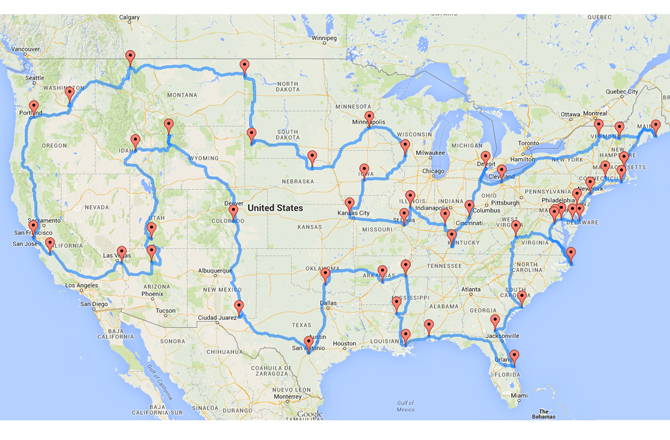
Here’s the map from the road trip article:

road trip map

Discovery News worked with Randy Olson, a doctoral student at Michigan State University, to plan a trip that visits landmarks on all of the 48 contiguous states in the U.S. A computer algorithm plotted a route that allows participants to jump on anywhere and continue to follow the loop until they arrive back at their starting point.

This road trip map appealed to me because traveling is one of the things my husband and I hope to do a lot of now, in the early years of our retirement.

My first reaction to this map is that it omits the entire western side of Washington State, which happens to be where I live. And while the Hanford nuclear dump site in eastern Washington might be interesting, it is hardly the best landmark in the state. It looks as if the computer algorithm chose Hanford simply because it needed something from Washington to include that wouldn’t go too far off the path it wanted to beat.

If you undertake this trip, I suggest you go a bit further west in Washington to see these sites, which I think greatly outrank Hanford in terms of sight-seeing status:

Those are my additions to the list. As for the map’s list, I use underlining to indicate sites I’ve already visited and red text to indicate places that are on my bucket list of sites in the U.S. that I hope to visit before my traveling days are over.

Here is the list of the landmarks you’d stop at in each state on this road trip:

  1. Grand Canyon, AZ
  2. Bryce Canyon National Park, UT
  3. Craters of the Moon National Monument, ID
  4. Yellowstone National Park, WY
  5. Pikes Peak, CO
  6. Carlsbad Caverns National Park, NM
  7. The Alamo, TX
  8. The Platt Historic District, OK
  9. Toltec Mounds, AR
  10. Elvis Presley’s Graceland, TN
  11. Vicksburg National Military Park, MS
  12. French Quarter, New Orleans, LA
  13. USS Alabama, AL
  14. Cape Canaveral Air Force Station, FL
  15. Okefenokee Swamp Park, GA
  16. Fort Sumter National Monument, SC
  17. Lost World Caverns, WV
  18. Wright Brothers National Memorial Visitor Center, NC
  19. Mount Vernon, VA
  20. White House, Washington, DC
  21. Colonial Annapolis Historic District, MD
  22. New Castle Historic District, Delaware
  23. Cape May Historic District, NJ
  24. Liberty Bell, PA
  25. Statue of Liberty, NY
  26. The Mark Twain House & Museum, CT
  27. The Breakers, RI
  28. USS Constitution, MA
  29. Acadia National Park, ME
  30. Mount Washington Hotel, NH
  31. Shelburne Farms, VT
  32. Fox Theater, Detroit, MI
  33. Spring Grove Cemetery, OH
  34. Mammoth Cave National Park, KY
  35. West Baden Springs Hotel, IN
  36. Abraham Lincoln’s Home, IL
  37. Gateway Arch, MO
  38. C. W. Parker Carousel Museum, KS
  39. Terrace Hill Governor’s Mansion, IA
  40. Taliesin, WI
  41. Fort Snelling, MN
  42. Ashfall Fossil Bed, NE
  43. Mount Rushmore, SD
  44. Fort Union Trading Post, ND
  45. Glacier National Park, MT
  46. Hanford Site, WA
  47. Columbia River Highway, OR
  48. San Francisco Cable Cars, CA
  49. San Andreas Fault, CA
  50. Hoover Dam, NV

How about you? How many of these places have you already been to? What suggestions do you have for additional stops in specific states? Give us the benefit of your home-state experience in the comments.

Three Things Thursday

Last Friday morning I realized that I had not done a post for Three Things Thursday, the purpose of which is to “share three things from the previous week that made you smile or laugh or appreciate the awesome of your life.” I don’t know how I forgot to do it, since it’s one of the things I most look forward to in my week.

However, I’m back this week with…

A Walk Through the Woods

We live within walking distance of the Point Defiance Zoo & Aquarium. All we have to do to get there is cross a road and walk a short path through the woods, and there we are, on the edge of the parking lot and about a block from the zoo entrance.

Last Saturday was a beautiful day here in Tacoma, WA, USA, and so we took off for a visit to the zoo. We saw lots of interesting things there, both animals and plants, but what I’d like to show you this week is three interesting things I noticed while walking the path through the woods.

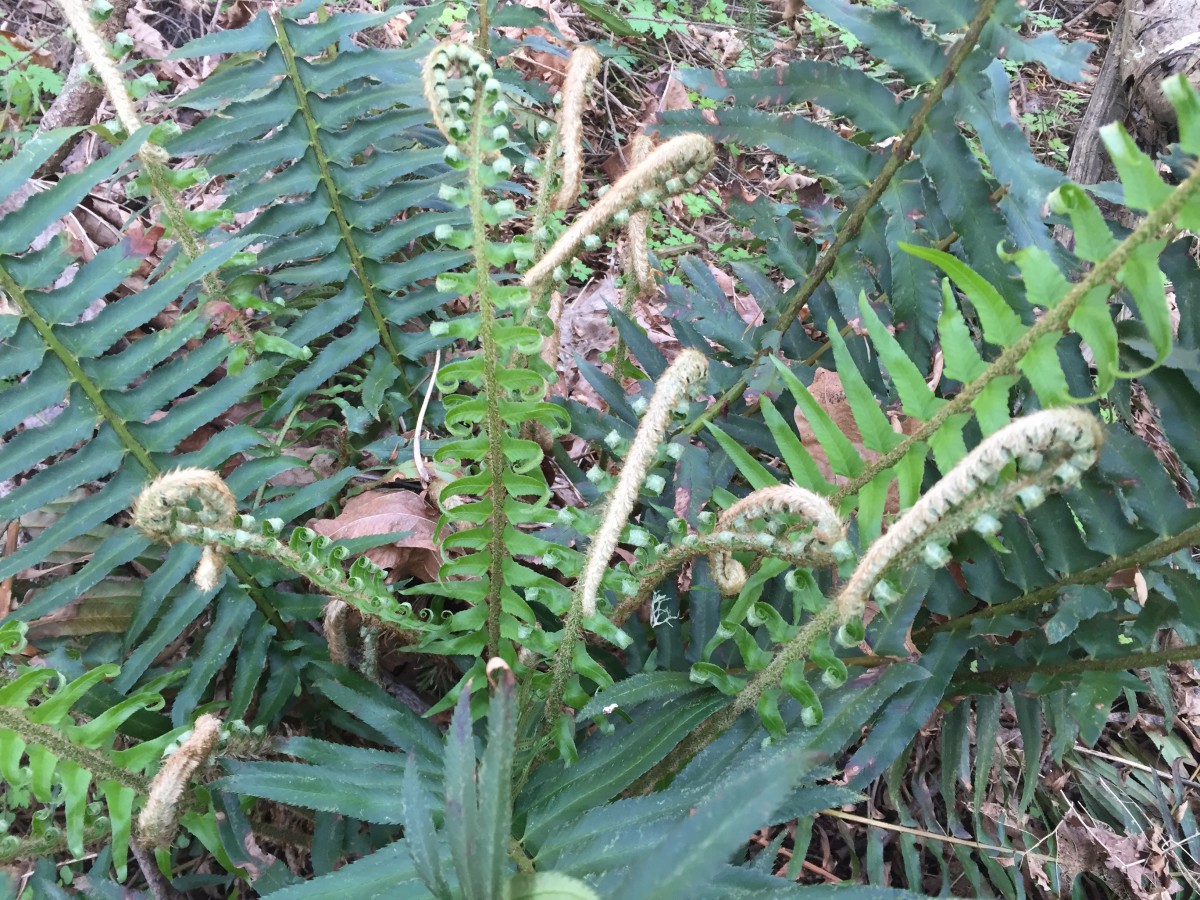
1. Fiddleheads

fern fiddleheads
Fern fiddleheads

I think these are sword ferns. You can see why the new fronds growing out of the center of the plant are called fiddleheads.

In the Stephen King novel The Girl Who Loved Tom Gordon, a young girl gets lost on the northern end of the Appalachian Trail and wanders through the forest for several days. One of the things she eats to survive is fiddleheads.

But I don’t suggest that you go out and get some of these to boil up for dinner. Check with a local naturalist before consuming anything you find growing in the wild. Better still, just don’t eat anything you’re not absolutely sure about.

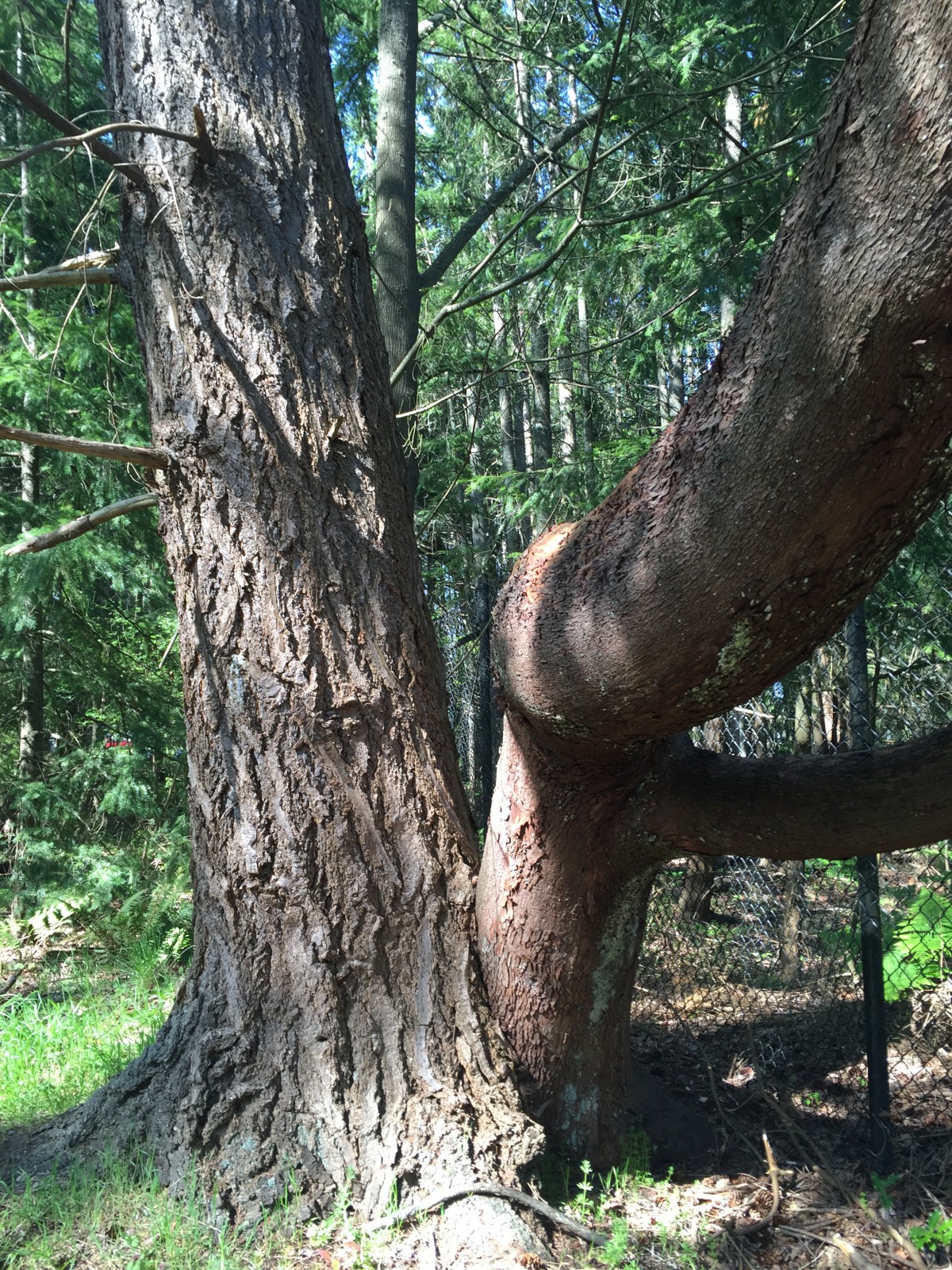
2. Two Trees

two trees
Two trees

The tree on the left, with the shaggy bark, is an evergreen, most likely a Douglas fir. It grows straight and tall, with spindly branches at the top that drape down. The tree on the right is a madrona—or, alternately, madrone—which often grows at an angle to reach any open space of sunlight beneath the evergreen canopy. Madronas are all angles and elbows as they send out lots of branches in search of sunlight. They are much shorter than their evergreen neighbors.

Perhaps these differences are what allowed these two trees to snuggle up so closely while growing. Douglas fir and madronas often grow near each other.

Madronas grow along a limited stretch of the Pacific coast, from northern Oregon up to southern British Columbia. They are easily recognizable by their brownish-red bark that peels off in thin sheets.

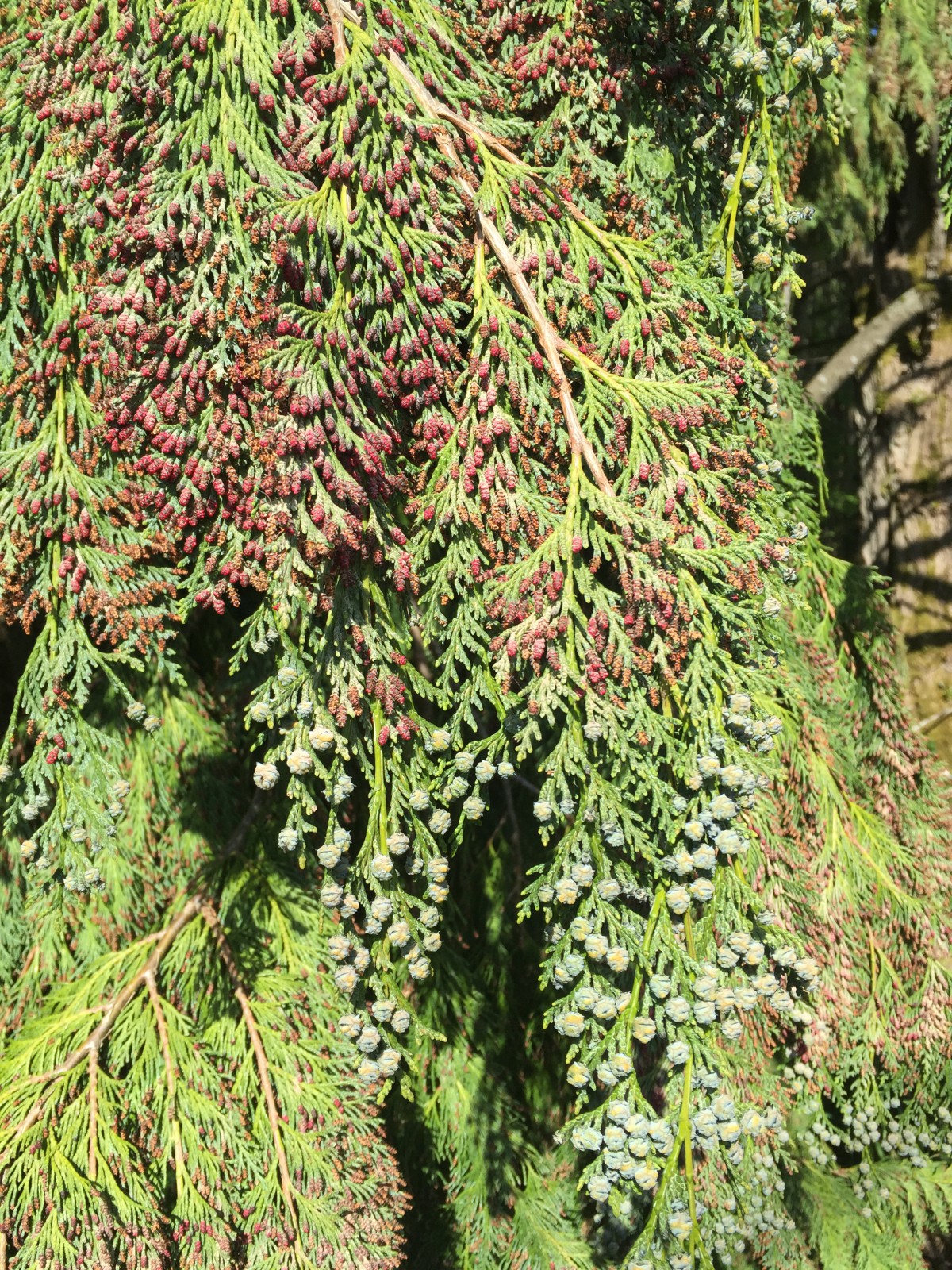
3. Hemlock? Cedar?

unknown tree
Do you know what this tree is?

I’m still trying to figure out what tree this is. I will have to go back and look at the bark more closely.

When we touched the brownish areas on the leaves, a very fine brown dust wafted off. The bluish berries near the ends of the leaves resemble those of cedar trees.

If you know what tree this is, please let me know in the comments. It grows in Point Defiance Park in Tacoma, WA, USA.

Reference

Cover: Plants of the Pacific Northwest CoastPolar, Jim and Andy MacKinnon. Plants of the Pacific Northwest Coast: Washington, Oregon British Columbia, & Alaska
Revised edition, 2004
Vancouver, British Columbia: Lone Pine Publishing
ISBN 978–1–55105–530–5

Opening Day: Puyallup Farmers’ Market

Our daughter K. lives in Puyallup (pronounced pew-AL-up), a city about 12 miles southeast of Tacoma. The Puyallup River Valley provides great growing conditions that have made the area a prime site for growers of all kinds of produce, and the city has therefore hosted a thriving farmers’ market for 32 years.

It has become our summer tradition to meet K. for a trip through the Puyallup Farmers’ Market followed by lunch. Today was opening day. The market is held from 9:00 to 2:00 every Saturday in Pioneer Park, the center of downtown Puyallup. It’s sponsored by the Puyallup Main Street Association, an organization that “envisions a downtown business district that is alive, inviting, healthy and thriving while retaining its hometown, friendly charm.”

In addition to fruits and vegetables, the market features local artisans offering their products, including candles, soap, tea, wood crafts, jewelry, clothing, knitting, crocheting, honey, jams and jellies, meat, fish and other seafood, and baked goods. Often civic organizations also attend. Today the people from greyhound rescue were there with some of their dogs.

Because spring arrived here about a month earlier than usual this year, there was already an abundance of vegetables at the market:

Veggies
Veggies

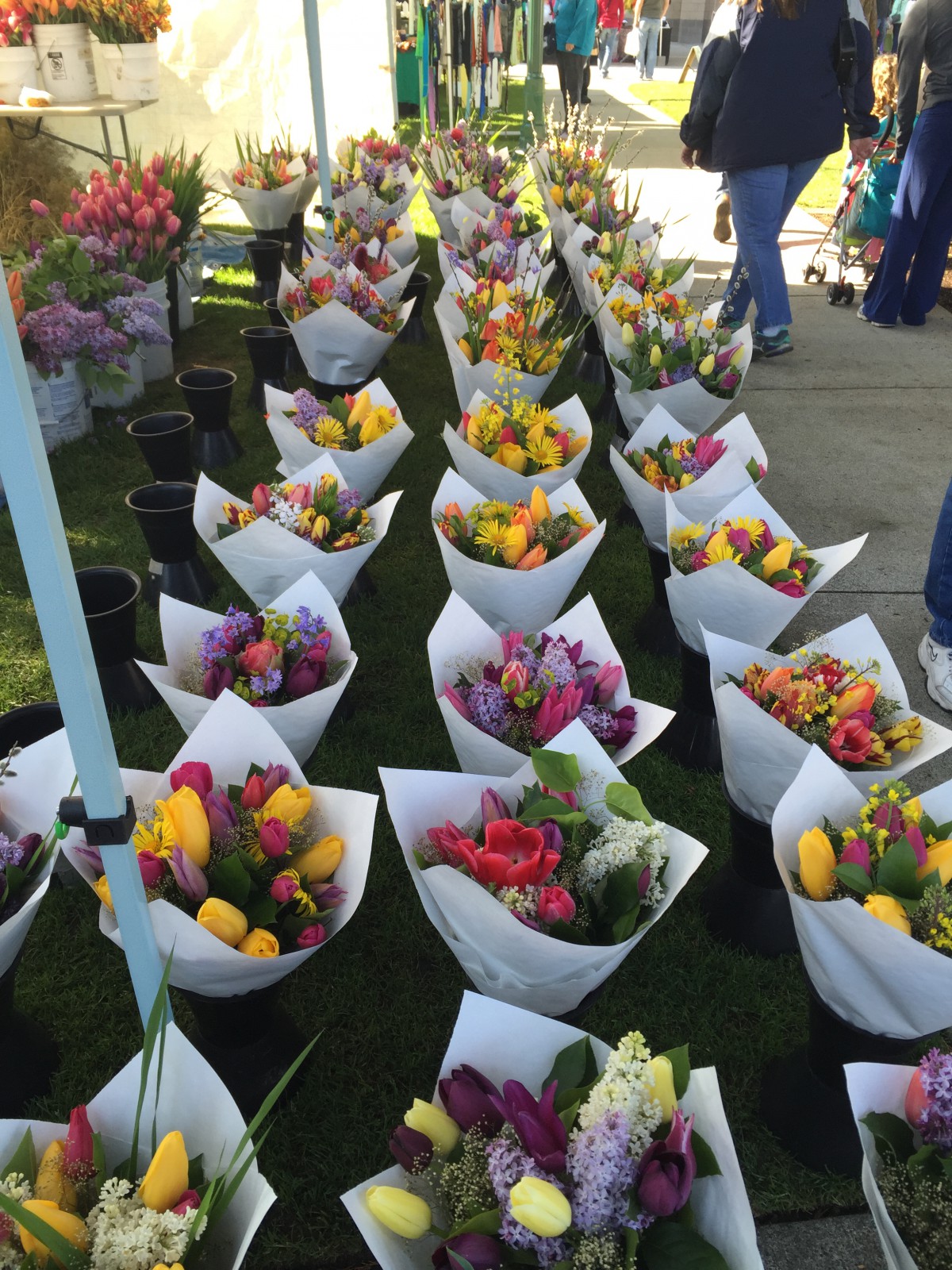
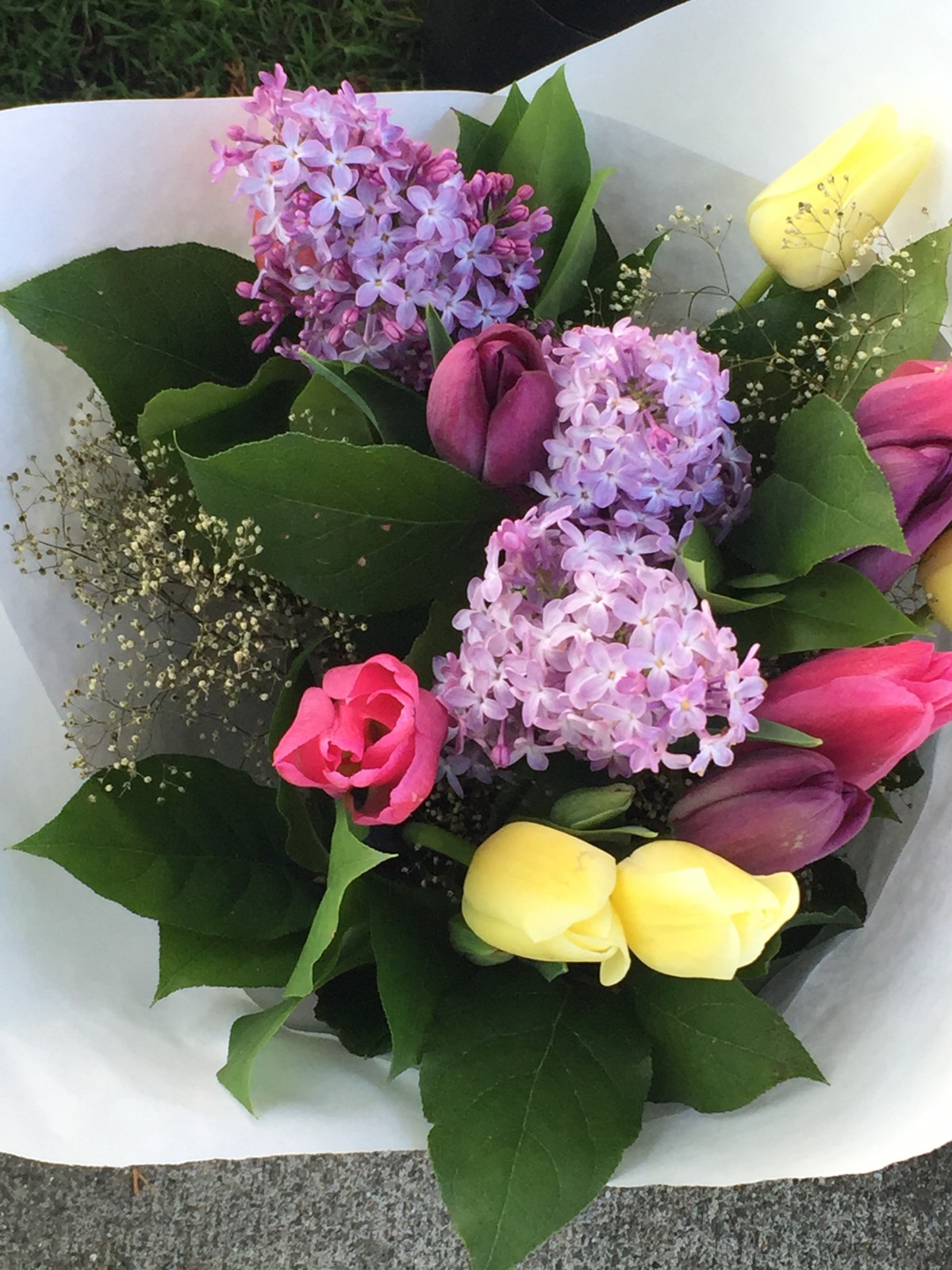
The other main crop is always flowers. There are endless artistic bouquets available at reasonable prices:

bouquets
Bouquets

There are flowers and more flowers:

Puy mkt flowers02

flowers


People interested in growing their own vegetables, fruits, herbs, and flowers can also find starter plants:

Plants for sale
Plants for sale

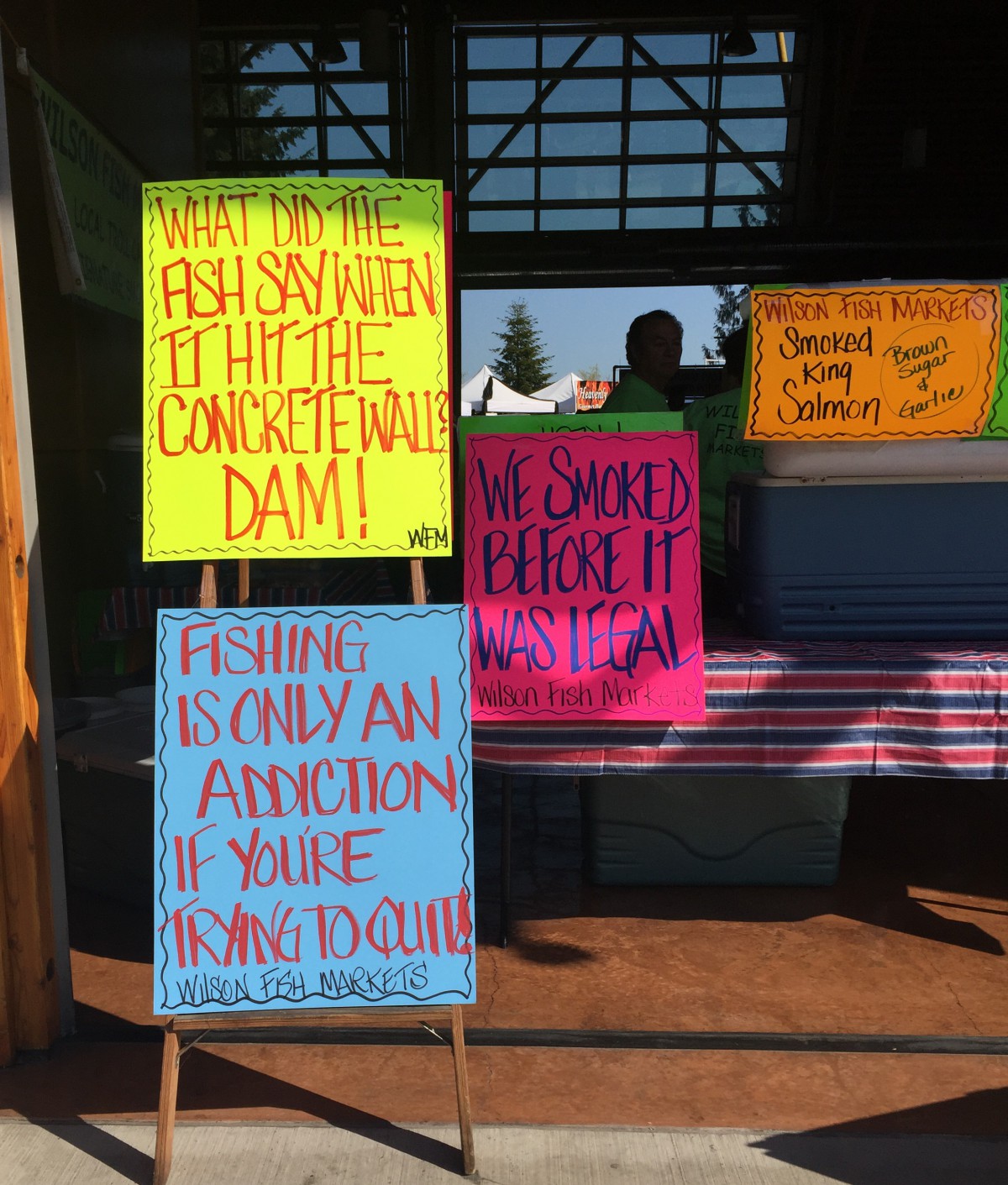
We bought some delicious salmon from a fisherman with quite a sense of humor:

Wilson Fish Markets signs
Wilson Fish Markets

And Puyallup is smack in the middle of Seahawks country:

Seahawks Gear
Seahawks Gear

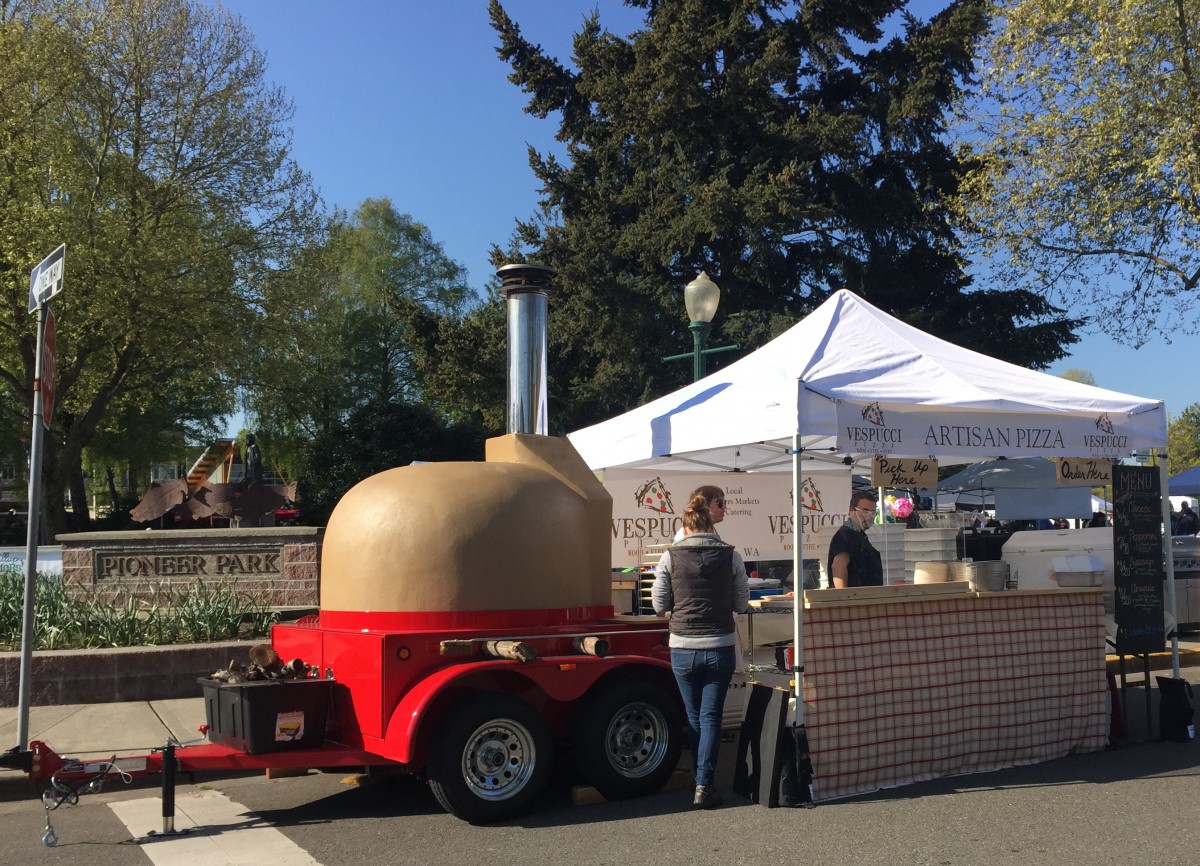
And where there’s a crowd there must be food. You can find just about any food item you like. The Vespucci Pizza oven had a good spot at the place where we entered the park:

Vespucci Pizza oven
Vespucci Pizza oven

There are a lot of items to see at the market, but people watching is also a grand experience. The market is family friendly, and a there are a lot of people pulling wagons full of both kids and purchases. Although dogs are not allowed inside the covered pavilion, lots of people walk their dogs in the uncovered areas. We saw one black Great Dane whose gorgeous coat glistened in the sun.

It was a beautiful, sunny day, with temperatures in the low 60s, to celebrate the Puyallup Farmers’ Market opening. I definitely “like” the Puyallup Farmers’ Market Facebook page. This year we’ll be able to enjoy it every Saturday through October 17.

The 2 Lessons I’ve Learned So Far from My Blog Challenge

The first three months are in the books, one-quarter of the year done. I’ve posted reports for each of the first three months with all kinds of numbers. But the most important lessons don’t lie in the statistics.

Beyond the numbers, so far I’ve learned two lessons from writing a blog post every day.

1. Writing daily makes writing easier.

Writing is a skill, just like playing the piano or kicking a soccer ball: The more you practice, the better you get. And the better you get, the easier the task becomes.

When I undertook this challenge, the first question I wanted to answer was whether I could find something to write about EVERY SINGLE DAY. I found that I could if I just paid attention to the whole world around me. Having to write about something forces me to find out more about the subject than I otherwise would. It makes me look at the subject in detail instead of simply glancing over it.

An example of this is the post Tacoma’s Daffodil Princesses. From my first two springs here in Tacoma I knew that the Daffodil Festival occurs every year and is a newsworthy event. But I didn’t know exactly what it is or why it’s so important. This year, when I saw the event in the newspaper once again, I decided to do some research and find out more about it. I learned that the festival celebrates the agricultural heritage of the region and is a display of community history and pride.

With a little research, which I love doing, I not only had my blog post for the day but also learned a bit of local history as well.

2. The easier writing is, the more difficult it becomes.

The truth of this paradox arises from the second question I wanted to answer when I undertook this challenge: Could I break free from my personal guardedness to explore the depths of my own life and discover a sense of purpose? I have therefore started working on vertical writing, personal writing aimed at going more deeply into the self.

The problem with writing that comes easily is that it’s so seductive. That post about the Daffodil Princesses was easy to write. A quick Google search, a little aggregation and organization, and I had it, the day’s required blog post. Press “publish,” add the word count to my Excel file, and I’m done. Easy peasy.

Too easy. Because what that post about the Daffodil Princesses doesn’t contain is how I felt about the topic. When I first arrived in Tacoma two years ago and read about the Daffodil Festival in the newspaper, I chuckled. I thought this festival sounded like some quaint local custom. I admit it: the whole thing sounded a bit silly to me. I felt a little superior, someone who wasn’t caught up in the festival tradition and could therefore see it for what it truly is: an amusing trifle not worthy of all the press coverage it gets.

And then I did the research. I discovered that, rather than being a silly trifle, this festival is an agricultural celebration deeply rooted in the local land. The annual festival celebrates not only one of the major crops of this area, but also the community that the crop sustains. This festival is no different from the nearly universal celebrations that communities put on in the fall to celebrate harvest; this one just happens to occur in the spring, at the beginning of the growing season, because that’s when daffodils bloom. Because they are among the earliest spring flowers, they suggest rebirth, the new growth after the bleakness of winter.

This local Daffodil Festival is no amusing little shindig. It’s an archetypal celebration of human community and appreciation of the land.

Who did I think I was?

I hope I’ve learned not to make that mistake again.