Notes on the Olympic Peninsula

Mother Nature is making up for last year by providing us with yet another sunny day. Today I had some time to read through the booklet in our cabin about Mount Rainier, Olympic, and North Cascades national and state parks. Here are some of the nuggets of knowledge I picked up.

The western side of the Olympic Mountains receives an average of 140 inches of rain every year. There are three reasons why the area is so wet:

  • Cool ocean currents
  • Prevailing westerly winds
  • The Olympic Mountains

On the Olympic coast, the greatest rainfall occurs during December and January, with daytime temperatures averaging in the 40s.

The top of Mount Olympus receives 200 inches of rain annually, while the town of Sequim (pronouced squim), located on the northeast side of the mountains, receives 16 inches or fewer in a year.

Almost the entire Olympic Peninsula is protected land as part of either Olympic National Park or Olympic National Forest. Highway 101 follows the edges of the peninsula, but there are no roads that cut across the full width of the peninsula. Spur roads off of 101 provide access at several points to interior areas, but the only way to get from one side of the peninsula to the other is by following 101 around. Some areas are closed in winter.

Several tribes have traditional ties to this land: Lower Elwha Klallam, Hoh, Jamestown S’Klallam, Makah, Port Gamble S’Klallam, Quileutae, Quinault, and Skokomish. They originally lived in communal homes called longhouses. They fished and gathered most of their food during the spring and summer. During the winters, which are mild near the coast, the women wove baskets and clothing from red cedar bark. The men carved dugout canoes and made ceremonial items from wood.

In 1788, John Meares, an English sea captain, named Mount Olympus after the mythological home of the Greek gods. Four years later Capt. George Vancouver made the name official when he entered it on his map and referred to the whole mountain range as the Olympic Mountains. Mount Olympus is 7,980 feet high. By comparison, Mount Rainier, in the Cascade Mountain range, is 14,410 feet high.

Throughout the late 19th century pioneers moved into the Olympic peninsula to fish, farm, and cut lumber. In 1885 and 1890, the U.S. Army came through the area to survey and scientifically document the interior. In 1909 President Theodore Roosevelt created Mount Olympus National Monument. In 1938 President Franklin D. Roosevelt signed a bill designating 624,000 acres as Olympic National Park. In 1953 most of the coastal wilderness was added to the park. The 1988 designation of Olympic National Park as a World Heritage Site protects the area by forbidding road building, mining, lumber cutting, hunting, use of off-road motorized vehicles, and other types of development within the designated wilderness area.

Happy Thanksgiving & Three Things Thursday

For the third day, we awoke to clear, sunny weather. We cook most of our meals in the small kitchen in the cabin, but on Thanksgiving we treat ourselves to the buffet at the lodge’s Creekside dining room:

It took us a little over an hour to eat our way through both tables of the buffet.

Three Things Thursday

Beachcombing

You never know what you might find if you keep your eyes open while walking along the beach.

1. Decorative Little Doll

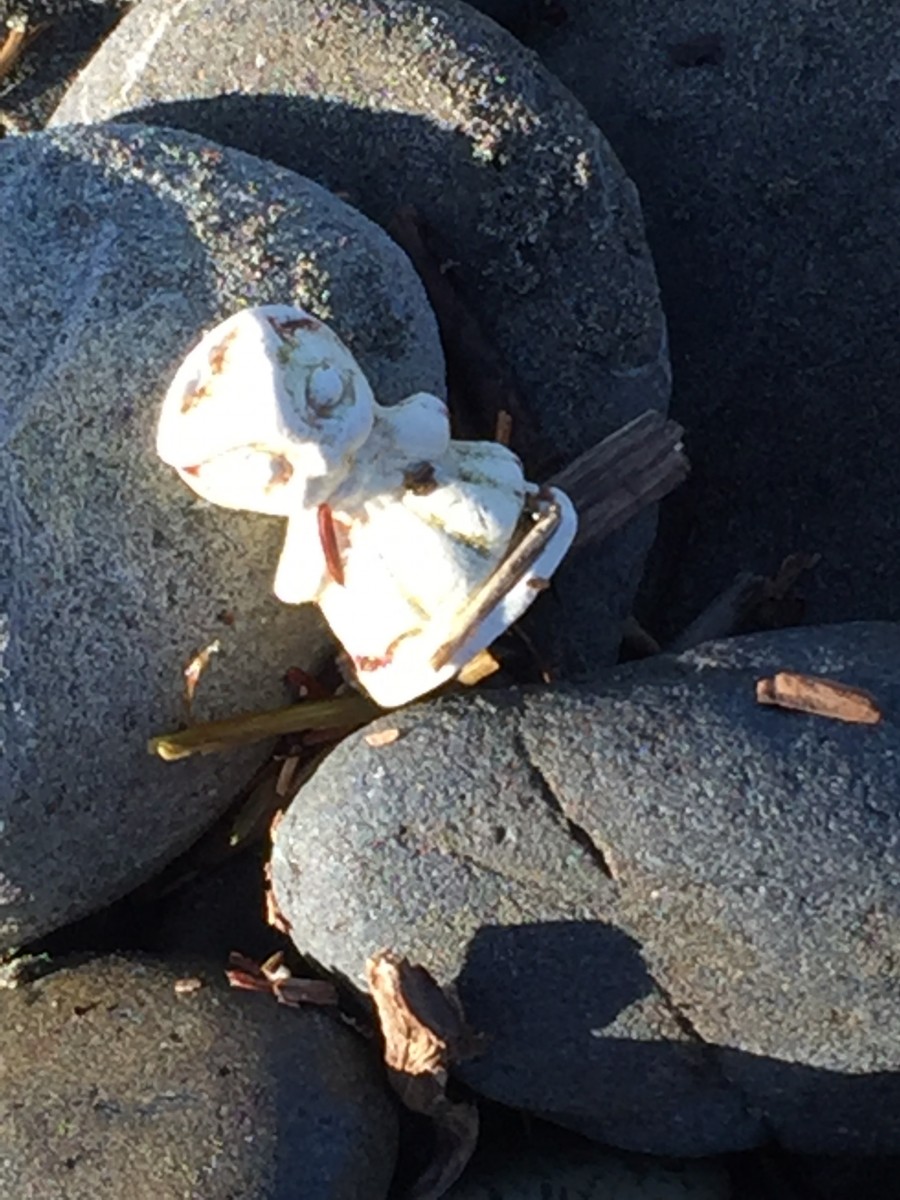
china doll on beach

I found this little china figurine, about an inch long, among the stones on Ruby Beach yesterday. What might she represent, and where did she come from? Is some little girl missing one of her personal treasures? Or has the little doll’s disappearance gone unnoticed; if so, why?

2. Forest Reminders

Strewn across Ruby Beach were these reminders that we are not far from hundreds of acres of coniferous forest:

cone and needles

3. Holey Rocks

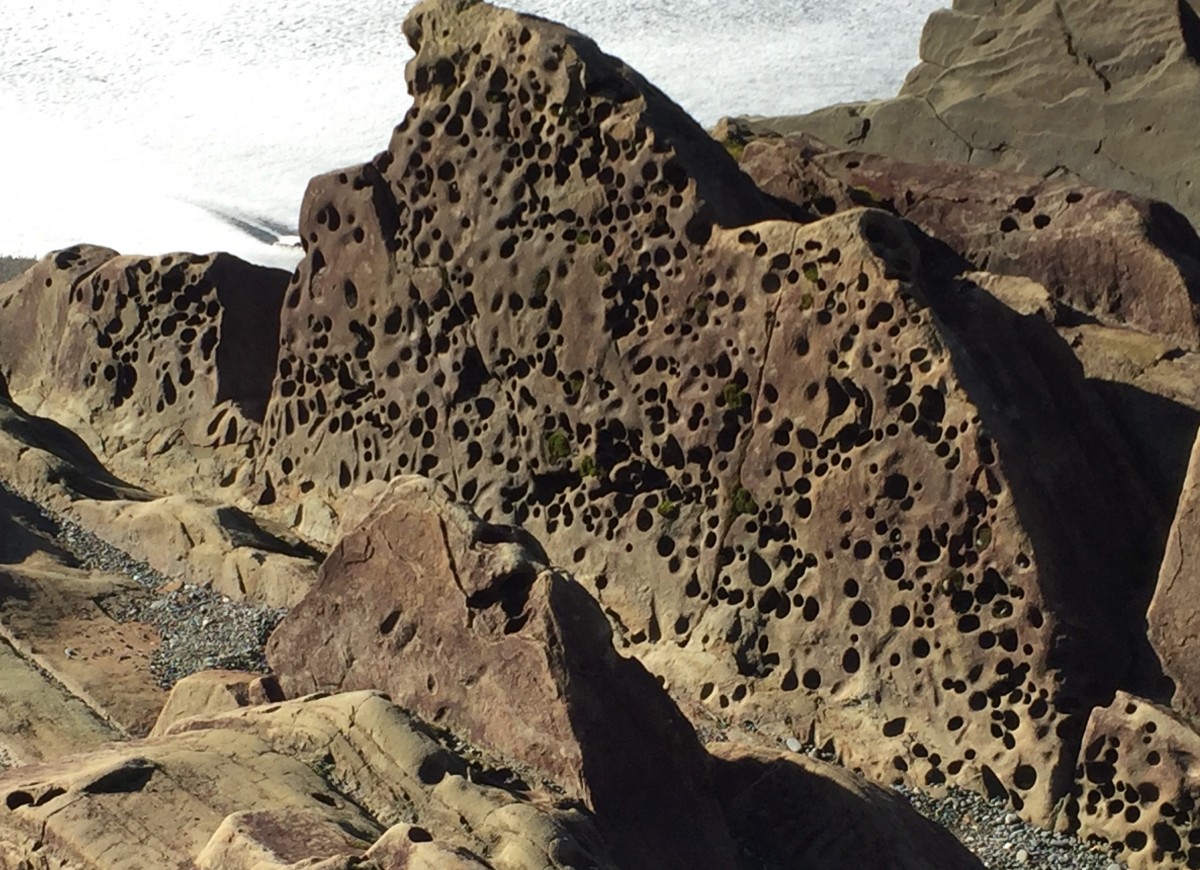
The holes in these rocks at Beach 4 were made by piddock clams, which use a rocking motion to burrow into the sandstone:

rocks with holes made by piddock clams

Beach Day

Once again, we awoke to beautiful sunshine. There was frost on the cars and on the sides of the driveways where the sun hadn’t yet reached, but the cabin’s heater and the comforter on the bed kept us warm throughout the night.

We drove the short distance north on U.S. Highway 101, toward Forks, to Ruby Beach (see map ). After we left Ruby Beach to drive back to the lodge, we stopped at Beach 4, also on Highway 101. I had been to Ruby Beach before but never to Beach 4. I’m glad we stopped at Beach 4 on the way home because the two beaches are quite different and I learned a bit about the Washington coast.

(Click on any photo to see a larger version.)

Ruby Beach

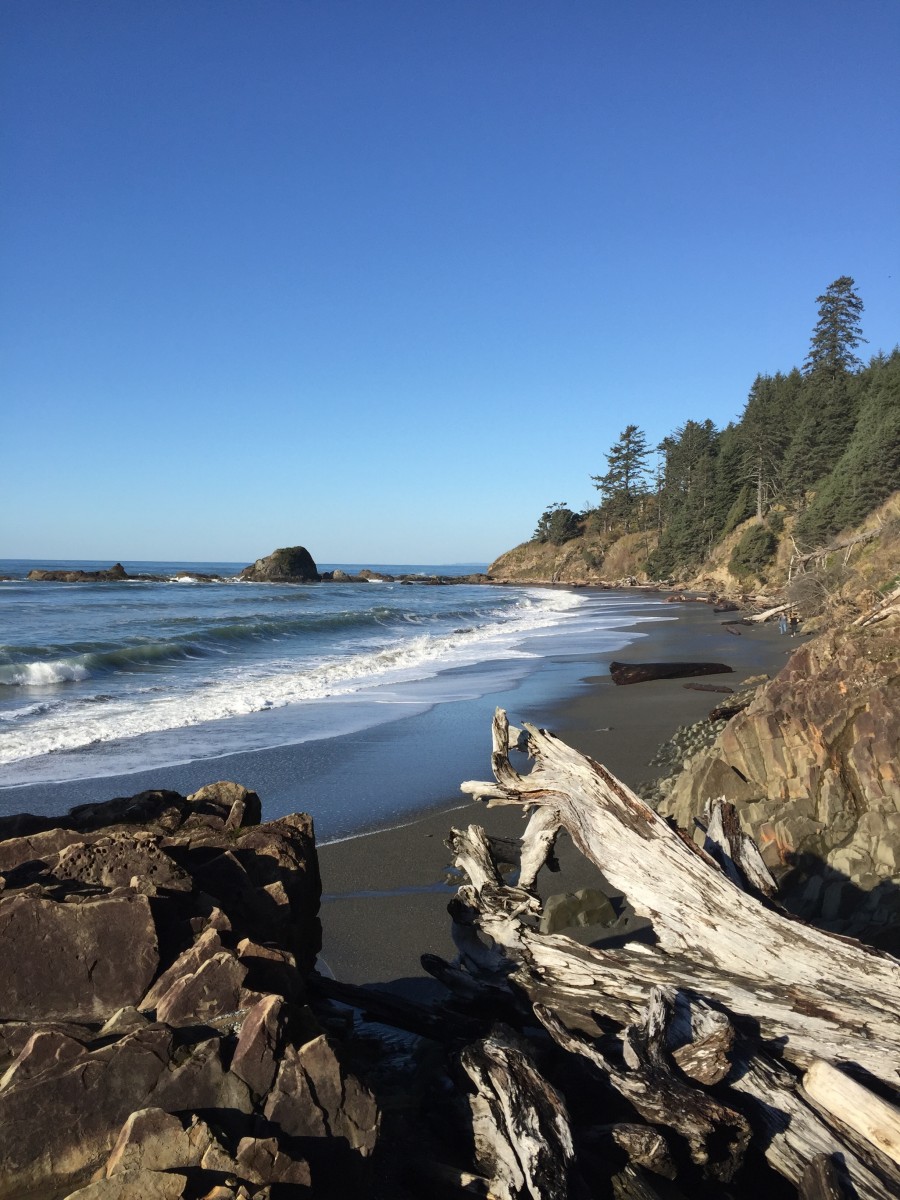
I had been here twice before. It’s beautiful because of the rocks, called sea stacks, that jut out of the water not too far out from shore. The stacks, remnants of eroded coastal cliffs, provide a place for birds, including cormorants, murres, pigeon guillemots, and petrels, to breed and raise their young.

sea stacks

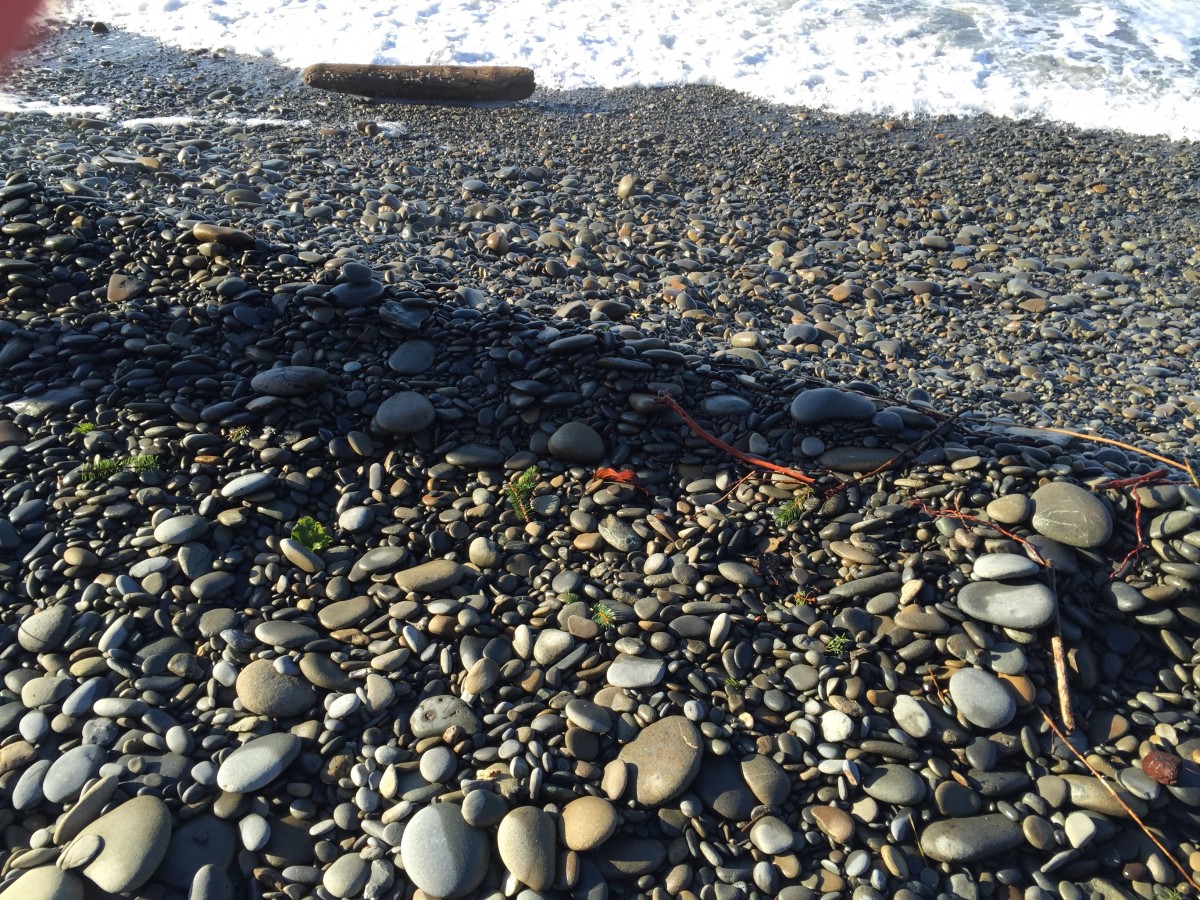
Because we arrived just a few minutes before high tide, the sandy part of the beach was hidden by the waves. The area open for walking was covered by stones. Looking at the stones reveals that some have been in the water longer than others. Most of them have been tumbled into smooth discs or ovoids by being in the water so long, but occasionally one appears that still has an irregular shape with some jagged edges. Walking across the beach on the stones is a challenge because the stones give way and shift underfoot.

rocky beach

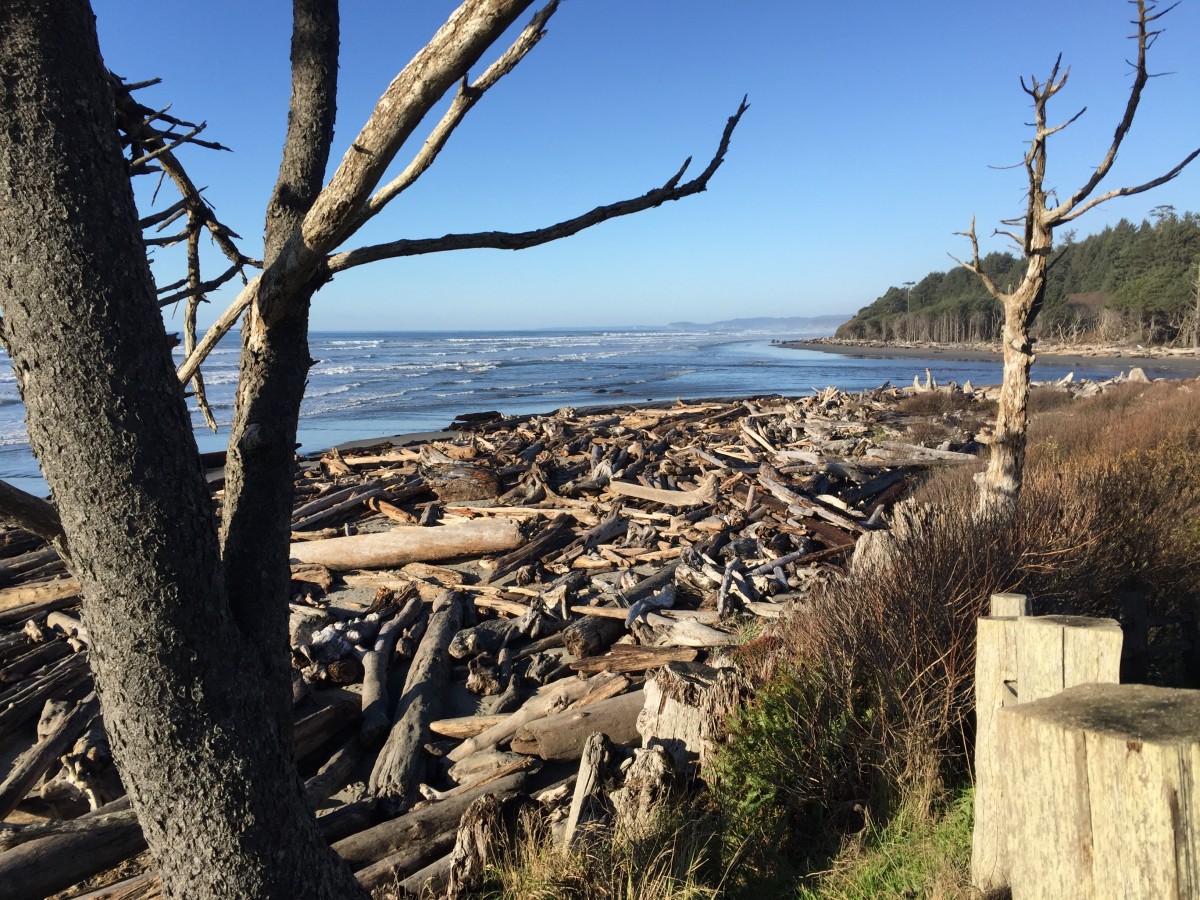
Ruby Beach, like the beach here at Kalaloch Lodge, is also covered with logs that have been tumbled around by the water and have eventually washed ashore.

logs on beach

Together, Olympic National Park and Olympic National Forest protect a huge old-growth forest with trees between 200 and 1,000 years old. Nearly one million acres on the Olympic Peninsula are protected as wilderness—95% of Olympic National Park, five areas in Olympic National Forest, and more than 600 islands in national wildlife refuges. The logs on the beaches serve as a reminder that most of the area is covered with trees.

Beach 4

About 73 miles of coastline along Highway 101 are protected as wildlife refuge. Many of the beaches are accessible only on foot or by boat, but Beach 4 offers a parking lot and a walking trail..

The path from the parking lot down to the beach terminates in this wooden walkway:

boardwalk at Beach 4

From here you can venture out onto the rocks, if you’re brave enough. We weren’t brave enough, but there were some younger people there who were.

guys on rocks

When we arrived, the tide had recently begun to ebb. There are not as many logs on this beach as there are at Ruby Beach and at Kalaloch Lodge.

Beach 4 has few logs

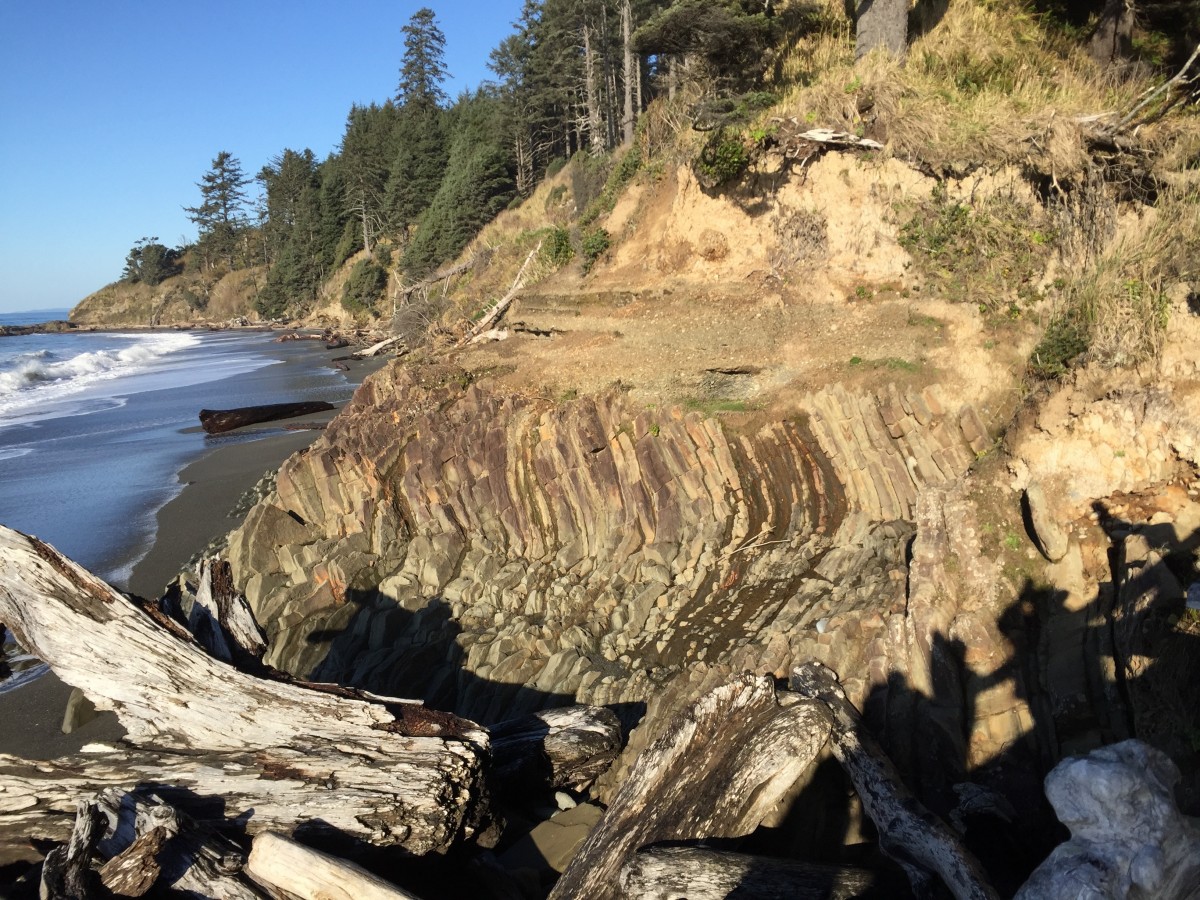
Here the rocks take center stage and demonstrate how the coastline formed over the last 15 million years:

rocky coast at Beach 4

Earth’s outer crust consists of vast mobile plates carried along by convection currents. As the ocean floor collided and dipped beneath the land plate, the rocks which form the Olympic peninsula were skimmed off and added to the continent.

Hoh Rain Forest

We drove through the rain for the last hour or so of the trip yesterday. Since we had rain for the whole week we were here last year, I expected that the rain would continue, but we awoke this morning to bright sun.

We decided to take advantage of the good weather by visiting nearby Hoh Rain Forest. We had hoped to go last year, but Mother Nature didn’t cooperate. It’s about a 30-mile drive from the lodge to the visitors’ center. (See the map in yesterday’s post.)

(Click on any photo to see a larger version.)

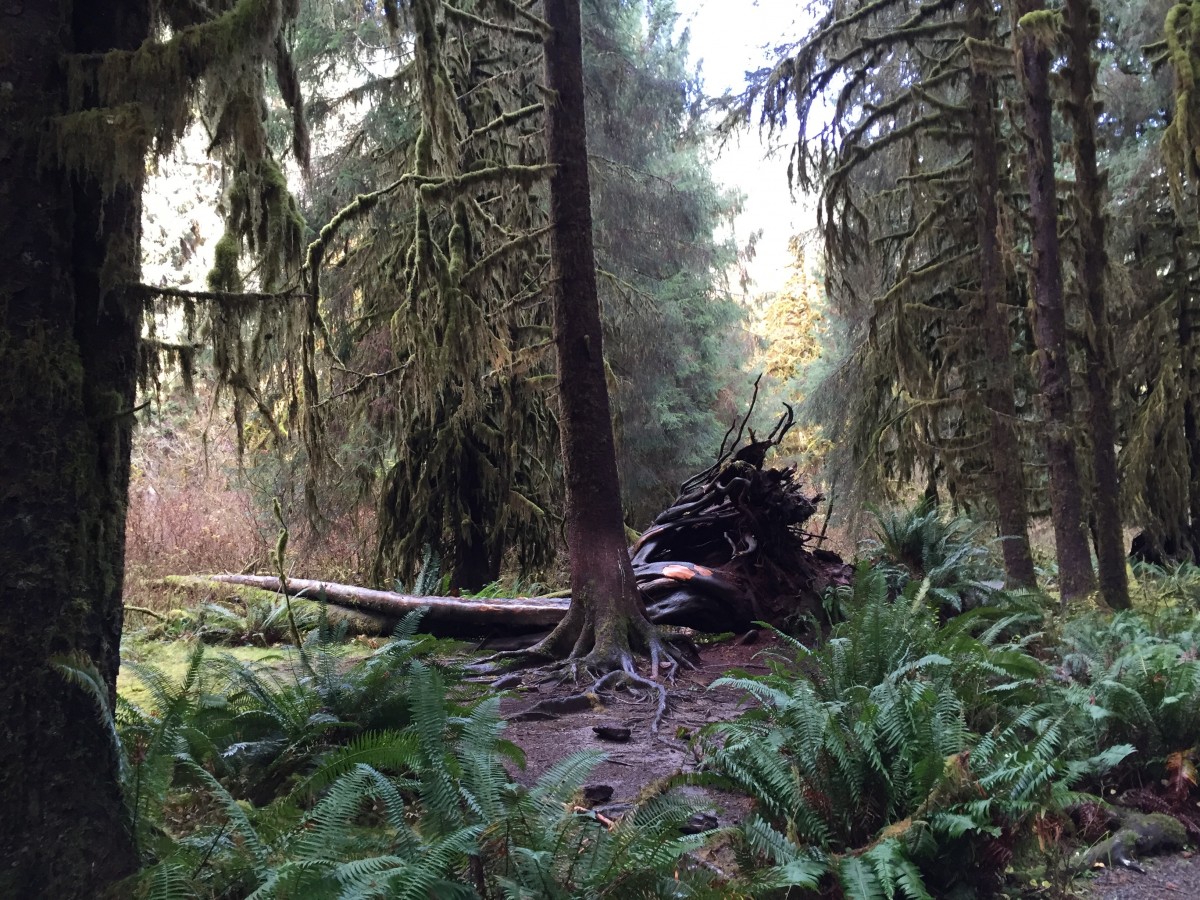
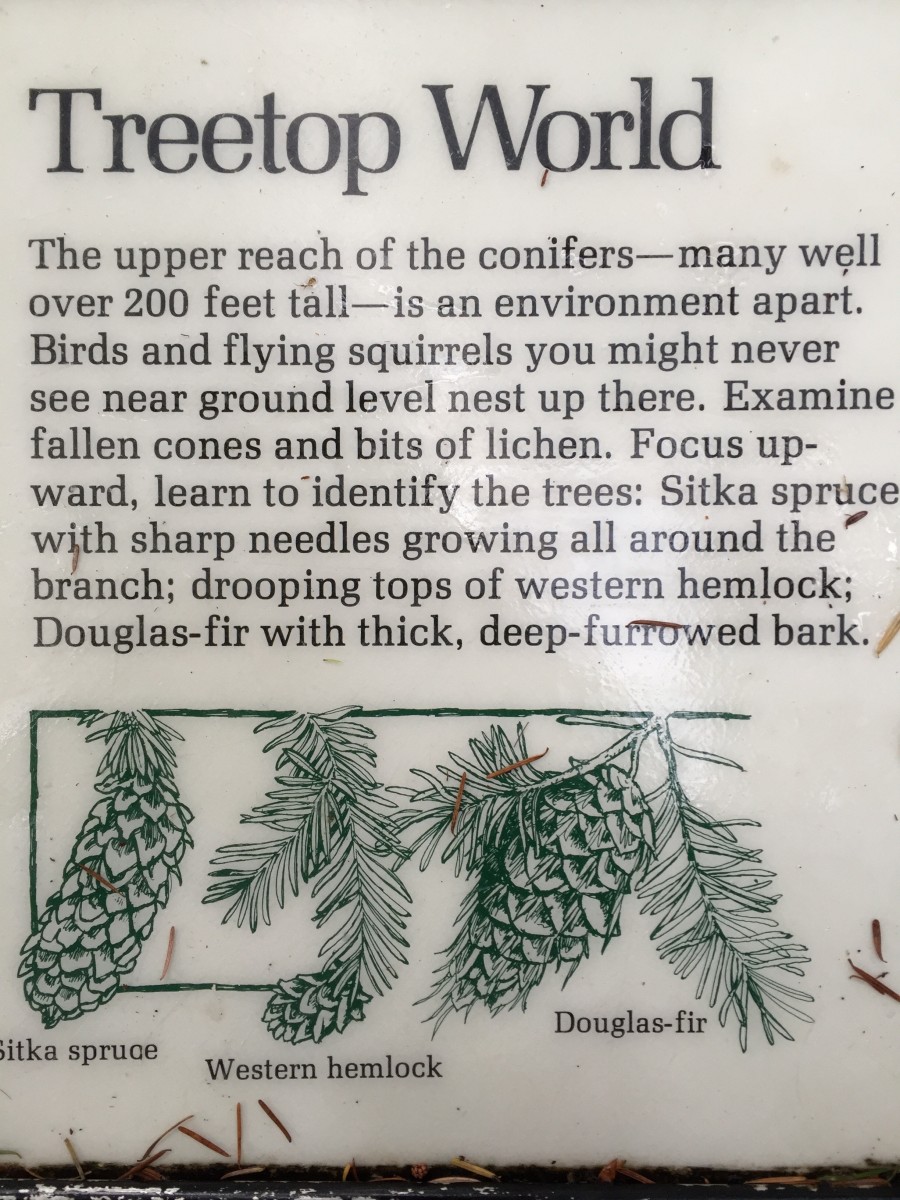
Located 30 miles from the coast on the west side of Olympic National Park, Hoh Rain Forest receives about 140 inches of rainfall annually. Some of the largest trees in the world grow here. Western red cedar and western hemlock grow up to 200 feet tall, while Sitka spruce and Douglas firs can reach 300 feet.

Types of trees in Hoh Rain Forest

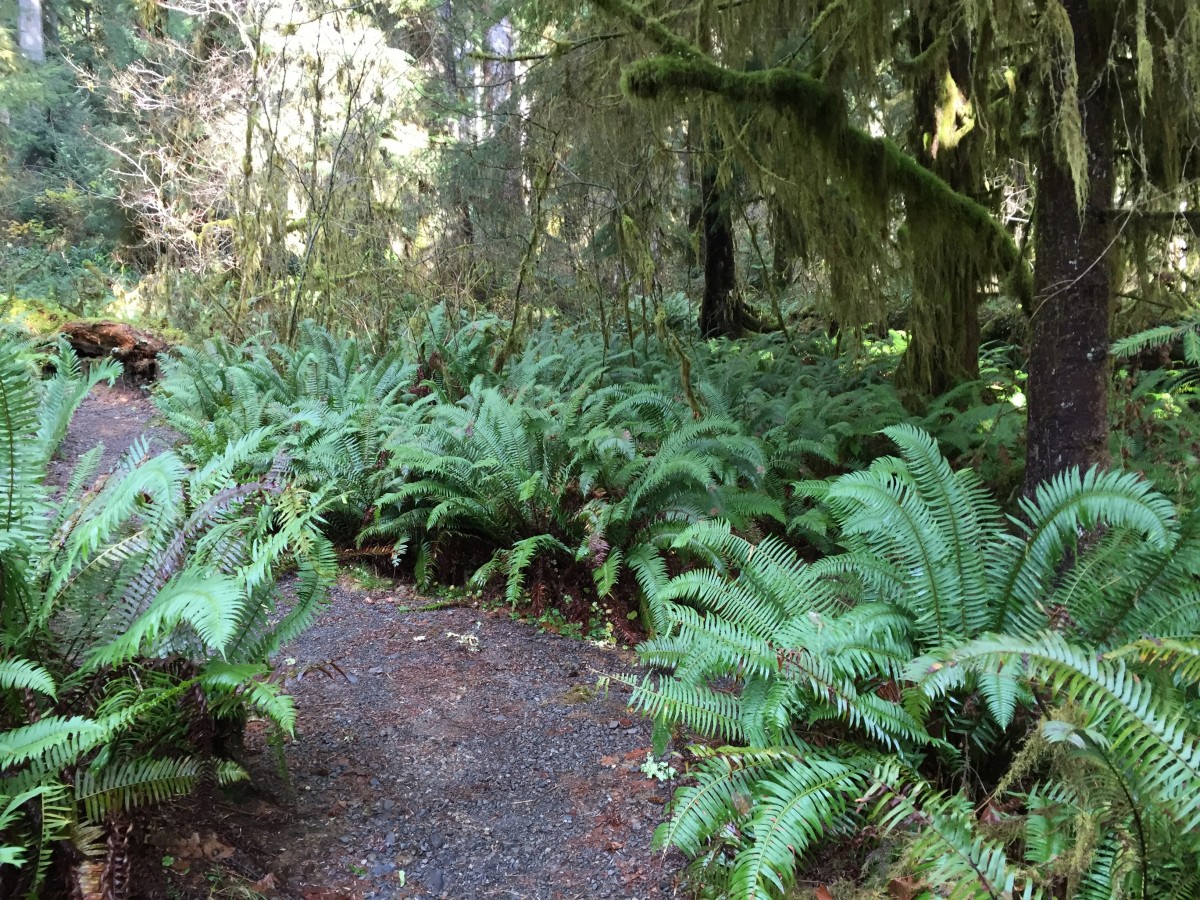
The rain forest environment is also perfect for ferns:

Ferns love the rain forest

We took the trail called the Hall of Mosses. Mosses cover the trees, making trunks and branches look like green fuzz.

The heavy moisture in the air muffles sounds. If you look up, you’re likely to see the tops of the evergreens swaying in a breeze that you neither hear nor feel.

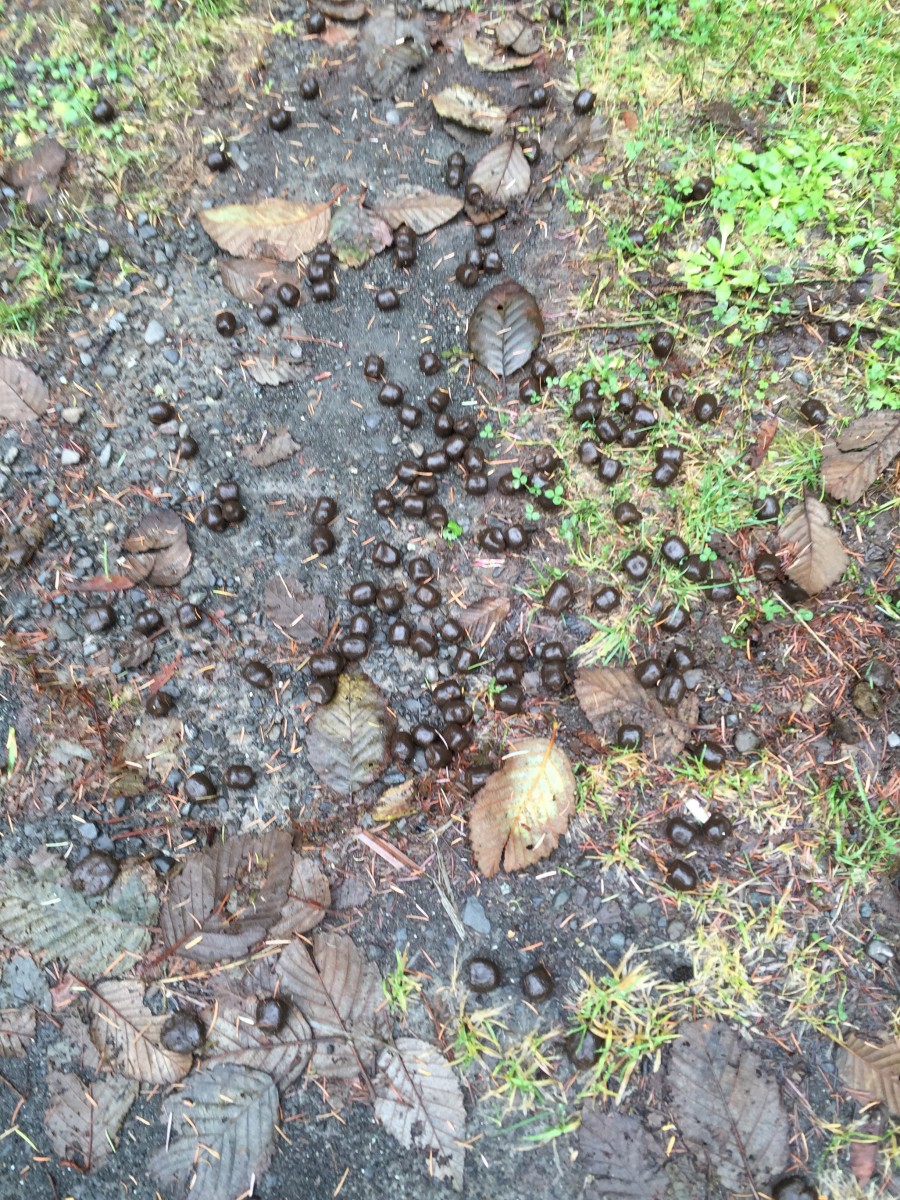
Elk scat
Elk scat

Roosevelt elk live here, where they find a rich food source of all the plants that grow on the forest floor. Elk are especially fond of salmonberry bushes, which they keep trimmed well below their growth potential of 15 feet. We didn’t see any elk, but we did see evidence of their presence:


Three Things Thursday

Here are some photos from our recent trip to Winthrop, WA, in honor of Three Things Thursday, the purpose of which is to “share three things from the previous week that made you smile or laugh or appreciate the awesome of your life.”

Click on any photo to see a larger version.

1. Floyd

Floyd
Floyd

This North American bison from Wyoming greets visitors just inside the door at Sun Mountain Lodge.

2. Mule Deer

mule deer at lodge
mule deer at lodge

The Methow Valley has one of the largest herds of mule deer in the country. A good portion of them gather to graze on the lawn of Sun Mountain Lodge.

3. Stunted Pine

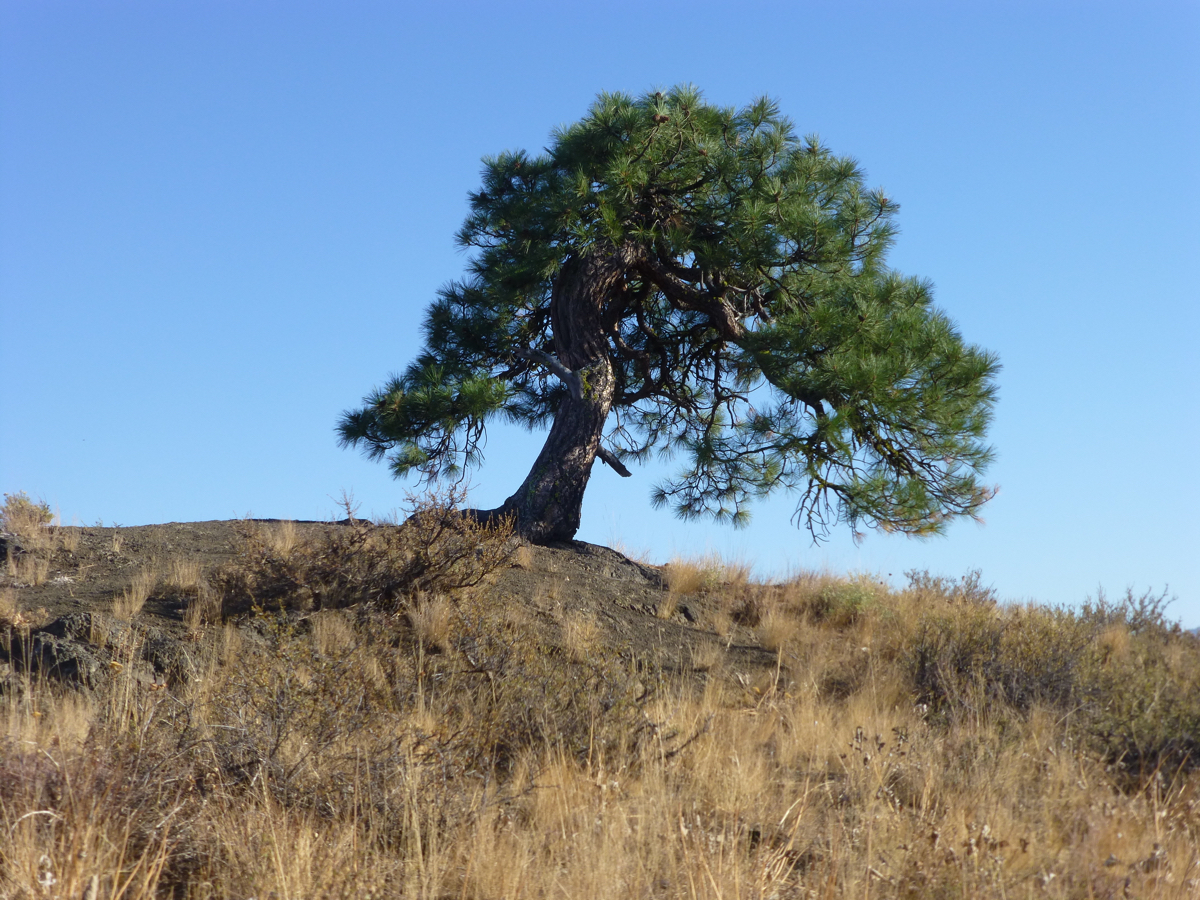
Stunted Ponderosa pine

Just a bit behind the deer in photo #2, this Ponderosa pine sits atop a hill. Because it is growing from a crack in the rock, it has remained small. It reminded us of a bonsai tree.

Road Scholar Program: Day 2

Today began with more of Dana’s presentation “How Nature Works.” He emphasized the way that fire serves to maintain nature’s balance. This is a salient issue because the recent wildfires in Washington burned close by but were stopped before reaching downtown Winthrop.

According to Dana, Ponderosa pines have developed thick bark that protects them from fire. Brush fires burn quickly, and when they sweep through a forested area, they are gone before they can burn through the bark of a Ponderosa pine and harm the interior, living part of the tree. These fires burn low-lying vegetation that competes with trees for nutrients from the soil. When allowed to burn freely, these fires keep down the growth of vegetation on the forest floor. But when the fires are routinely extinguished, low vegetation builds up so that, when a fire does arise, there is plenty of fuel for it to burn through. This is why the recent fires were able to spread across the area so quickly.

(Click on any photo to see a larger version.)

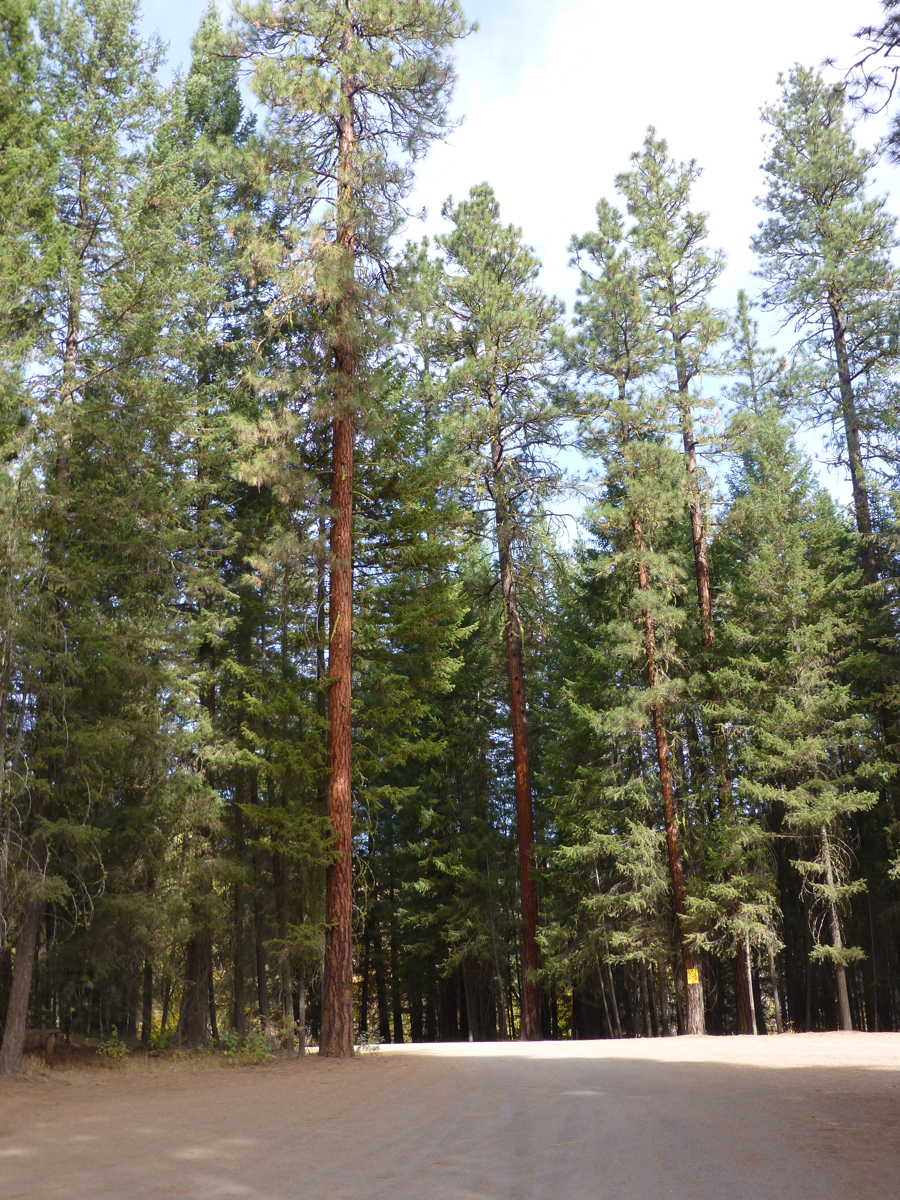
Later, on a walk along the trails near the lodge, we saw the tall Ponderosa pines, with their distinctive orange bark:

Ponderosa pines
Ponderosa pines

Dana also took us to the nearby beaver pond. Despite the name, beavers no longer live there because the owners of the land now trap and relocate them when they show up. The reason, Dana told us, is that beavers would cut down all the aspens that surround the pond within about 10 years.

beaver pond

Although we didn’t get to see beavers, we did see both ducks and geese swimming on the pond.

The second part of today’s program was the introduction of “Northwest History in Story and Song” presented by Hank, a singer, historian, and storyteller. Hank discussed the European exploration of the Pacific Northwest. He punctuated his slide presentation with songs that capture the spirit of the people who manned the ships that came looking for the Northwest Passage. Such songs represent the oral history tradition that prevailed before most people could read and write. On the ships, the shantyman sang songs that provided the rhythm necessary for whatever job the men were performing: The more rapid the action, the more lively the song.

Road Scholar Program: Day 1

Since our move to Washington State, we’ve done most of our exploring along the coast, between northern Washington and San Francisco. Now that summer is over, we decided to head east over the Cascade Mountains. This is not a trip for summer, as the temperatures east of the Cascades are often in the 90s, sometimes even more than 100. We signed up for the Road Scholar (formerly ElderHostel) class called Nature at Work in the North Cascades, Northwest History in Story and Song, and Life in Methow Valley.

(Click on any photo to see a larger version.)

This morning we set out on our trip over the Cascade Loop:

Cascades Loop map

We decided we’d take the northern route out today and the southern route on our way back home. Highway 20 goes through the North Cascades in an area often referred to as the North American Alps. You can see the pointed, rocky mountaintop typical of this area in the photo at the top of this post.

Our destination was Sun Mountain Lodge, a resort on 3,000 acres with miles of hiking trails, on the outskirts of Winthrop, Washington. This area is known as the Methow Valley. Methow is pronounced MET-how. The river and its surrounding valley take their name from the Native Americans who originally traveled the land fishing, hunting, and gathering wild foods such as berries and roots.

The program began in mid-afternoon with a lecture entitled “How Nature Works” by Dana, a local botanist. His focus was on how plants convert energy from the sun into food. After his talk he lead us on a nature walk on one of the trails closest to the lodge. He showed us how to use a botanist’s loupe (small magnifying glass) to look closely at flowers, leaves, and seeds.

My big discovery on this walk was quaking aspens, which I had never seen and heard before. Or at least I’m not aware of having seen them before. According to my book about plants of the Pacific Northwest, aspens cover New England, where I grew up, but I don’t remember them. Perhaps I lived in an area that wasn’t high enough for them. Because aspens like cool weather, they are usually found at elevations between 5,000 and 12,000 feet (1,500–3,700 m).

The flat leaves of these aspen trees, Populus tremuloides, shake or quiver in the slightest breeze in an effort to take in as much carbon dioxide and to expel as much oxygen as possible. This behavior has given the trees the name quaking or trembling aspens.

If, like me, you’ve never seen and heard quaking aspens, here’s a short video for you (it really is short, just 17 seconds; be sure to turn up the volume on the video player so you can hear the quaking):

Three Things Thursday

It’s time again for Three Things Thursday, the purpose of which is to “share three things from the previous week that made you smile or laugh or appreciate the awesome of your life.”

three-things-thursday-participant

Here are three miscellaneous, interesting tidbits from our Alaskan cruise. Click on any photo to see a larger version.

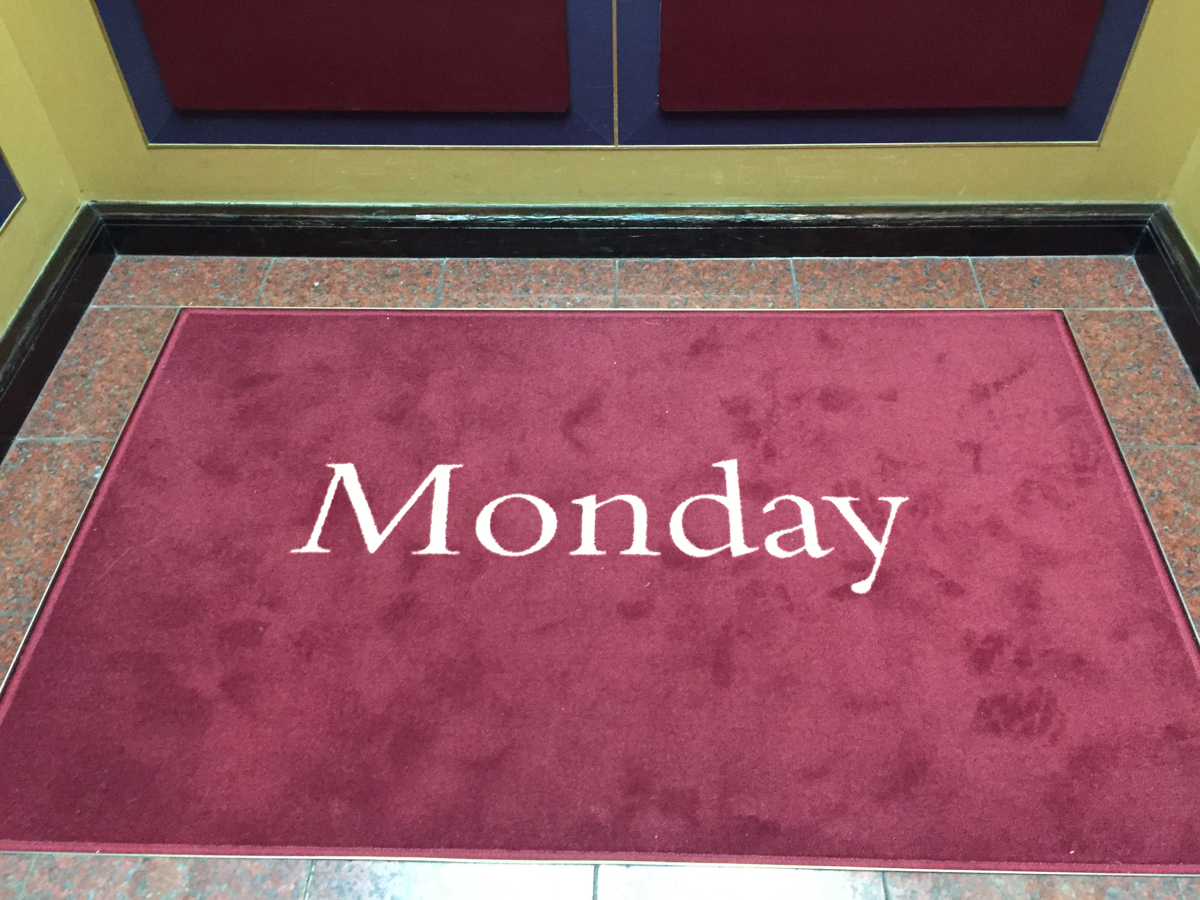
1. Calendar carpet

With no cell service and only intermittent internet availability on a cruise, it’s easy to lose track of what day of the week it is. Fortunately, our ship’s staff changed the carpets in the elevators every day to keep us up to date.

Calendar carpet

2. Sitka humor

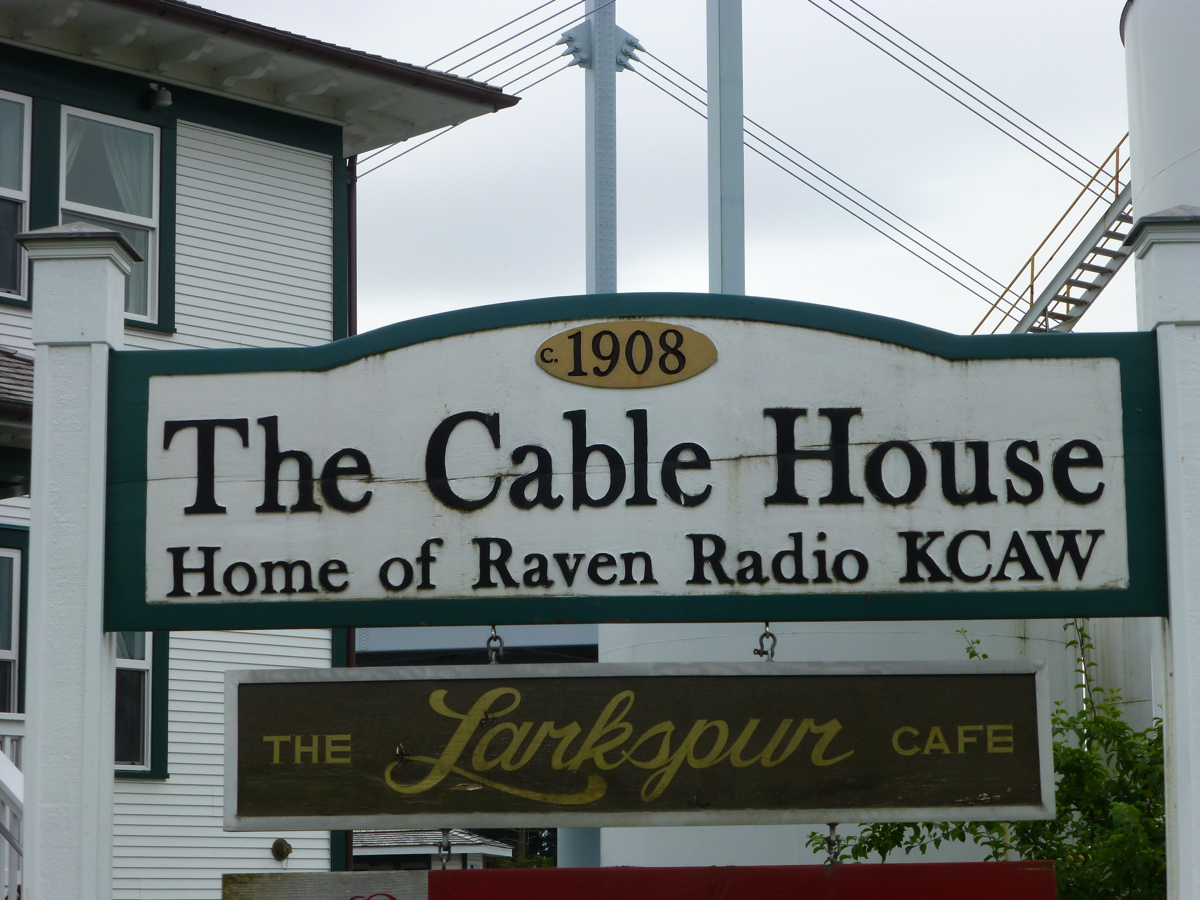
Notice the call letters of Raven Radio in Sitka, AK.

KCAW

3. For all you Deadliest Catch fans

I’ve never watched this show, but our shuttle driver in Homer, AK, pointed out that this boat was in the harbor on the day we visited Homer.

Time Bandit

Sitka: Sea Otter & Wildlife Quest

Today we are cruising from Sitka, AK, to Victoria, British Columbia. This day at sea allows me time to tell you about the shore excursion we took yesterday in Sitka.

About 15 of us boarded a water jet catamaran ship, the Sea Otter Express, for a three-hour excursion entitled “Sea Otter & Wildlife Quest” in the area around Sitka. We weren’t gone too long before one of the two naturalists aboard directed our attention to the pointed noses of a couple of Steller sea lions. From then on we saw lots of local creatures.

You can click on any photo here to see a larger version. Although the ship captain took us in as close as possible to view the wildlife without scaring them, we still had to use a telephoto lens for most of these shots. With the boat idling on the sea waves, we never had a completely stable base. Most of these photos will therefore be somewhat out of focus when viewed at larger sizes.

Steller sea lions

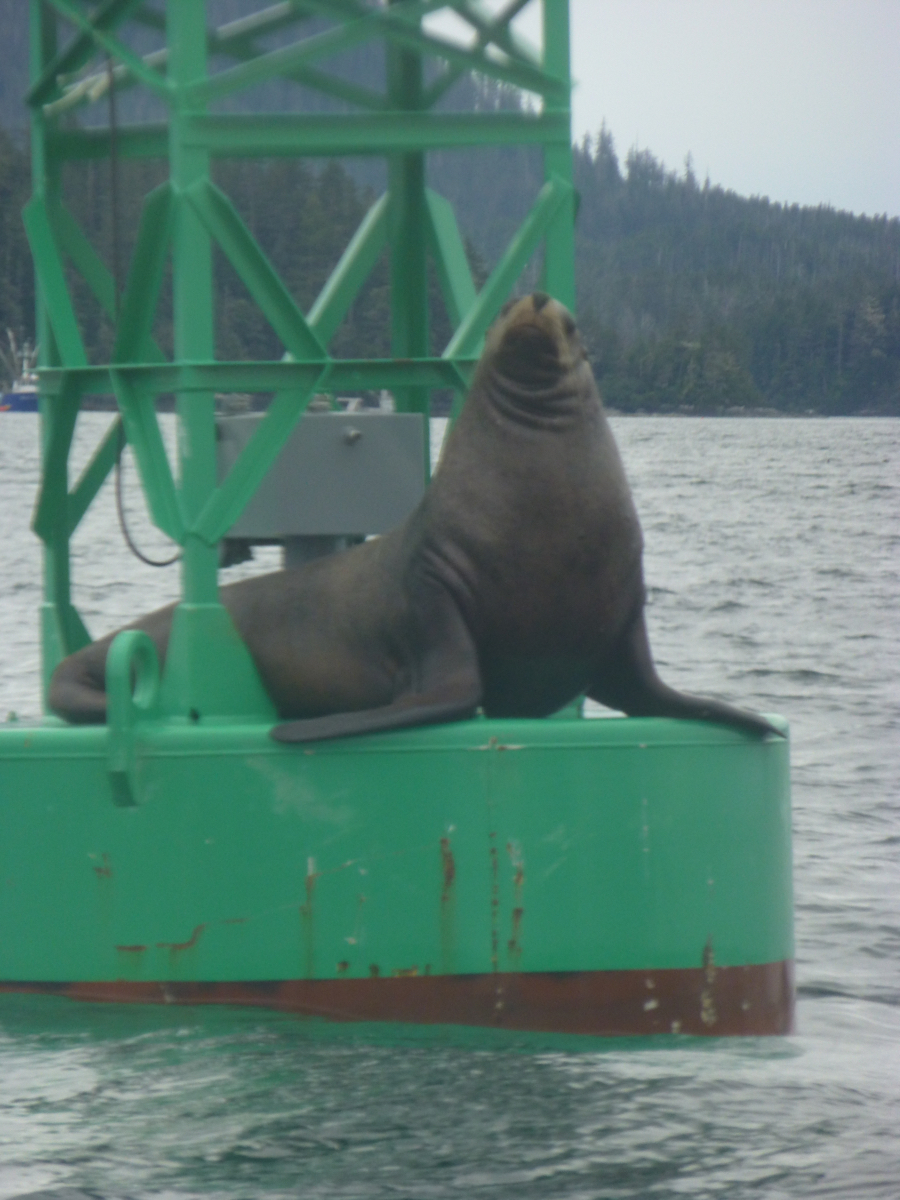
Steller sea lions are named after naturalist Georg Wilhelm Steller, who first described them in 1741 while accompanying Vitus Bering on his explorations of the area around Alaska for the Russian government. These animals are big. An average female is eight feet (2.4 meters) long and weighs about 600 pounds (272 kg). An average male is 10 feet (3 meters) long and weighs in at 1,250 pounds (567 kg).

Sea lions can be distinguished from seals by their larger size, their ear flaps, and their rotating rear flippers. In the water, sea lions project pointed noses, while seals present a round head, like a bowling ball.

We originally saw Steller sea lions in the water. Later, this big guy on a buoy presented an irresistible photo opportunity:
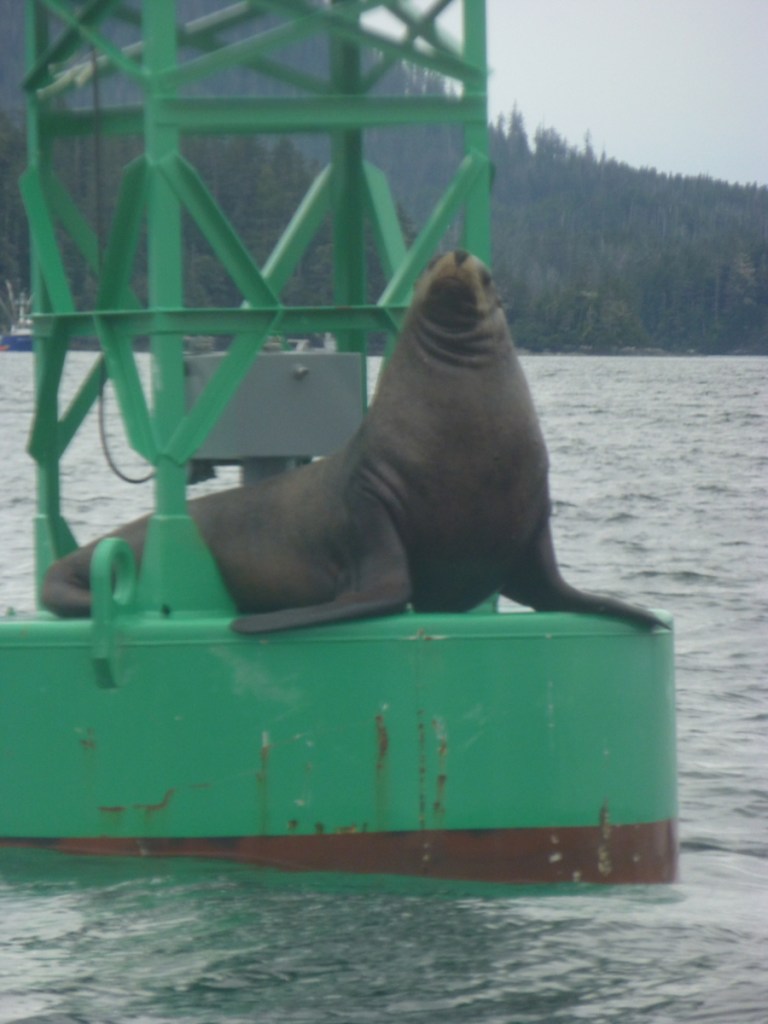
sea lion on buoy

According to our trip brochure, the sea lion population around northern and western Alaska has plummeted by about 80% in the last 20 years. The probable cause of this decline is the overfishing of pollock, sea lions’ main food source.

Harbor seals

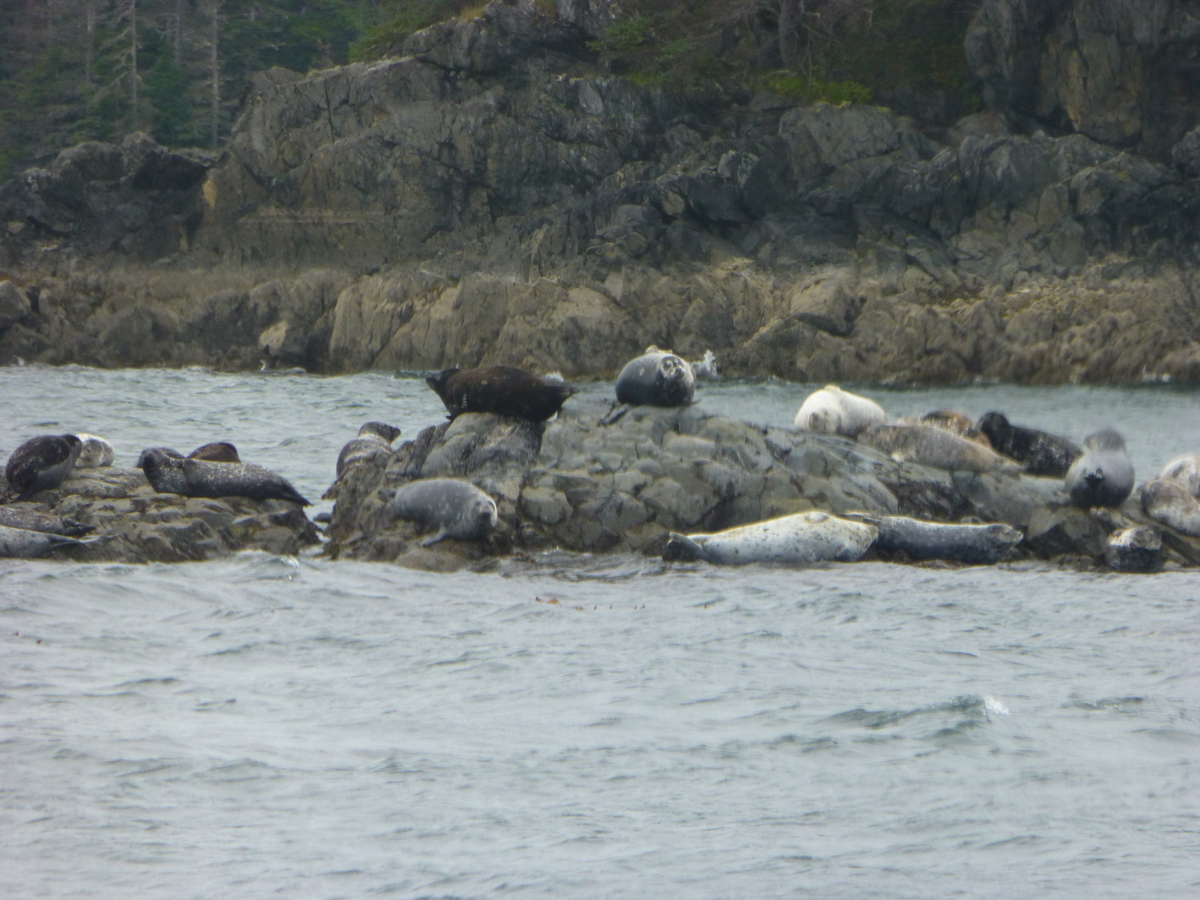
These harbor seals are stretched out on rocks getting some sun.
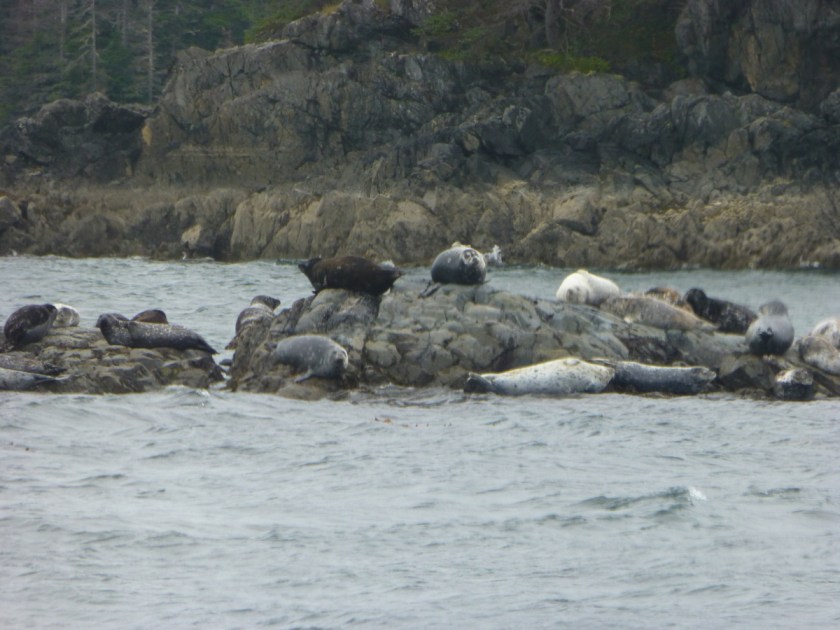
seals

Seals are smaller than sea lions. A typical harbor seal is about six feet (1.8 m) long and weighs about 180 pounds (81.6 kg). Seals flop around on rocks. They cannot use their flippers to pull themselves up and stand, as the sea lion on the buoy in the photo above is doing. In the water seals swim along with their round heads just breaking the surface.

Harbor seals have a thick layer of body fat to protect them from the cold water. Their coats consist of coarse, short hairs that can vary in color from blonde to nearly black. Many seals are spotted, streaked, or blotched. They can dive quite deep to catch the fish they depend on for food.

Sea Otters

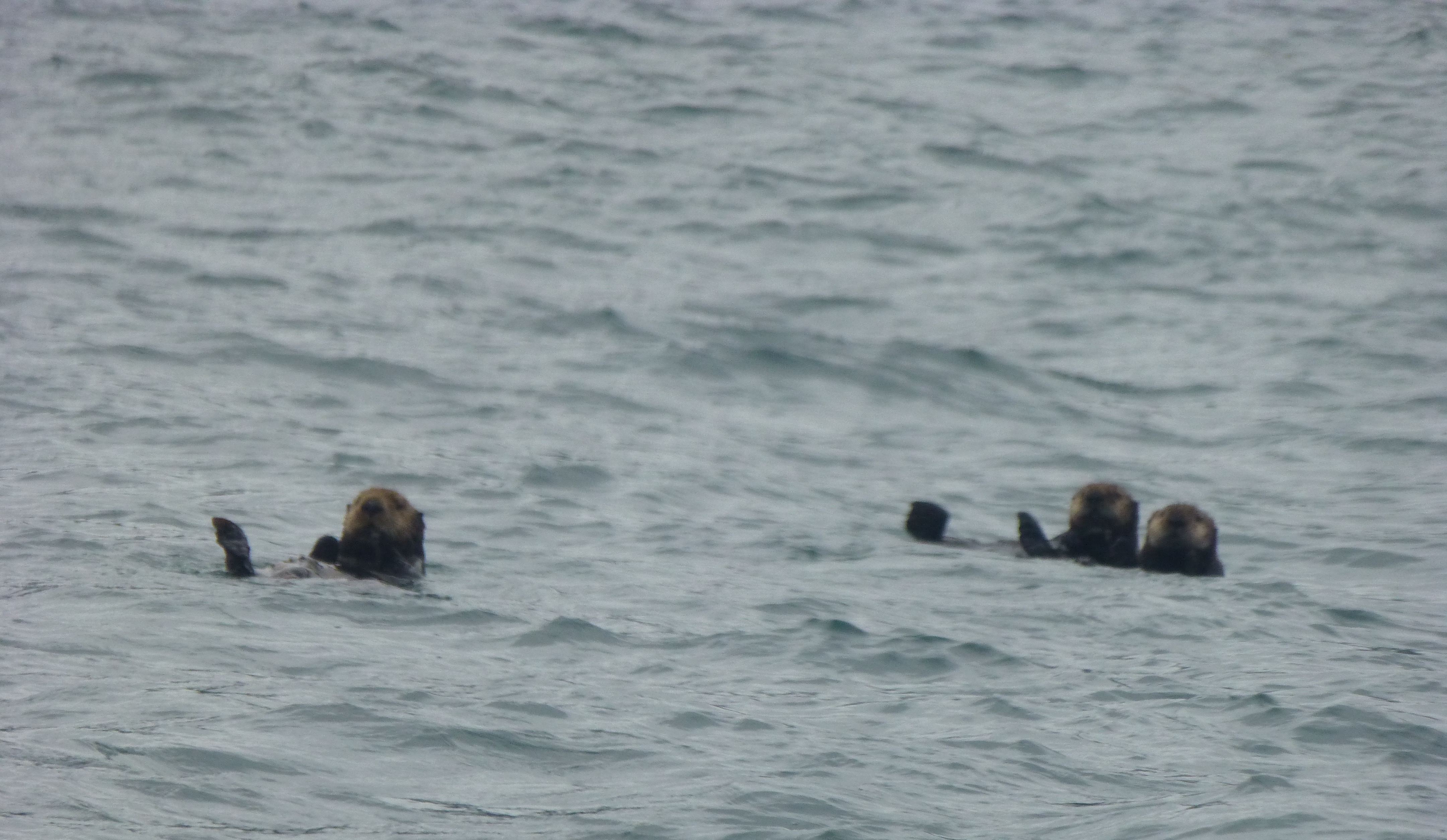
Unlike seals and sea lions, most sea otters spend all their time in the water. An average male is five feet (1.5 m) long and 70 pounds (31.8 kg), while an average female is four feet (1.2 m) long and 60 pounds (27.2 kg).
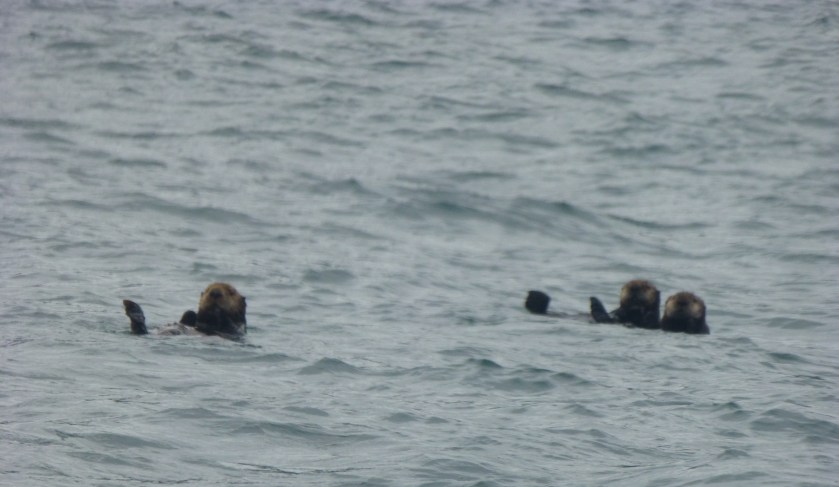
sea otters

Unlike other sea mammals, sea otters do not have a fat layer to protect them from the cold water. They depend entirely on their thick, rich fur to keep them warm. Sea otters have an average of 300,000 hairs per square inch, the densest fur of any animal in the world.

Because of their dense, soft fur, sea otters were hunted nearly to extinction in the late eighteenth and early nineteenth centuries. By 1911, only about 2,000 remained, widely scattered across the North Pacific. Restrictions on hunting and relocation programs have increased their number to about 150,000. In the 1970s a number of sea otters were brought to the area near Sitka from a distant point in the Aleutian Islands. This repopulation program has increased the number of sea otters in the region to about 12,000 today.

Sea otters are what is known as a keystone species—their presence or absence dramatically influences the environment. They eat invertebrates such as sea urchins, which can greatly reduce a region’s kelp supply, necessary for fish habitat, if left unchecked. Otters also eat abalone, clams, crabs, and octopuses. They can use rocks as tools to break open shells. They have a high metabolism and must consume about one-quarter of their body weight in food every day.

Sea otters are very social but segregate themselves by gender. They hang out in groups called rafts; each raft will contain either all males or all females and pups. The males have no part in caring for the pups.

Sitka black-tailed deer

We were lucky enough to see a female Sitka black-tailed deer grazing along the shore. The captain of the boat spotted her and slowly took us in close enough to see her. She was well camouflaged against the shore, and most of us couldn’t see her until we get in quite close.
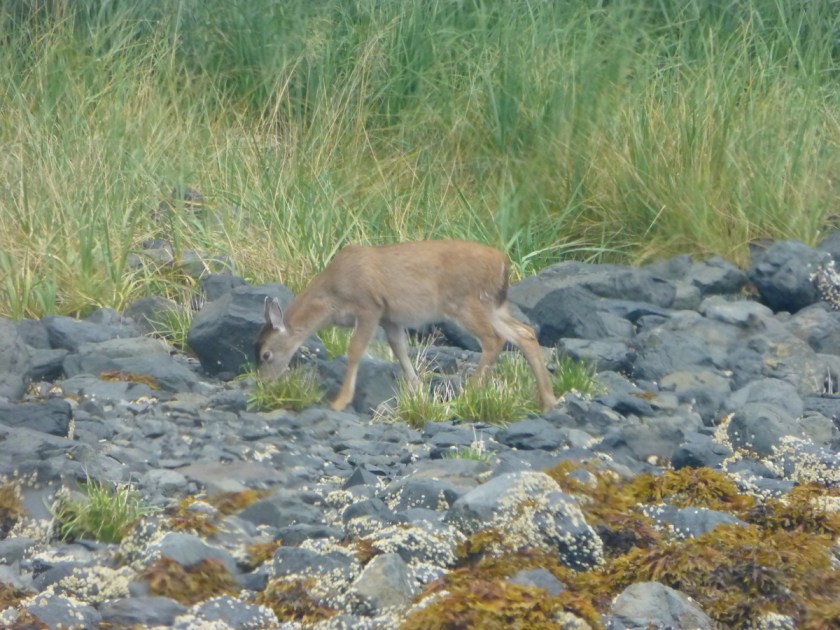
Sitka black-tailed deer

These deer are quite small. An average male weighs about 120 pounds, an average female about 80 pounds. This one, though full grown, looked like a fawn to most of us.

The naturalist told us that Sitka black-tailed deer are a hallmark of the old-growth forests that cover Alaska. The deer feed on the plants that cover the ground beneath the tall trees. When an area is logged, the deer disappear from the edge areas (the logged areas) deeper into the old-growth forest.

These deer have also been known to swim from one island to another in search of food. Although they primarily eat vegetation, during the salmon run they may occasionally be seen eating fish, according to our naturalist.

Cormorants

We didn’t get any photos of these black birds, but we saw several of them both flying and sitting in the water. They have long, curved necks and can dive deeply in search of the small fish they feed on. They have large feet that they use to paddle, like ducks, when resting in the water.

Bald eagles

Again, we weren’t able to get photos of these, but we saw several flying along the shore and out over the water in search of food. Their white heads are easy to spot against the green forests of the islands.

Lots and lots of gulls

Yes, lots. According to one of our naturalists, there are several different species of gulls in the Sitka area, and they ofter interbreed, producing difficult-to-identify hybrids.

Salmon spawning area

Our visit to Alaska came at the very end of the salmon season, so we didn’t see the fish. But this waterfall flows from a fresh water lake above into the sea water below:
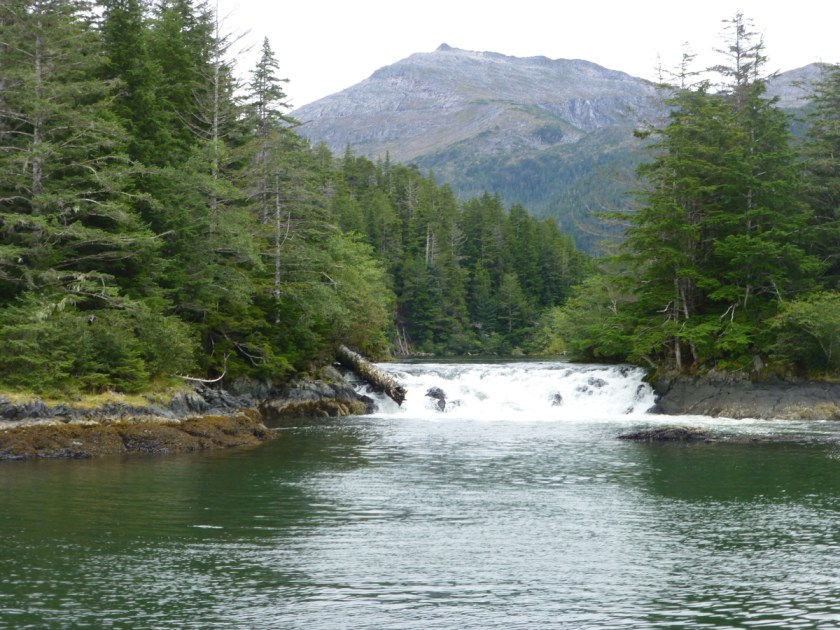
Sitka waterfall

At spawning time the salmon will run up this waterfall to get back into the lake to spawn.

Humpback whales

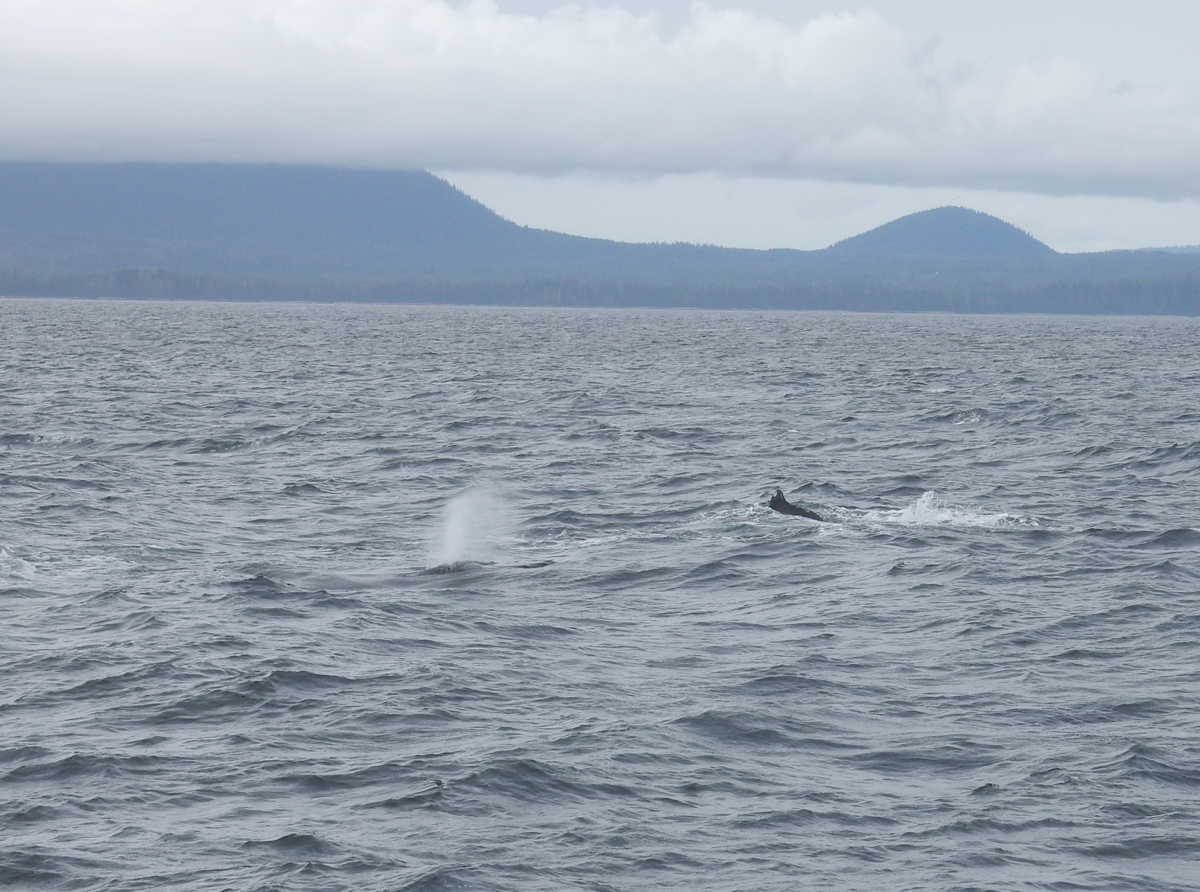
I’ve saved the best for last, and so did our tour’s captain. After we had seen all the animals above, he headed further out to where he hoped we might be able to see a whale or two. It wasn’t long before the naturalist said, “I’m seeing quite a few blows up ahead. It’s unusual to see so many.” The blows are the jets of water visible when the whale exhales.

That was the signal for us to head up top for a better view. And soon we were seeing the blows all over. We’d see three off to our right, then somebody would report two off to the left. I had planned to try to get some photos, but I was seeing so many exhalations that I just kept looking all around. My husband had his camera out and I could hear him shooting, so I just kept looking.

In the photo below, you can see an exhalation from a whale on the left and the back of another whale on the right:

whale blow

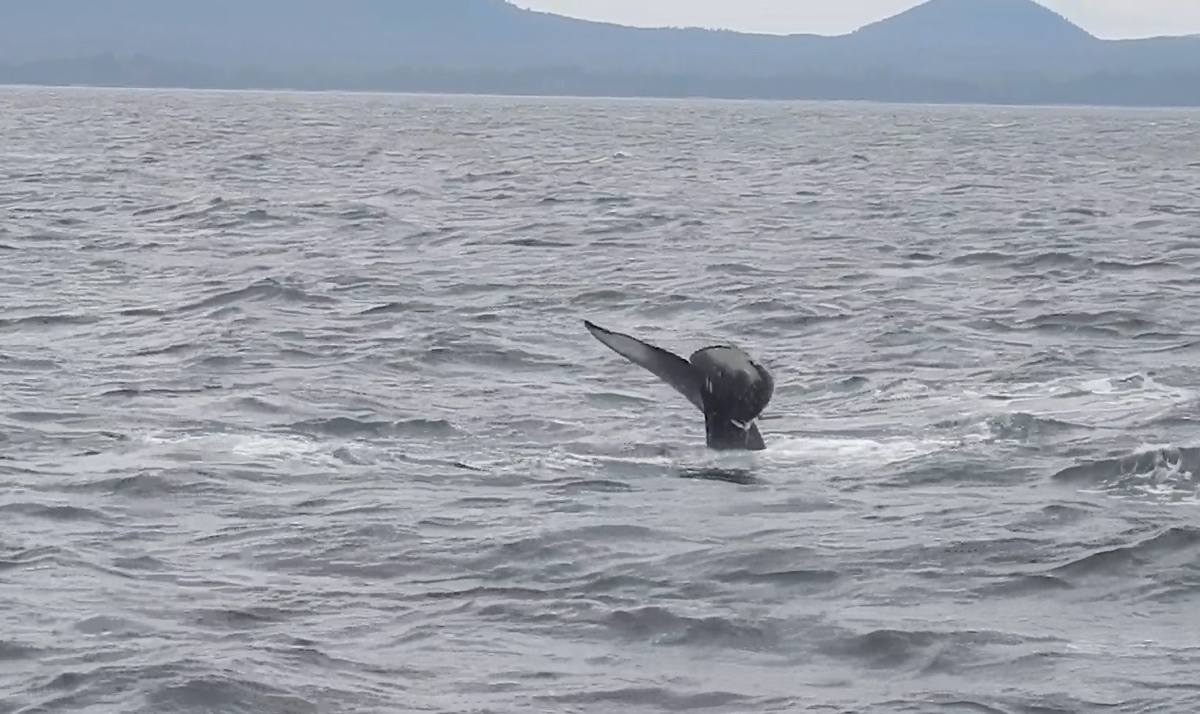
In the end, I saw 11 flukes, the usual signal that a whale is diving after spending time near the surface. We would see each group surface three or four times; then, one after the other, they’d rise up and show us their flukes. We had seen three humpback whales—two adults and a juvenile—on a whale-watching tour off the coast of Santa Barbara, CA, in late August of 2011. And back in about 1998 we had followed three or four orcas for a while on a small-ship cruise through the San Juan Islands off the coast of Washington State and Canada. But this was a truly magnificent display.

The markings on the underside of a whale’s flukes are as distinctive as a human fingerprint. Researchers track whales by these markings.
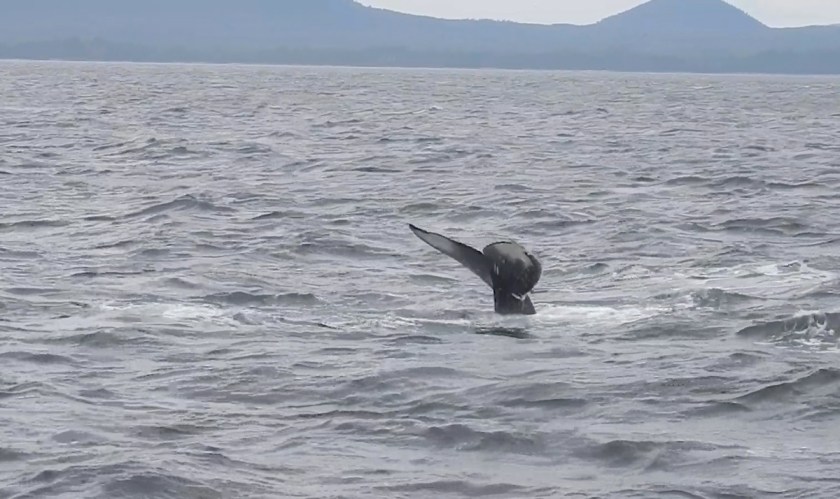
whale flukes

According to our trip brochure, scientists believe that more than 700 humpbacks inhabit the waters around southeastern Alaska. Our on-board naturalist explained that these whales were actively feeding. At the end of the summer they will migrate south, to the warmer waters around Hawaii or Mexico, to give birth. The whales must give birth in the warmer water because their calves are born without the layer of fat necessary for protection in colder waters. But the warm water doesn’t supply the kind of food the humpbacks need. They therefore eat heavily at the end of summer, and they may not eat at all again until they return north the next year.

Anchorage: The Alaska Zoo

Anchorage is a shallow port. Cruise ships have to dock at high tide and cannot leave until high tide, ensuring visitors of almost 12 hours in which to enjoy the city. Anchorage is Alaska’s most populous city, containing about 40% of the state’s total population.

We visited Anchorage the same day as President Obama. There was some disruption of traffic in the downtown area because of his presence. Fortunately, we had chosen to take a trip to the Alaska Zoo, which is located on the outskirts of the city. This zoo is appropriately named, since it’s the only zoo in Alaska.

According to our tour guide, it all started with an elephant named Annabelle. In 1966 an Anchorage resident won a contest that offered as the prize $3,000 or a baby elephant. He chose the elephant, a female named Annabelle. Visiting Annabelle became such a popular activity that eventually a non-profit corporation was formed to build a place where the public could visit and learn about animals. The Alaska Children’s Zoo opened in 1969; the name was changed to the Alaska Zoo in June 1980.

Annabelle died in 1997, but the Alaska Zoo continues to thrive. Located on 25 acres of land, it attracts about 200,000 visitors per year. It houses a variety of animals native to the state and also participates in the Species Survival Program for tigers and snow leopards.
We saw so many animals that it’s tempting to include way more photos than you probably want to see, so I’ll focus on three animals: musk ox, snow leopard, and gray wolf. Click on any photo to see a larger version.

Our home town zoo in Tacoma, Point Defiance Zoo & Aquarium, features three musk oxen, and they have long been among my favorite animals. I was therefore thrilled to learn that the Alaska Zoo has several, including a baby:

musk ox mother and baby

They keep the baby’s father in a separate, adjacent enclosure:

musk ox male

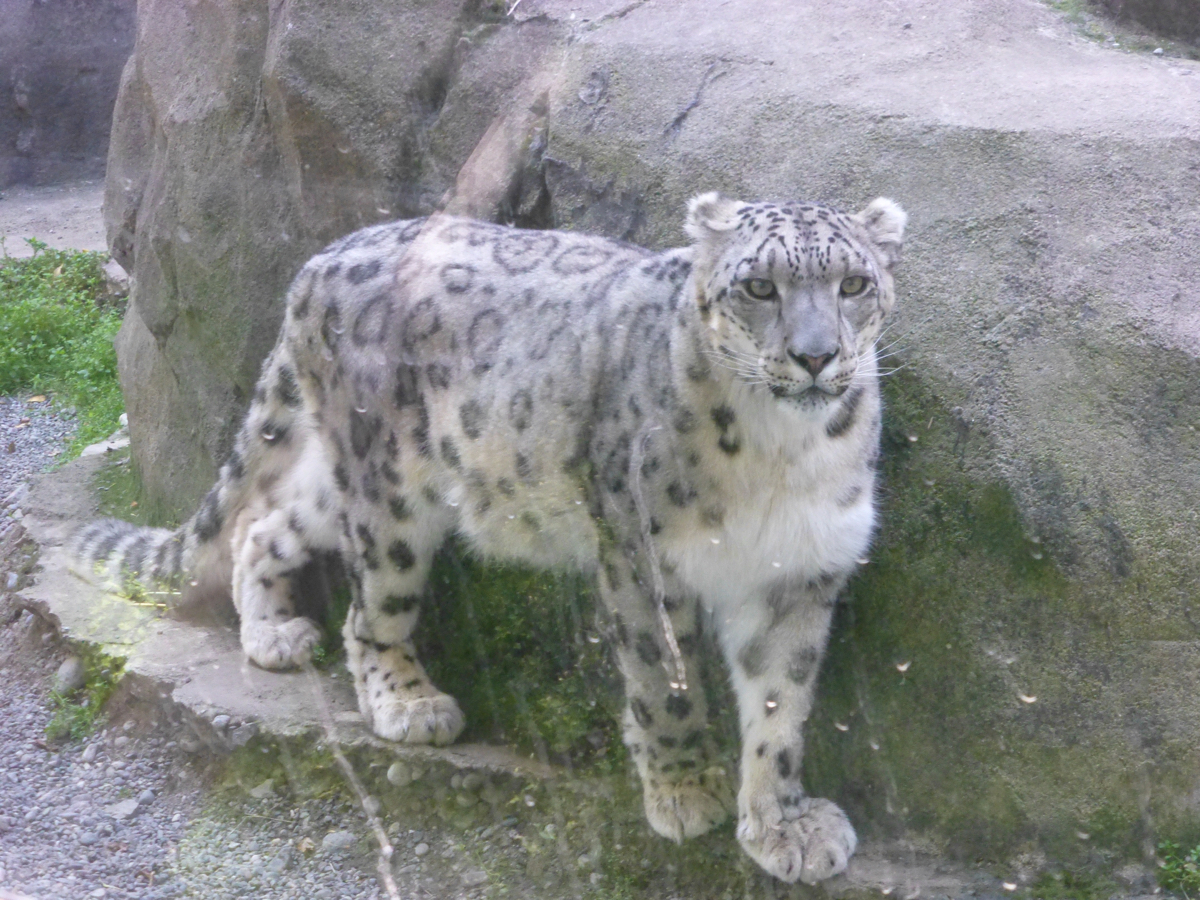
The snow leopard is an endangered species of cat native to the mountains of Central and South Asia. This one lives at the Alaska Zoo:

snow leopard

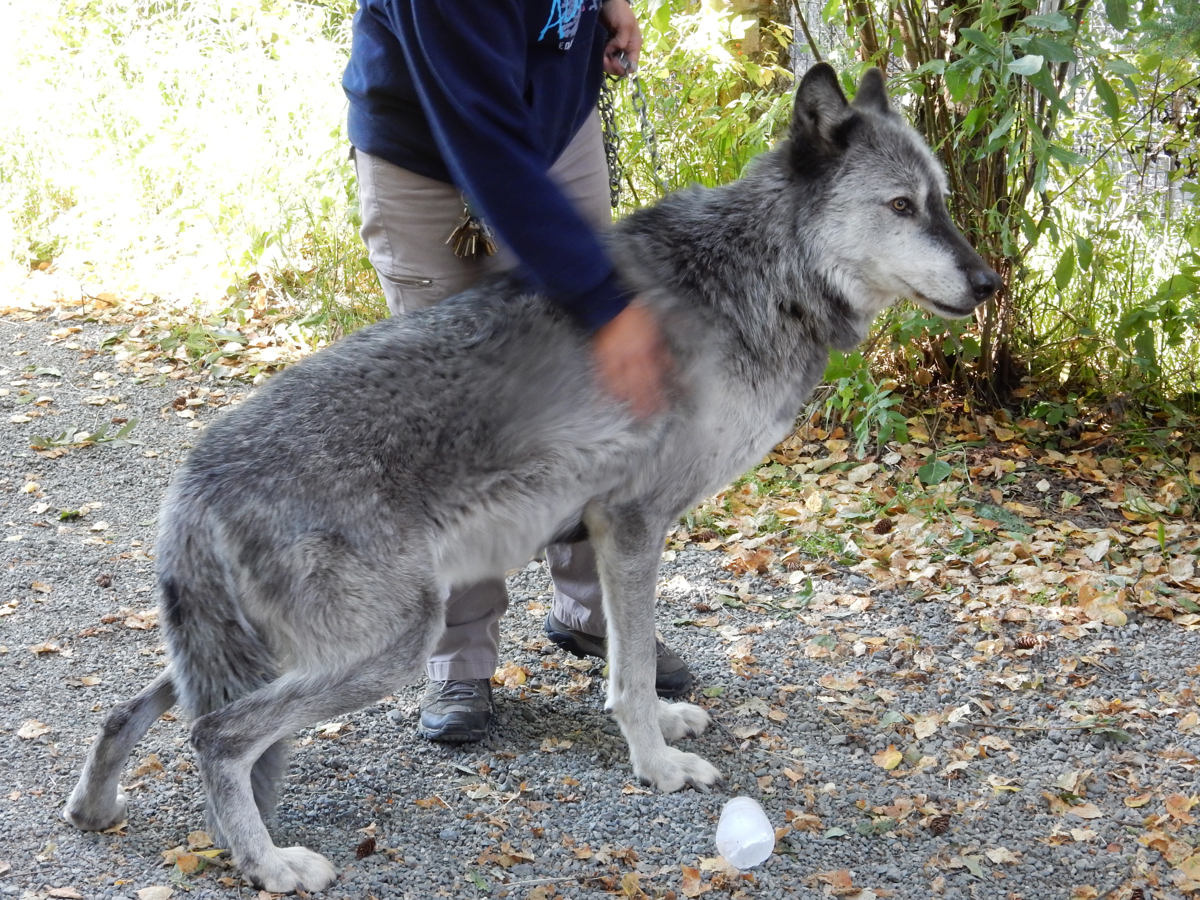
We also got to see one of the gray wolves kept at the zoo:

gray wolf

Someone asked if the zoo keeper approved of the interbreeding of wolves with dogs for domestic pets, and he replied adamantly that he does not. “These animals are not pets,” he said, stressing that the jaws of the wolf are twice as powerful as those of a dog and could inflict severe damage on a human. As beautiful as this wolf is, I did not want to get too close to him.

In addition to these three, we also saw the following animals:

  • alpaca
  • Tibetan yak
  • moose (adult male and calf)
  • brown bear and cubs
  • swans and cygnets
  • bald eagle
  • tiger
  • caribou
  • coyote

On the trip from the zoo back to our ship, the bus driver stopped where we could see Mount Denali (photo at the top of this post), formerly known as Mount McKinley. With a summit elevation of 20,310 feet (6,190.5 m) above sea level, it is the highest peak in North America. Shortly before President Obama’s visit to Anchorage, the U.S. Department of the Interior announced that the mountain would now officially be designated by its native name, Denali.