Three Things Thursday

Thanks to Nerd in the Brain for the weekly challenge Three Things Thursday:

three things that make me smile: an exercise in gratitude – feel free to steal this idea with wild abandon and fill your blog with the happy

three-things-thursday-participant

Beautiful Purple Iris

The record-breaking warm temperatures we had last week brought lots of people, including us, out to visit local parks. We are lucky enough to live within walking distance of Tacoma’s main park, Point Defiance Park.

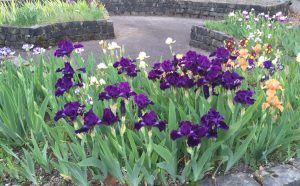
Point Defiance Park includes many separate gardens, including Northwest Native Plants, Iris, Rose, and Dahlia gardens. Last week’s warm temperatures also brought out spring seasonal flowers in abundance, such as the iris pictured below.

Since my favorite color is deep purple, I was delighted to find these three beauties in bloom:

(Click on photos to see a larger version.)

Until next week, I wish you all well!

Photos © 2016 by Mary Daniels Brown

Three Things Thursday

Thanks to Nerd in the Brain for the weekly challenge Three Things Thursday:

three things that make me smile: an exercise in gratitude – feel free to steal this idea with wild abandon and fill your blog with the happy

three-things-thursday-participant

Earth Day

First celebrated in 1970, Earth Day is now observed annually on April 22 to emphasize the importance of environmental protection.

In honor of Earth Day tomorrow, here are three photos of what the earth offers us here in the beautiful Pacific Northwest of the U.S.

(Click on any photo to see a larger version.)

(1) Magnificent Hoh Rain Forest

Hoh feature image

On Washington State’s Olympic Peninsula.

(2) The Majestic Pacific Ocean

Beach 4 has few logs

Off the coast of the Olympic Peninsula.

(3) Mystical Mount Rainier

Mt Rainier 010

My most recent photo.

I hope everyone has a good week!

Photos © 2015 & 2016 by Mary Daniels Brown

Three Things Thursday

Thanks to Nerd in the Brain for the weekly challenge Three Things Thursday:

three things that make me smile: an exercise in gratitude – feel free to steal this idea with wild abandon and fill your blog with the happy

three-things-thursday-participant

Oh deer!

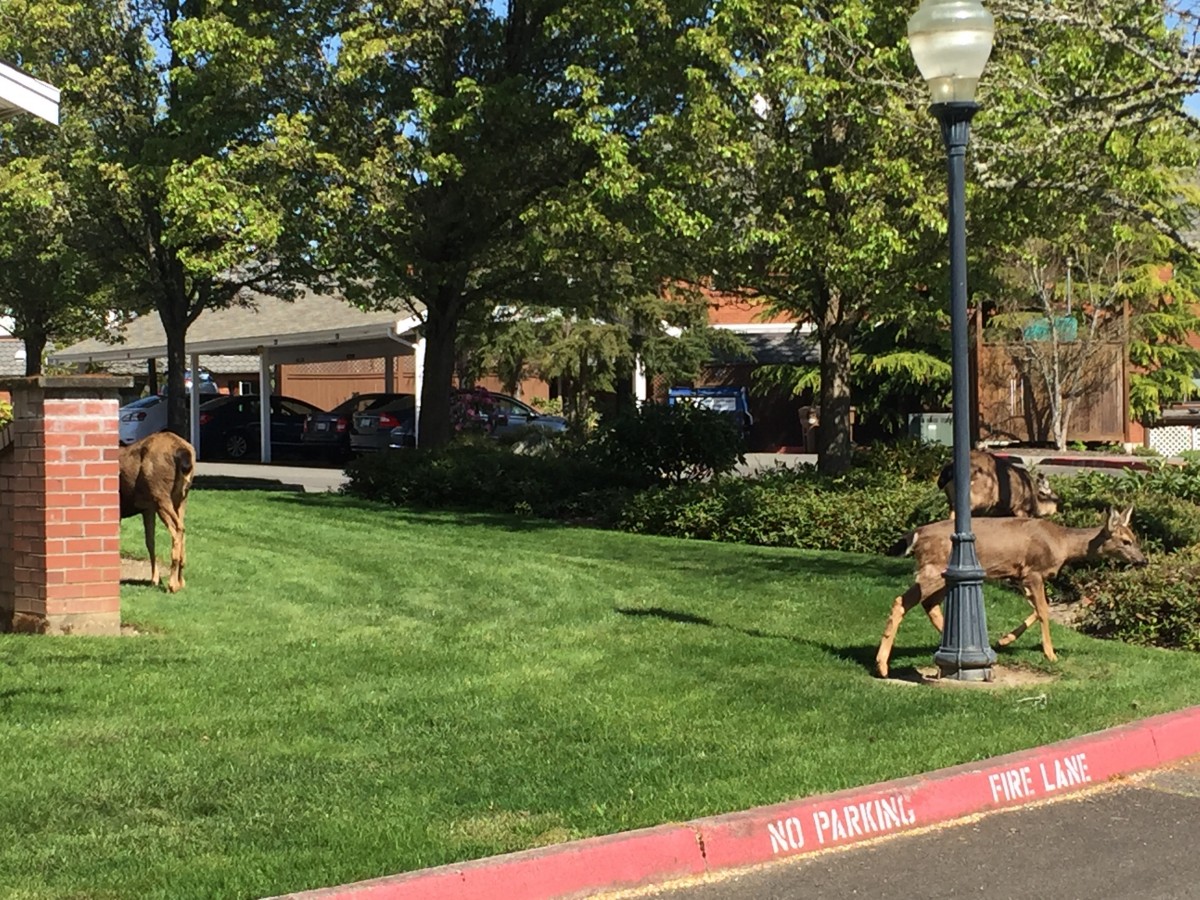
We live adjacent to a park that is the home of lots of deer. The deer frequently come to visit us because they like to dine on our succulent bushes and flowers. Here are the three that came to graze on my lawn recently:

deer on lawn

I’m not a gardener, so I don’t get too worked up when I see them. After all, the deer are not invading our land: We have invaded theirs.

However, I do understand why people who are serious gardeners get so worked up over the deer. This bush, right across the street from where the deer were grazing on my lawn, shows why: The bush should be covered with white flowers all over, but the deer have eaten all around the bush, leaving flowers only in the middle, where they can’t reach:

bush eaten by deer

Crab season

Dungeness crab season has arrived at a local fish market:

advertisement for Dungeness crab

I love life in the Pacific Northwest!

Happy week to all.

© 2016 by Mary Daniels Brown

‘Customers First’ to Become the Law in Retirement Investing – The New York Times

The Labor Department, after years of battling Wall Street and the insurance industry, will require financial advisers and brokers to act in their clients’ best interests.

Source: ‘Customers First’ to Become the Law in Retirement Investing – The New York Times

This looks like a topic that warrants further investigation.

Three Things Thursday

Thanks to Nerd in the Brain for the weekly challenge Three Things Thursday:

three things that make me smile: an exercise in gratitude – feel free to steal this idea with wild abandon and fill your blog with the happy

three-things-thursday-participant

It’s Been A Great Week for Sports Fans

(1) Men’s College Basketball: What a Championship Game!

On Monday night the Villanova and North Carolina men faced off for the championship trophy. It was a close game throughout, with the lead changing back and forth several times. As the final minute wound down, NC was behind when it managed to tie the score with an awkward yet acrobatic three-point basket. The shooter had jumped in the air, which meant that he had to shoot; if he landed holding the ball, he would have turned the ball over to Villanova because of traveling. But in midair he torqued his body and threw a shot that miraculously went through the net.

That shot tied the game with 4.7 seconds left. Just about everybody in the world, including me, thought the game was about to go into overtime. Villanova inbounded the ball, the dribbler passed the ball off to Kris Jenkins, and Jenkins launched a shot from way behind the three-point arc. The ball left Jenkins’s hands well before the final buzzer sounded. It swished through the net, gaining Villanova a three-point victory and its second national championship.

Feature photo credit: NCAA.com

(2) Women’s College Basketball Final Four Tournament

My husband and I grew up in Connecticut. Even though we didn’t attend the University of Connecticut, we’ve followed the UConn (pronounced Yukon) women’s basketball program, which has developed into a near-dynasty over the last 20 or so years. On Tuesday night the UConn Huskies women won their fourth consecutive national championship in a game that was not as competitively close as the men’s game.

Another high note of the women’s championship tournament this year is that the University of Washington Huskies women made it to the Women’s Final Four for the first time in program history. They were one of the lowest seeds (#7 in their region) to make it to the tournaments’s final weekend.

Washington Women's Basketball
Photo credit: gohuskies.com

As recent transplants to Washington, we were thrilled to see the women’s basketball team’s extraordinary tournament run. Maybe some day soon we’ll see a championship game featuring the East Coast Huskies vs. the West Coast Huskies.

Go Huskies!

(3) Can the Seattle Mariners Contend This Year?

The Mariners opened their season on the road against the Texas Rangers. Their loss of the opening game left me dispirited: same old same old. But they managed the win the second and third games in decisive fashion, with big innings toward the end of the game. Last year the pattern was that even if the Mariners managed to build a lead by the middle of the game, they would often lose it over the final innings and not be able to recover.

But the hitters have shown up, at least so far. After an off day today, the Mariners open at home tomorrow night against the Oakland A’s. Maybe this year will be better than last year.

© 2016 by Mary Daniels Brown

Three Things Thursday

Thanks to Nerd in the Brain for the weekly challenge Three Things Thursday:

three things that make me smile: an exercise in gratitude – feel free to steal this idea with wild abandon and fill your blog with the happy

three-things-thursday-participant

Last Saturday was the first non-rainy weekend day we’ve had in a long time. The absence of rain and a temperature in the high 50s brought lots of people, including us, to the beach area of nearby Point Defiance Park. As we walked along the beach, we watched a dog swim out to fetch a ball thrown into the water and four children work a see-saw made of a flat log placed perpendicularly over a round log at the water’s edge.

Here are three things from our walk. Although there was no rain, the day was overcast, so these pictures are somewhat subdued. (Click on any photo to see a larger version.)

(1) Long Live Harry Bosch

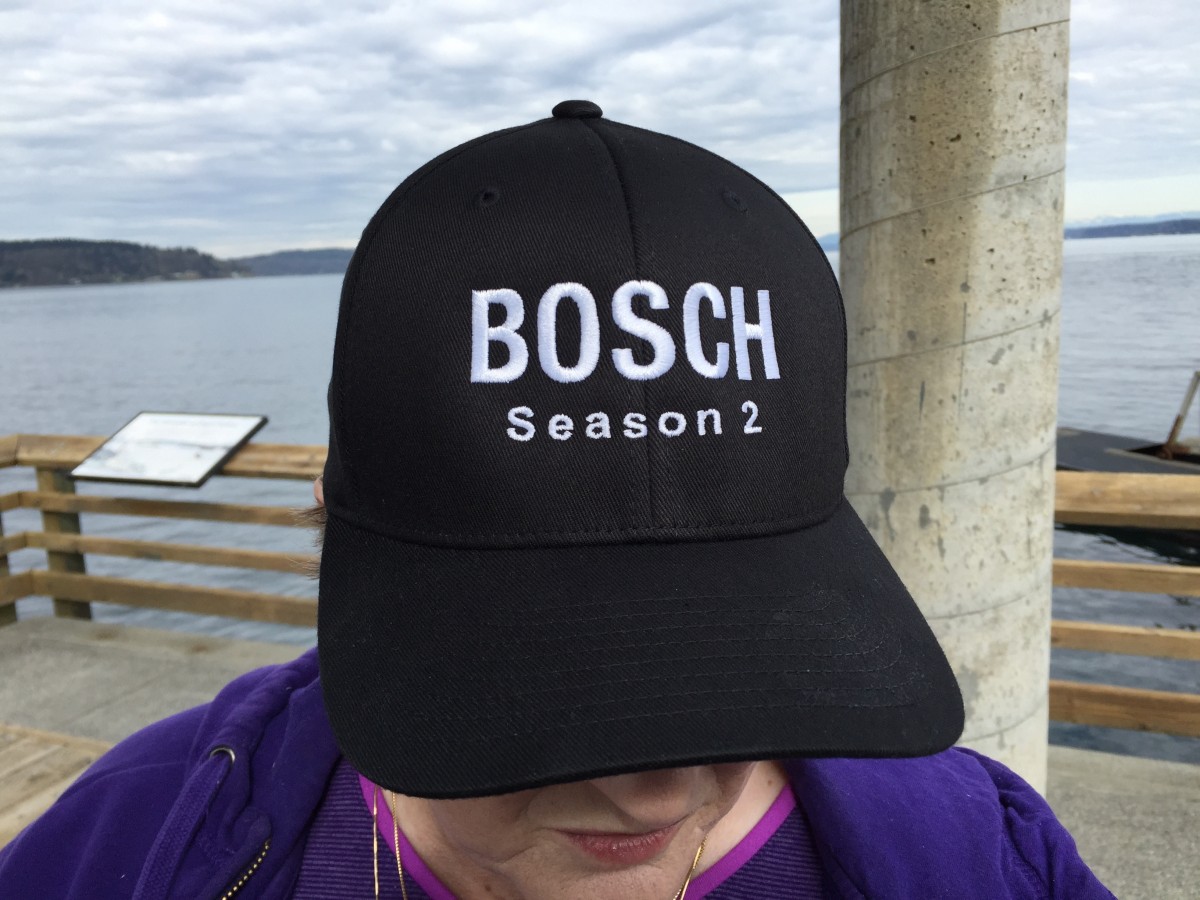
A couple of weeks ago Amazon Prime released the second season of its show Bosch based on the mystery novels of Michael Connelly. When I tweeted that we were spending the day watching all 10 episodes, I received a message from Connelly’s web master offering me a Bosch ball cap.

Bosch hat: front

Our walk on the beach was my first opportunity to wear my spiffy new cap. Fans of Michael Connelly’s Los Angeles Police detective Harry Bosch will smile at what’s on the back of the cap:

Bosch hat: back

(2) Horsetails

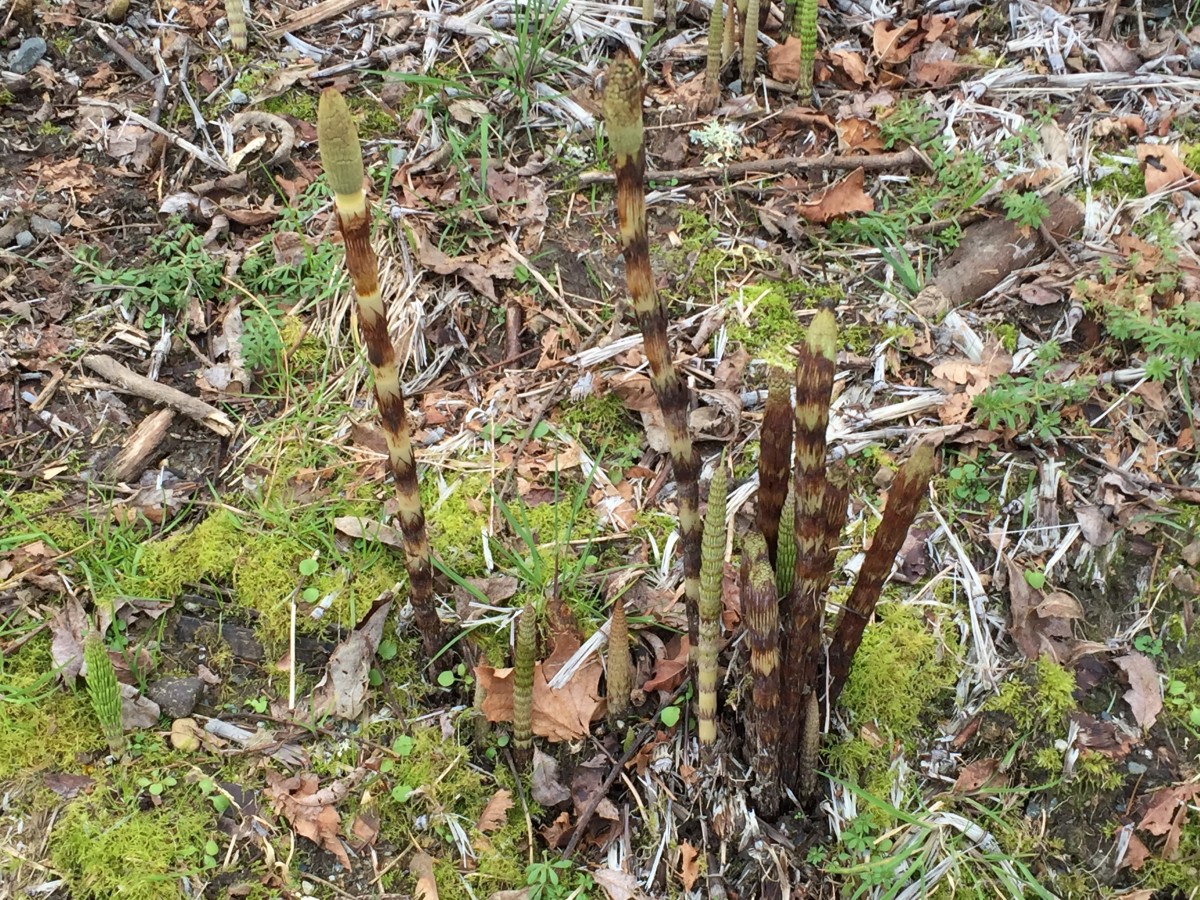
Vegetation is beginning to break through. These things that look like striped asparagus are the earliest growth of horsetails:

horsetail sprouts

Later the stalks will branch out and look more like what they’re named after. Here’s a photo of some plants that are further along and have already begun to stretch out:

horsetails beginning to leaf out

Horsetails love wet areas. Here are a few more interesting facts about horsetails from Plants of the Pacific Northwest Coast by Jim Pojar and Andy MacKinnon:

(a) Ancient Romans ate young common-horsetail shoots as if they were asparagus. They also used the shoots to make tea and as a thickening powder.

(b) Common horsetail is one of the most widespread plants in the world and often turns up as a bad garden weed.

(c) Common horsetail was the first vascular plant to send up green shoots through the debris of the 1980 eruption of Mount St. Helens.

(3) Fog Bells?

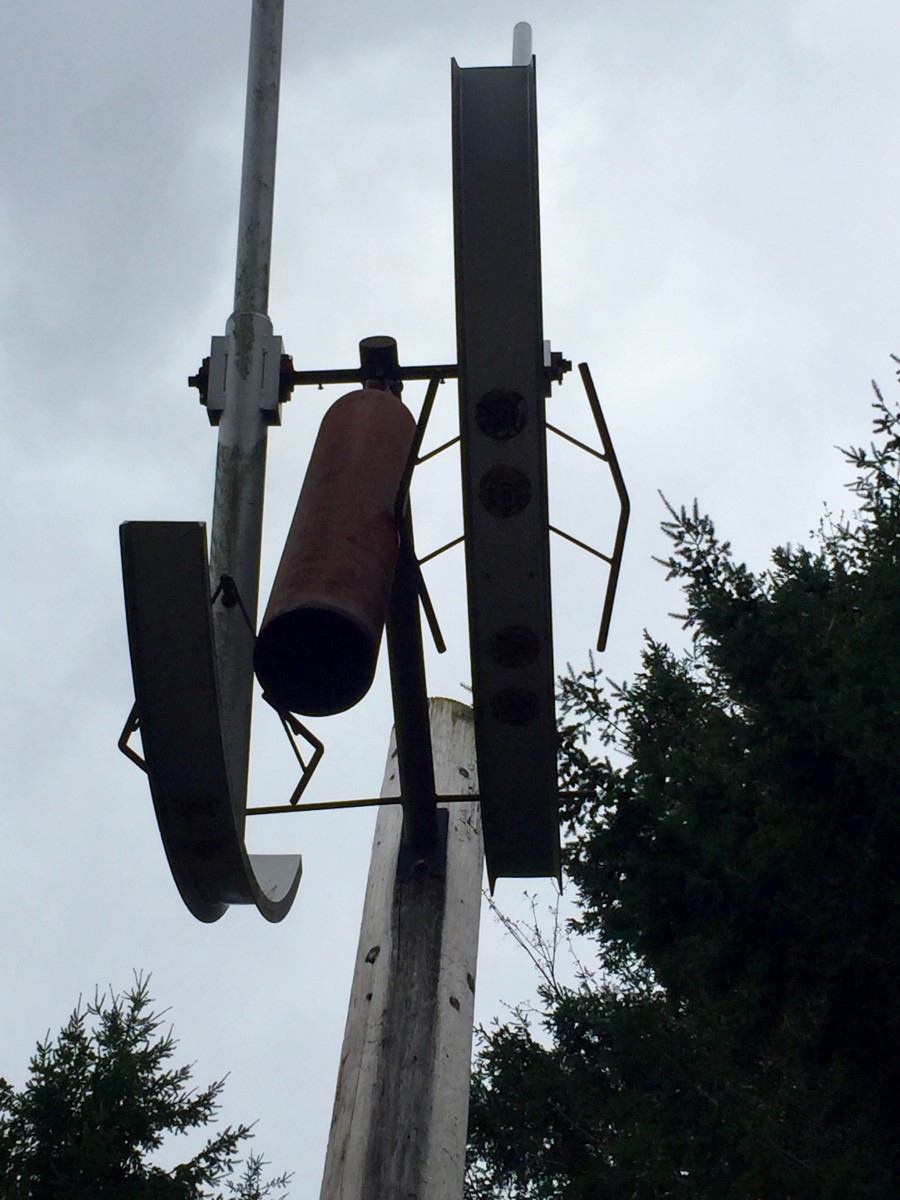
We’ve seen these things in Point Defiance Park before, right near the water’s edge, but aren’t sure exactly what they are:

fog bells?

All we can figure out is that they may be fog bells. Here’s a close-up of one:

possible fog bell: view from below

It looks as if the curved pieces swing back and forth, allowing the protruding rods to strike the clapper (the thing that looks like a long fire extinguisher).

A Google search turned up no information about these things. I did, however, discover that fog bells have been used since about 1850. If that’s what these things are, fog gongs might be a more appropriate term.

If anyone knows what these are and how they work, I’d love to hear from you in the comments.

In the meantime, have a good week.

© 2016 by Mary Daniels Brown

Notes on Aging

Tai Chi and Heart Disease

Tai chi is a favorite type of exercise offered to older adults because it requires only slow, gentle movement and deep breathing. Tai chi helps improve balance, an important benefit to help prevent falls and their related injuries. Some more recent evidence also suggests that tai chi may also promote cardiovascular health by slowing heart rate and lowering blood pressure.

Ask Your Doctor if This Ad Is Right for You

The health care industry spent $14 billion on advertising in 2014, according to Kantar Media, a jump of nearly 20 percent since 2011. That includes over-the-counter medications, but not sponsorships (the Super Bowl had two health care systems as partners). While magazine advertising has dropped off somewhat with the withering of the publishing industry, television advertising has risen 55 percent for hospitals and 30 percent for prescription drugs in that period.

This article, not specifically directed toward older adults, examines advertising trends that attempt to drive people with good health insurance toward expensive prescription drugs and treatment programs. Many of these advertisements occur on television during popular programs such as presidential debates and sports events like the Super Bowl. Many of the pricey drugs advertised are available in much cheaper generic brands.

But as the volume and spending on advertising increases, health economists and doctors are raising concerns about the trend, which they say increases prices and encourages patients to seek out more expensive and, often, inappropriate treatment.

Using the Arts to Promote Healthy Aging

across the country, the arts in their myriad forms are enhancing the lives and health of older people — and not just those with dementia— helping to keep many men and women out of nursing homes and living independently. With grants from organizations like the National Endowment for the Arts and the National Institute on Aging, incredibly dedicated individuals with backgrounds in the arts have established programs that utilize activities as diverse as music, dance, painting, quilting, singing, poetry writing and storytelling to add meaning, joy and a vibrant sense of well-being to the lives of older people.

Read about how programs that keep people creatively engaged in the arts are improving the quality of life for many older adults.

Why living in a 55-plus community may be better for your health

When my husband and I decided to move 2,000 miles away for retirement, we had to decide whether to buy a house or enter a retirement community in our new city. We decided on a retirement community because we didn’t want to have to bother with chores such as mowing the lawn and cleaning out the gutters. Only after we had been here for a while did we realize how much easier it is to meet people and to stay socially active in a retirement community than it would have been in a house.

This article well describes how living in a senior-oriented community can improve quality of life for older adults. There’s also information here on CCRCs, continuing-care retirement communities, which offer “a range of long-term options that, in addition to independent town homes or apartments, can include on-site assisted-living facilities, memory care units for residents who develop dementia, and nursing homes.”

Entering just about any senior community can involve many rules and regulations, so be sure to read over and understand everything before you sign a contract.

The $1,000 Shoes

Joyce Wadler confesses:

I just paid $1,000 for a pair of orthopedic shoes. I was forced to do this because as one gets older, one’s feet often get wider, and designers, concerned as they are with cultivating older shoppers, offer shoes that look like boats… . When I was in my 20s and saw older women in these ugly shoes, I wondered what made them buy them. Now I understand that it was the same thing that made them go out with unsuitable men: availability. You search and search and there’s nothing out there. After a while you say: “I can’t take it. Just let me find something I can make do with. I don’t care if it’s not perfect, just let it get me through the Kornberg destination funeral.”

I haven’t worn anything but flat shoes for probably 15 years now. My problem wasn’t my feet; it was my back. At some point you just have to decide which is more important, vanity or comfort.

And here’s another confession, perhaps related: I haven’t worn a dress or skirt in about the same length of time. Pants are just so much more comfortable, and they cover my worst feature, my large calves. Also, it’s much easier to find flat shoes to go with pants than flat shoes that go with skirts.

And thank heaven for retirement, which has rendered all these considerations moot. I never go anywhere that requires an outfit dressier than nice pants (though I prefer jeans), and I’ll even wear my open-toe sandals, which fit amazingly well, in winter if I can’t get away with comfortable athletic shoes.

I do admit, though, that sometimes even those comfortable athletic shoes cost way more than I think they should. But nowhere near $1,000.

Three Things Thursday

Thanks to Nerd in the Brain for the weekly challenge Three Things Thursday:

three things that make me smile: an exercise in gratitude – feel free to steal this idea with wild abandon and fill your blog with the happy

three-things-thursday-participant

(1) Porter Doughnuts

When in Ireland a couple of years ago, we had Guinness beef stew, a dish cooked with a generous helping of Guinness Beer. In fact, a splash—or even a big glug—of beer can improve the flavor of a lot of things.

Even doughnuts. For the month of March local bakery the Original House of Donuts is adding some Grit City Porter, made by local craft brewery Pacific Brewing & Malting Co., to its traditional cake doughnut.

porter doughnuts

Today was our day to indulge. We drove downtown to pick up a half dozen of these gems. The rich, malty taste that the beer gives the doughnut is offset nicely by the sweet, creamy icing. My husband and I devoured all of these quickly, as they went down nicely with some strong, extra bold coffee.

Next week we plan to go back and get some of the shamrock-shaped, green-iced, Irish-cream—filled St. Patrick’s Day doughnuts. They’re not made with beer, but I’m sure they’ll be just as delicious as the porter doughnuts.

(2) Downton Abbey Finale

NOTE: This bit contains some spoilers, so if the final episode of Downton Abbey remains unwatched on you DVR, you might want to skip down to item #3.

Call me sentimental, but this is one series that I truly wanted to see end happily. And happily, it did. Everybody got the best possible ending. Edith’s happy ending—marriage to her beloved Bertie—provided the occasion to bring together a lot of the characters. Even Rose, whom we hadn’t seen for a while, arrived for the wedding with photographs of her own three-month-old baby. Mary had her own happy news, and for once she was woman enough not to try to overshadow Edith on her big day. Even Isobel and Lord Merton managed to work things out, to the delight of everyone, even Violet (Grannie, the Dowager Countess).

And I’m not the only one to have a sentimental reaction. One of the reviews I read said that, on the first rehearsal of the scene in which Edith comes downstairs in her wedding dress and her father says, “You look so lovely,” both actors burst into tears. I don’t blame them. This has been a great series, and I’m glad the writers brought it to a proper closure.

(3) Even More Spring

I’ve posted some earlier photos of the first signs of spring. But time marches on, and now lots of trees and shrubs are blooming. Our neighbor has some beautiful purple azaleas in front of her house, which we can see from our kitchen window:

purple flowers

Since we get so much rain and so many dreary days here in the Pacific Northwest, it’s only fair that we get all these beautiful blooms to enjoy as compensation.

I hope you all have a good week.

© 2016 by Mary Daniels Brown

Three Things Thursday: Welcome, Spring!

Three Things Thursday, the purpose of which is to “share three things from the previous week that made you smile or laugh or appreciate the awesome of your life.”

three-things-thursday-participant

I’m not a gardener myself, so I’m not as knowledgeable about flowers and plants as many other folks. But I don’t have to be a gardener to appreciate the flowers that mark the arrival of spring, those reminders that our dreary winter will give way to warm weather and bright patches of color.

Here are three such signs of spring we’ve observed around town. (Click on any photo to see a larger version.)

The rhododendrons, Washington’s state flower, aren’t quite in bloom yet, but this daffodil nearby means that it won’t be long:

daffodil

I’m pretty sure this flowering shrub is an azalea. If it isn’t and you know what it is, please let me know in the comments:

azalea

Purple is my favorite color, and purple iris is one of my favorite flowers. Aren’t these beautiful?

purple iris

Have a good week!

© 2016 by Mary Daniels Brown

Notes on Aging

Centenarians Proliferate, and Live Longer

It’s nice to see some good news for us old folks. Thanks to medical advances such as vaccines and antibiotics, improvements in hygiene, and new technology and medical treatments, the number of Americans age 100 and older is up by 44% since 2000. And not only are there more centenarians, but they are living longer.

The news is especially good for women:

Women, who typically live longer than men, accounted for the overwhelming majority of centenarians in 2014: more than 80 percent.

It’s likely that the numbers will continue to increase as more and more Baby Boomers enter retirement. “Experts are warning that the United States is unprepared to handle such large numbers of seniors, especially as the life expectancy of older people continues to rise.”

Ranks of U.S. centenarians growing rapidly: report

Reuters also reports on the same data as in New York Times article above, released by the Centers for Disease Control and Prevention.

Genetic research indicates that about 17 percent of the U.S. population has traits that increase their chances of living past 100, said Dr. Thomas Perls, a geriatrician and director of the New England Centenarian Study at Boston Medical Center.

Perls added that in the early 1900s people lost about one quarter of their children to infectious diseases and other public health problems. Medical advances have greatly increased the number of people who now survive the critical years of childhood.

The top causes of death among centenarians in 2014 were heart disease, Alzheimer’s disease, stroke, cancer, influenza and pneumonia, the CDC study found.

Ask the aged

Gerontologist Karl Pillemer offers some informative observations about what happened when he stopped conducting research and performing statistical analyses on aging and went out and actually talked with some older people.

One question he asked was whether one needs a purpose in life and, if so, how to discover it. His respondents told him “you are likely to have a number of purposes, which will shift as you progress through life”:

The elders recommend that we re-shape the quest for a purpose, thinking instead of looking for a general direction and pursuing it energetically and courageously. Determining a direction in life is easier, more spontaneous, more flexible, and less laden with overtones of a mystical revelation that sets you on an immutable life path. Times change, circumstances change – indeed, change itself is the norm rather than the exception. A grand purpose, in their view, is not only unnecessary – it can also get in the way of a fulfilling career. Instead, they have offered the idea of finding an orientation, a ‘working model’ if you will, that guides you through each phase of life.

And the way to find such an orientation, Pillemer says, is to interview your future self. That’s literally impossible, of course, but the next best thing is to talk with an older person who is living the life you’d like to see your future self living, someone who is

preferably really old. You don’t want a 40-year-old if you are 20; you want someone in his or her 80s, 90s, or a centenarian if you can find one. You need your future self to have the truly long view, as well as the detachment that comes from a very long life.

If you’re already in that preferred age group, why not consider making yourself available to be interviewed by people just starting out in life through a mentoring or community service program?

As Population Ages, Where Are the Geriatricians?

Who is going to take care of all of us as we continue to live longer?

Geriatrics is one of the few medical specialties in the United States that is contracting even as the need increases, ranking at the bottom of the list of specialties that internal medicine residents choose to pursue.

Geriatricians are physicians already certified in internal or family medicine who have had additional training in caring for older adults. They are equipped to handle not only medical care, but also the psychological and social problems of aging.

According to the article, a big part of the reason that so few physicians choose geriatrics is Medicare, the insurance program that covers U.S. Citizens age 65 and older:

Since the health care of older patients is covered mostly by Medicare, the federal insurance program’s low reimbursement rates make sustaining a geriatric practice difficult, many in the field say.

Medicare also does not reimburse physicians for much of the long consultation time that may be necessary for advising patients and their family members and/or caregivers.