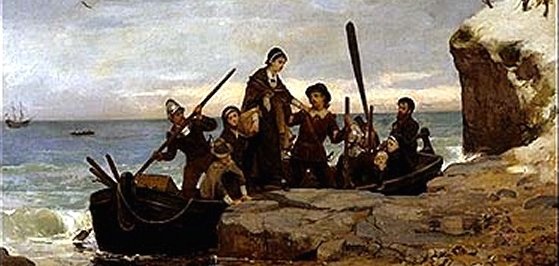
 On Dec. 21, 1620, the Pilgrims arrived at Plymouth, Mass., following a 63-day voyage from England aboard the Mayflower.
Source: On This Day, Dec. 21: Pilgrims arrive at Plymouth, Mass. – UPI.com

On Dec. 21, 1620, the Pilgrims arrived at Plymouth, Mass., following a 63-day voyage from England aboard the Mayflower.
Source: On This Day, Dec. 21: Pilgrims arrive at Plymouth, Mass. – UPI.com
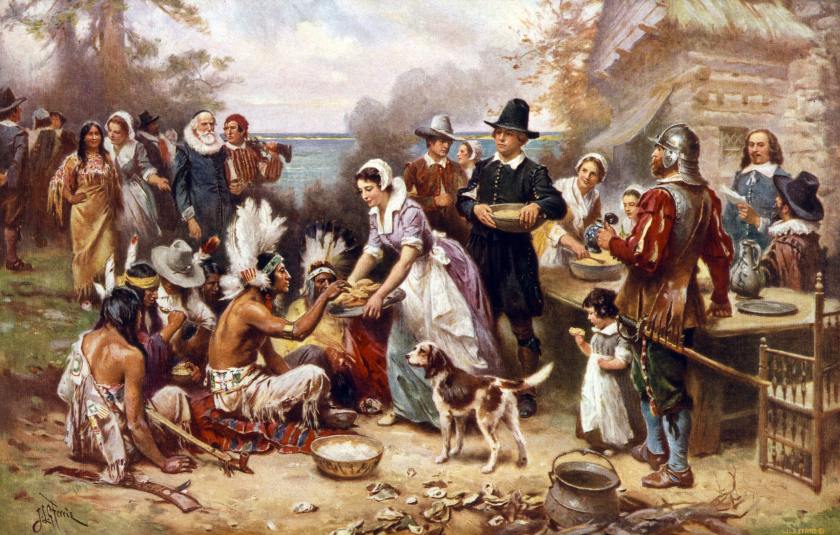 In my research and experience as a teacher educator, I have found social studies curricular materials (textbooks and state standards) routinely place indigenous peoples in a troubling narrative that promotes “Manifest Destiny” – the belief that the creation of the United States and the dominance of white American culture were destined and that the costs to others, especially to indigenous peoples, were justified.
Source: Where are the voices of indigenous peoples in the Thanksgiving story?
Click on this link to see the photo, even if you don’t read the article.
“After an operation that looked like a cross between a lunar landing and a low-budget sci-fi flick, entomologists on Saturday suctioned away the first “murder hornet” nest found in the United States.”
The first nest of the invasive Asian giant hornets was found and destroyed in northern Washington state. It’s an interesting article, with a lot of photos.
Reading comprehension, defined as the “ability to process and retain information from texts,” is something we usually think of as happening to children in their early years of school. But here Christine Ro reports on some recent research into enhancing reading comprehension for adults and offers some suggestions for doing so.
Unsurprisingly, some of her suggestions involve slowing down while reading and actively engaging with the text, for example, by annotating, all examples of slow reading.
Amidst all the discussion of pandemic fatigue, many families are wondering if they’ll be able to celebrate together this fall and winter. This article indicates that Barbara Alexander, a physician and the president-elect of the Infectious Diseases Society of America, will not attend the annual Christmas gathering of about 35 people at her parents’ farm this year.
“the CDC [Centers for Disease Control and Prevention] is acknowledging that even brief contact can lead to transmission. Specifically, the new guidance suggests that those spending a total of 15 minutes of contact with an infectious person over the course of a 24-hour period should be considered in close contact.”
Here’s some more information if you’re still making up your mind about attending family events this holiday season.
In normal times, Dr. Vin Gupta would be spending more time with his family and less time on national TV.
But since the world is battling a pandemic — and a flood of conflicting information — pick any weekday and you’ll likely see Gupta, a critical care pulmonologist and an affiliate assistant professor at the University of Washington’s Institute for Health Metrics and Evaluation, on at least one news show on either NBC or MSNBC as a medical contributor.
Many of the first cases of COVID-19 in the U.S. appeared in Washington state. Here’s a profile of a physician from the University of Washington who has emerged as one of the experts seen most often on news coverage of the virus.
One of the worst things about growing old is the social isolation caused by the loss of friends and family members. This year the viral pandemic, with its enforced isolation to suppress the contagion, has been especially hard on older people, particularly those in nursing homes, where strict regulations prohibiting visiting have been necessary to control the spread of the disease.
The article explores how some facilities are addressing the seemingly contradictory requirements for both physical distancing and personal human contact.
I always watch the World Series, even when, like this year, none of my favorite teams is one of the last two left standing. But I turned the TV off after the announcement of the Series MVP (Corey Seager of the L.A. Dodgers) and didn’t learn until the next day that Dodgers’ player Justin Turner, who had been pulled late in the final game because of a positive COVID-19 test result, had come out onto the field to celebrate the victory with his teammates.
While I can certainly understand his desire to celebrate, I was incensed and disappointed by his action. In many of the photos he’s not even wearing a mask.
Should Turner have been allowed to leave the room where he was isolated and mingle with his teammates on the field?
© 2020 by Mary Daniels Brown
As we prepare to turn the clocks back an hour on Sunday morning, experts in winter depression say the loss of daylight — just as coronavirus infections start to spike again and election tension comes to a head — could make this an unusually difficult stretch.

In 44 states and the District of Columbia, voters can keep an eye on where their ballot is through systems that track when a ballot is requested by, sent to and returned by the voter.
Source: How to track your mail-in ballot
One of the most painful experiences, for me, of the COVID-19 pandemic, has been watching the formerly revered CDC (Centers for Disease Control and Prevention) cut its own throat. I fear it won’t recover in the remainder of my lifetime.
I still remember where I was when I heard that Janis Joplin was dead. But I don’t remember hearing about this:
When Janis Joplin died of a heroin overdose on October 4, 1970, she left behind a will that included an offbeat, albeit totally in-character, stipulation: $2500 of her estate should be dedicated to funding a hard-partying wake in her memory.
Today something like this would be big news, all over the internet, but times were simpler back in 1970. So we’ll have to content ourselves with reading about it here.
I always enjoy reading about accomplishments of older adults. In this interview Louis Glück says, “Aging is more complicated. It isn’t simply the fact that you’re drawn closer to your death, it’s that faculties that you counted on — physical grace and strength and mental agility — these things are being compromised or threatened. It’s been very interesting to think about and write about.”
All of my life I had a troubled relationship with my mother. When I took my aging mother on a long trip to visit, for probably the last time, her aging sister who had dementia, my aunt talked about some long-ago family events that involved me as a child. I learned just enough to wonder if my mother, if she developed dementia, would fill in some of the blanks—secrets never talked about—of our lives.
My mother did develop dementia, but hers was marked my aphasia, the inability to put words together to express complete thoughts. If you asked her if she was cold or hungry, she could answer either yes or not, but she couldn’t say more than two or three words. As her physical condition worsened, we went to visit her in the memory-care facility where she spent her final months. When she saw me, her eyes lit up, she smiled, and said, “I want to tell you . . .”
Those five words were all she could manage. I’ll never know exactly what she wanted to tell me. I know what I want her to have wanted to tell me, but I’ll never know what was on her mind. That’s why this article caught my eye. Ina Kjøgx Pedersen of Copenhagen, Denmark, was able to talk with her mother as her dementia deepened. She was fortunate: “At last I got to know my mother as something other than just my mum, and saw the contours of the strong-willed, vibrant and incisive person she might have let out if she hadn’t experienced so much personal tragedy so early in life.”
Perhaps if my mother had been able to talk through her dementia, I would have learned a similar story
Deaths from dementia during the summer of 2020 are nearly 20% higher than the number of dementia-related deaths during that time in previous years, and experts don’t yet know why. An estimated 61,000 people have died from dementia, which is 11,000 more than usual within that period.
Geriatrician Laurie Archbald-Pannone, Associate Professor Medicine, Geriatrics, at the University of Virginia, examines some of the possible reasons for this increase and offers some tips for caregivers.
When I was a kid, my favorite treat was a Hostess Twinkie. If you remember this cloyingly sweet treat, you might be interested in this story.
© 2020 by Mary Daniels Brown
How exactly do we remember John Lennon? In recent years, the legacy of this revered icon has gotten more complicated, and more problematic. This season will be presenting us with multiple opportunities to assess his current reputation: October 9 would have been his 80th birthday, with a tragic twin anniversary just a few months away, as this December 8 will mark forty years since Lennon’s murder. Alan Light unpacks Lennon’s legacy, which has only become as complex as it is staggering.

 Please read this piece by award-winning novelist Jesmyn Ward.
Source: Jesmyn Ward on Her Husband’s Death and Grief During COVID-19 | Vanity Fair
As people live longer, adults frequently face “elder-care responsibility.”
“An important facet of these relationships, which often appears in fiction and nonfiction works, is the shifting power dynamic between older adults and their adult children, particularly in the United States and other predominately white Western countries,” writes Ellyn A. Lem. In this article Lem looks at how these relationships play out in literature by Shakespeare, A Thousand Acres by Jane Smiley, Let Me Be Frank with You by Richard Ford, Days of Awe by Lauren Fox, several works of nonfiction, and several films.
Not only are we dealing with our usual sources of uncertainty, but then there’s the whole global pandemic, where we’re trying to stop the spread of a virus we have never seen in humans before. We’re not just in uncharted waters—we’re scrambling to stay afloat. As it turns out, there are ways to more effectively deal with feelings of uncertainty, and embrace what’s next with some level of confidence (even if it’s very low).
Dr. Elizabeth Yuko, a bioethicist and adjunct professor of ethics at Fordham University, offers “two strategies for handling uncertainty in a healthier way.”
“Germany has found ways to display problematic monuments without elevating them.” Daniela Blei reports on the job of the Citadel Museum in the Berlin suburb of Spandau, which “aims to contextualize the past, putting uncomfortable realities on display in productive, educational, and sometimes challenging ways.”
I am definitely a night owl. When I was in college, I discovered that I worked better if I stayed up studying until about 2:00 AM, then slept until about 10:00. Because I went to a huge university with lots of class offerings, I was able to take almost all my classes between 1:00 and 6:00 PM. Unfortunately, after graduating from college, I realized that the rest of the world doesn’t work that way. Very few workplaces accommodate a night owl’s preferred schedule, and once I had a child who had to be gotten up and out for school, any possibility of catering to my own schedule went out the front door.
Because of my own experience, I’ve been interested in relatively recent research into the differences between early birds and night owls. This article reports on various chronotypes, the “master clocks” in our brains that determine how our bodies respond to the time of day. Recent research out of Finland found that “among both men and women, the morning types and many of the day types moved significantly more than the evening types, even when the researchers controlled for people’s health, professions, socioeconomic status and other factors.”
The conclusion: “Overall, the study’s findings suggest that late risers may want to monitor how frequently they move.”
Sam Dresser suggests “several philosophically inspired reasons not to be fearful of your own death.”
In addition to the philosophical insights offered her, the article includes some links and references to use if you want to dig more deeply into this topic.
The former English teacher and copy editor in me could not resist this article. Overall, not just in particular news sources, I’ve been appalled by all the examples I constantly find in publications (both print and digital) that make me groan, “If only you’d had a copy editor take a look at this . . . .”
© 2020 by Mary Daniels Brown
 Four years after San Francisco 49ers quarterback Colin Kaepernick took a knee to protest racial injustice, more athletes — including Sue Bird, Megan Rapinoe and Russell Wilson — are speaking out themselves.

 Retreading for Retirement