Letter to the Woman I See Walking Every Day

Dear Walking Woman,

I see you walking almost every day. You walk all over campus here in our retirement community. Sometimes I see you in the morning. Other times I see you in the afternoon. I have a feeling that you probably walk your circuit more than once each day. Or perhaps you walk different circuits at different times of day.

Soon after I moved in here two years ago I was walking to the front desk in the main building when our paths crossed as you walked toward me. As we approached each other our eyes locked for a second. Then you looked down. I said “hello” as we passed. You mumbled “hello” and kept walking with eyes cast down, letting me know you didn’t want to stop to converse. A few days later we again ended up on the same path, approaching each other. This time, when our eyes locked for a second, you looked off to your left. I got the hint. As we passed each other, neither one of us spoke.

Since that second time, I have avoided you when I’m outside. If I see you in the distance, I alter my path so we won’t pass each other. I’m an introvert myself, and I cherish my solitude, too. I get that you don’t want to stop and chat.

You walk all year. In the winter you wear a heavy coat, a knit hat that covers your ears, and gloves. I think you must live in one of our three options for independent living here, since your ability to walk so much means you don’t need assisted living care. Yet I have never seen you in any context other than walking. You don’t attend the monthly resident council meetings, nor do you take part in excursions such as the monthly Lunch Bunch trips to local restaurants or the quarterly dinners for independent-living residents.

I’ve even thought that perhaps you live somewhere nearby but come here to walk around our large and lovely campus. But recently I met a new resident here, M., who asked me if I knew the woman who walked all around. I said that I had seen you but that I don’t know you. M. told me, “She says she keeps walking because she’s afraid that if she stops, she might never start again.”

So you can talk, and you did carry on at least a minimal conversation with M. Now I have to wonder if there’s a particular reason why you talked with her but not with me. M. is an overtly friendly person. Perhaps she didn’t notice your body language and stopped to talk with you anyway. Or perhaps you reacted differently to her than you did to me. Did I give off some kind of aura that made you turn away to avoid me? If so, it was unintentional.

I’m glad you enjoy walking here. May you long continue to walk on in silence and serenity.

Sincerely yours,
Mary Brown

Three Things Thursday

It’s yet another good week for Three Things Thursday, the purpose of which is to “share three things from the previous week that made you smile or laugh or appreciate the awesome of your life.”

Olympic Music Festival

Last Saturday a group of us from Franke Tobey Jones drove an hour and a half out onto Washington State’s Olympic Peninsula for a performance at the Olympic Music Festival. The venue of the festival is snuggled into the grandeur of a forested, sparsely populated area.

Alan Iglitzin, a member of the Philadelphia String Quartet, founded the Olympic Music Festival in 1984. He originally intended the festival to be a summer retreat for the Philadelphia String Quartet, which had been the quartet-in-residence at the University of Washington in Seattle from 1966 to 1982. But the summer festival drew such large audiences that the festival quickly expanded from the three weekends of its opening season to the current twelve.

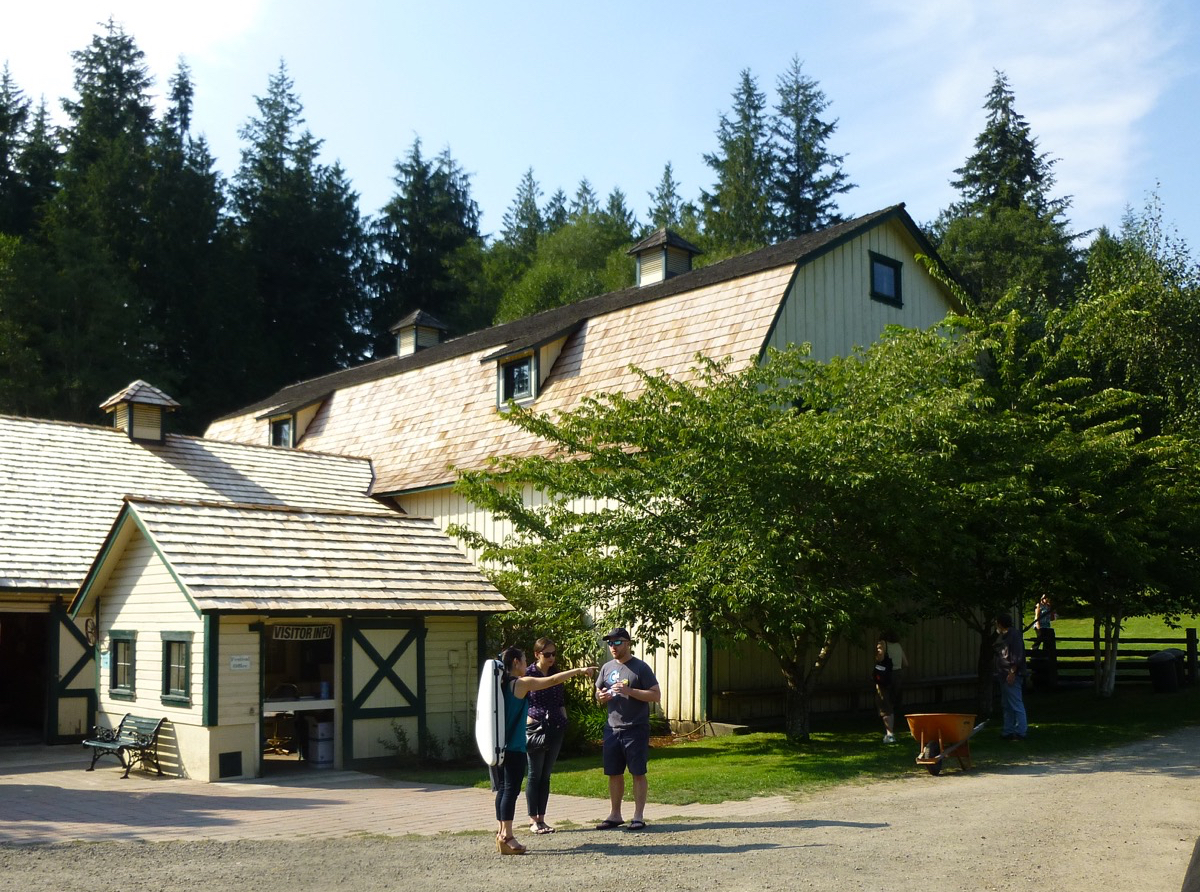
The Olympic Music Festival takes place in the refurbished barn of an old farm that Iglitzin purchased near Quilcene, WA. An extensive picnic area surrounds the barn, and many patrons arrive early and enjoy a picnic before the performance. Two listening options are available: seating on benches and bales of hay inside the barn, and outdoor listening (on your own chairs or blanket) on the grassy hillside adjacent to the barn. The outdoor seating allows families to bring children who may not be quite ready to sit still quietly indoors for an extended period. The atmosphere reminds me of Tanglewood in Lenox, MA, the summer home of the Boston Symphony Orchestra.

True Confession:

Last Saturday was a windy, overcast day with occasional sprinkles of much-needed rain. We did manage to eat our picnic lunches outdoors before the performance, but it was not a good day for photography. Therefore, the photos below are from our 2014 visit to the Olympic Music Festival.

1. The Barn

Barn at Olympic Music Festival

When Alan Iglitzin bought the farm near Quilcene, it had fallen into disrepair. He knew nothing about the farm’s history. But over the years he learned that the farm’s original owners were a Japanese American family who had built the farmhouse and barn to accommodate themselves and a herd of dairy cows. They also grew berries and other seasonal produce and for many years provided dairy items and produce to local residents.

When the U.S. entered World War II, the family was sent to an interment camp. After the war they were unable to regain the property, which passed through multiple owners but never again became a thriving, working farm.

In the 1990s Isamu “Sam” Iseri, the son of the family that had built the barn called Iglitzin and asked if he could visit his boyhood home. He and Iglitzin became friends. Sam died in 2004, but members of the Iseri family continue to visit their ancestral farm periodically.

2. Musician

For some, the festival provides the opportunity to speak to the young musicians.

Musician at Olympic Music Festival

3. Tractor

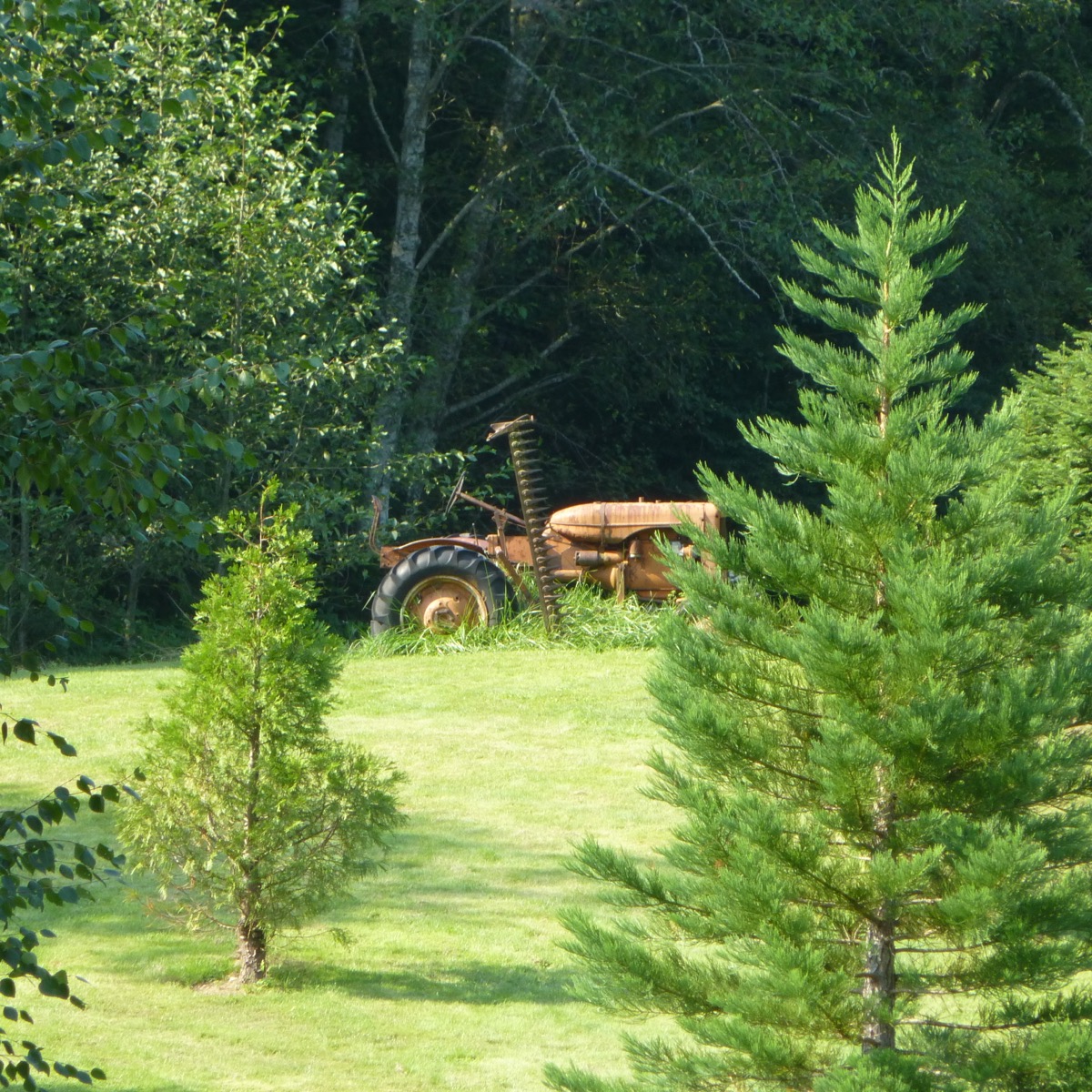
There are several reminders of the venue’s history as a working farm.

Tractor at Olympic Music Festival

Three Things Thursday

Here’s this week’s installment of Three Things Thursday, the purpose of which is to “share three things from the previous week that made you smile or laugh or appreciate the awesome of your life.”

three-things-thursday-participant

Seattle Mariners Game!

(Click on photos for a larger version.)

And awesome my life was yesterday, when a group of us from Franke Tobey Jones went up to Safeco Field for a day game between the Seattle Mariners and the Detroit Tigers. We sat in the Hit It Here Cafe, which is a covered area just above the right field wall.

1. Safeco Sign

Safeco Field is a beautiful stadium that officially opened on July 15, 1999. I especially like this sign along the third base side of the field:

Safeco Sign

2. Runners on 1st and 2nd

The Mariners had runners on 1st and 2nd in the opening inning but didn’t manage to score:

Runners on 1st and 2nd

3. Cleaning up the Infield

The grounds crew rushes out for a quick clean-up job on the base paths just before the start of the 7th inning:

7th inning: Cleaning up the infield

scroll divider

It was just about a perfect day for baseball. We were all glad that we had chosen the seats in the covered cafe, as people on the lower levels were in direct sun. The temperature was in the low 80s, but as always up here, it felt much cooler than that as long as you were in the shade.

We even had a bit of added excitement during the game: a fan ran onto the field. He was quickly tackled by security personnel and escorted off the field. He spent at least a few hours in jail and will pay a hefty fine. This guy wasn’t a streaker because he had pants on. I don’t know if you get fined extra for running naked onto the field.

The only thing that kept the day from being perfect was the Mariners’ 5–4 loss to the Tigers.

The Love-Hate Challenge

One of the bloggers I follow is Andrea at My Spoken Heart. Yesterday I read her post in response to The Love-Hate Challenge. I haven’t been formally challenged, but I liked the idea so much that I’ve decided to use it today.

The Love-Hate Challenge as us to write two lists of 10 items each: Things I Love and Things I Hate. I’m going to start with the hate list so that I can end on the positive note of listing things I love.

Things I Hate

1. Being around negative people

I recently wrote about ending a relationship with a narcissistic friend (scroll down to the question right before the bonus question). At that point I had decided that it was necessary for me to surround myself with only good people. My narcissistic friend didn’t make the cut.

A 2,100-mile retirement relocation gave me the opportunity to meet new people and make new friends. Most of the people in our retirement community are gems. There’s only one woman, whom I’ll call L., who is not. L. never stops talking, and she talks about only two subjects: other peoples’ shortcomings and her own superiority. I do my best, short of being downright rude, to avoid being near her. Most other people seem to have the same feeling, as no one ever voluntarily sits with L. at gatherings. L. is a constant reminder to me of how much better life is when I’m surrounded by pleasant, polite, caring people.

2. Brazen ignorance

All of us are subject to confirmation bias, the tendency to believe and remember information that confirms what we already believe or want to believe while at the same time denying and forgetting any information that contradicts our pre-conceived biases. A good many people, though, can look at something with an open mind when confronted with strong evidence and other points of view. It’s the people who stubbornly refuse to listen to any other points of view that I hate being around.

I also hate being around people who vociferously express opinions based on brazen ignorance. An example was a man, B., a fellow traveler on our recent European trip. After we had toured a Benedictine Abbey in Melk, Austria, that was built in the 16th century, B. sat across the aisle from me on the return bus ride. Here’s what he said to the person sitting next to him:

That was really something. Five-hundred years ago, when they were building this abbey, American Indians were still digging arrowheads out of the dirt. And in Africa they didn’t even have language yet. But look at what these Europeans were doing.

There’s nothing I can do but step away from such people.

3. Racist behavior

Someone might want to point out to me that this is the same as brazen ignorance. But this particular kind of brazen ignorance is so repulsive that it demands its own category.

4. Shoes that aren’t flat

Despite being short (5 feet, 2 inches), I have never wanted to wear shoes to make me look taller. Add to that the fact that I have a bad back, and you get my long-time refusal to wear shoes with any kind of a heel. If I can’t find a flat shoe appropriate for a particular occasion, I either don’t go or I go in inappropriate shoes.

5. Life without treats

cupcakesI’m talking about food here. I refuse to live in a world that does not allow for the occasional order of french fries, two-scoop dish of ice cream, or piece of cake with frosting. Or blackberry cobbler. Or blueberry pie. Or chocolate-covered cherries.

6. Hot, humid weather

For 40+ years we lived in St. Louis, MO, the nation’s capital of hot, humid summers. We turned the air conditioning on in April and didn’t turn it off until October. I was known in my neighborhood as the summer recluse because I almost never left my air-conditioned house to venture into the heat and humidity.

7. Bland white fish

When I was a kid, my mother would put pieces of cod in a baking dish, add about 1/2 inch of water, and bake the fish in the oven. She’d serve it just that way: not even a dash of paprika to give it some flair and flavor. To this day, the only kind of white fish I eat is swordfish, which I actually like a lot.

8. Getting up early

I hate it when people say something like “Get up early and get more accomplished during the day.” I am a night owl. Getting up earlier doesn’t make me more productive. It makes me more miserable.

9. Boring chores

These include vacuuming, dusting, cleaning up the kitchen, and folding laundry.

10. Forced socializing

When I was last in graduate school, we had to attend a five-day conference twice a year. We attended workshops together, ate meals together, and had more meetings and classes together after dinner. After a couple of days I felt frantic.

I’m an introvert. I need periodic time alone to process what’s going on around me and to recharge my batteries. I’m more comfortable with three or four people than with 150. I’m also a highly sensitive person (HSP). Too much stimulation—crowds, noise, movement—also makes me crazy.

The world is run by extraverts who think that we should all love getting together in large groups. And corporations favor group projects so much that schools now insist on teaching kids to work in groups. The world is not kind to those of us who require periodic solitude and quietness.

Things I Love

1. Spending time with family and friends

I’m sure this tops everyone’s list of things they love. But really, what would life be like if this weren’t true?

2. Reading

books03Reading has been my favorite activity ever since I can remember. I’m always fascinated when somebody says something like “I started reading at age 3.” I have no idea when I started reading. I just can’t remember a life when I couldn’t and didn’t read.

3. Book groups

The joke about book groups is that they’re often an excuse to get together, drink wine, and talk about life. But if you can find a good book group, one that actually talks intelligently about the book, there’s nothing better. I was fortunate to be in two such groups for several years, and I found most of my closest friends there.

When I moved from St. Louis, MO, to Tacoma, WA, one of the first things I did was to look for book groups. I was appalled to learn that the entire Tacoma Public Library system sponsors exactly one book group, which met at a time and place inconvenient for me. I tried a group run by one branch of the Pierce County Library system, but none of the people there were close readers who could talk about anything deeper than “I liked” or “I didn’t like” the book.

Finally, I found a classics group that meets at my local independent book store. The members of this group are informed and interested in the books. I’ve been attending this group for about 15 months now and have learned a lot.

4. Purple

Deep purple is my favorite color. I always wear something purple (although you might not always be able to see it). My nails are always purple.

Purple clothes go in and out of fashion, so, on years when purple is in, I buy whatever I find that I can wear. That allows me to weather the times when there isn’t a purple item anywhere in sight.

5. Being “of a certain age”

When I turned 50, I decided that I was old enough to speak my mind. So I’ve been speaking my mind for quite a few years now, and I feel a lot better, thank you very much.

outrageous older womanThis is my favorite shirt. Notice that it’s purple. I like it so much that I own two.

And there will be no facelift for me (although anything in a bottle, tube, or jar is fair game). I’m proud of these wrinkles. I endured a lot to get them. I’ve earned every one.

6. Having short hair

Really, life is too short to spend time fussing with my hair. It’s wash-and-go for me.

7. Writing

typingI’ve always loved writing, and I’ve always been pretty good at it. But I haven’t thought of myself as “a writer” until recently. I have challenged myself to write a blog post a day in 2015 to establish the habit of writing daily and to convince myself that I am a writer.

8. The Pacific Northwest

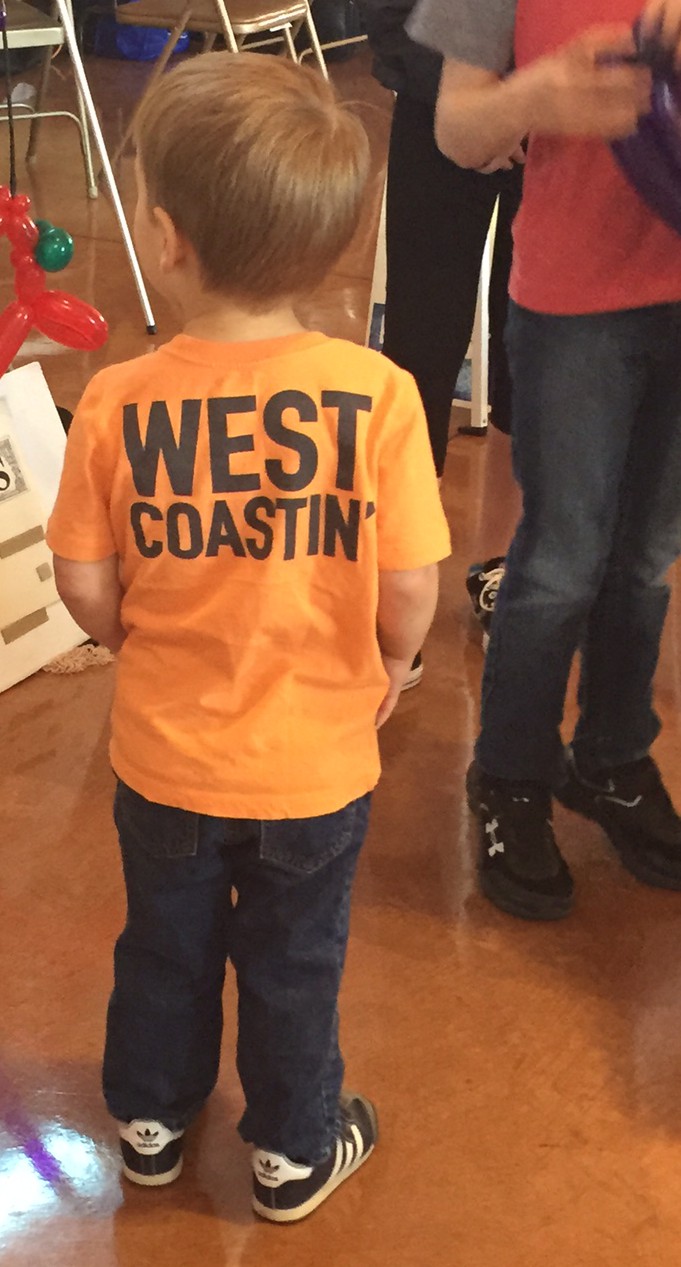
"West Coastin'" shirtMy husband and I lived in St. Louis for about 42 years. Our daughter was born there. When it came time for her to choose a college, she chose the University of Puget Sound in Tacoma, WA. She loved the area so much that she stayed.

Since she is our only child, it made sense for us to move here when we retired. We had been visiting Tacoma for about 15 years, so we knew we liked the area. As retirement approached, we became more and more eager to move out here.

Now we’re here, and we love it. We particularly like the more moderate climate. Also, we live near the city’s largest park and can walk to the zoo and aquarium.

9. Facebook

I know many people complain about Facebook, but I’m glad it exists. It allows me to keep in touch with friends we left back in St. Louis. It has also allowed me to reconnect with several of my cousins whom I had lost contact with over the years.

Perhaps I don’t get as annoyed as other people because I have a very small number of friends on Facebook. All these friends really are my friends or family, not some mere acquaintance I casually interacted with somewhere. I’m also careful about the kinds of information and photos I post.

10. Going to the farmers’ market

Most Saturdays during the summer we travel down to Puyallup, where our daughter lives, and go with her to the Puyallup Farmers’ Market. The Puyallup River provides a fertile growing area, so there is a lot of good local produce available there. This routine also allows us to see her at least once a week, which is, of course, the real reason we do it.

Lunch Bunch: C.I. Shenanigans

3017 Ruston Way, Tacoma, WA 98402
Phone: (253) 752 – 8811

The first Friday of every month our activities director at Franke Tobey Jones offers us the opportunity to go out for lunch. Today’s destination was C.I. Shenanigans, on beautiful Ruston Way. Shenanigans advertises that it features sustainable seafood, Harris Ranch beef “from cattle that spend approximately 80% of their lives grazing on grass,” and artisanal cocktails.

I can vouch for the cocktails. My Moscow Mule (vodka, ginger beer, and a splash of lime) was delicious. There were five people at our table. I had a cup of their lobster bisque, which turned out to be delicious. My husband ordered the crab-stuffed mushrooms and pronounced them quite good as well.

For our main courses, the gentleman who ordered mac and cheese said that it was too dry. Two women liked their salads, which were generously sized. My husband and I both had Columbia River King Salmon, “simply grilled,” which was cooked through but not dry. Our vegetables—green beans, wax (yellow) beans, and broccoli—were also good, not overcooked.

Our only complaint was that it took a LONG time to get the food. We had a group of 20, so it’s understandable that we might have put a strain on the staff. But our activities director always lets restaurants know well ahead of time how many people will be coming, so I’m disappointed if an establishment doesn’t prepare adequately for us. My husband and I have eaten at Shenanigans a couple of times on our own, and I don’t remember the service being particularly slow.

I see that Shenanigans gets three out of five stars on Yelp, 3.5 stars on Trip Advisor, and 4 stars on Open Table and Facebook.

Ruston Way hosts a huge crowd every Fourth of July. Early in the day the road is closed to traffic, and people pack the place. On our way to and from the restaurant we saw city workers setting up out rows and rows of blue portable toilets all along Ruston Way to accommodate tomorrow’s crowd. They were also setting out many huge plastic trash receptacles. We’ve never gone down on the Fourth because it’s just too crowded. And tomorrow’s high temperature will be about 88 degrees. So we’ll stay home tomorrow and let all those other people enjoy the day along Commencement Bay’s beautiful Ruston Way.

Three Things Thursday

It’s time once again for Three Things Thursday, the purpose of which is to “share three things from the previous week that made you smile or laugh or appreciate the awesome of your life.”

1. Farmers’ Market

We hadn’t been to the farmers’ market in three or four weeks because of our European trip. And, because spring arrived about a month early this year, when we went to the farmers’ market last weekend it was much different than the last time we were there.

I’m kicking myself for not thinking to snap any photos. You’ll have to use your imagination to picture all the festive colors of the produce:

  • vine-ripened tomatoes
  • snow peas
  • red and golden raspberries
  • green beans
  • carrots
  • green and yellow zucchini
  • Rainier and Bing cherries
  • blueberries
  • red and golden beets

And, of course, flowers galore. It was certainly a feast for the eyes.

2. Paprika

Before we left for our trip, our daughter surprised me by saying, “If you visit Hungary, you’ll have to try goulash.”

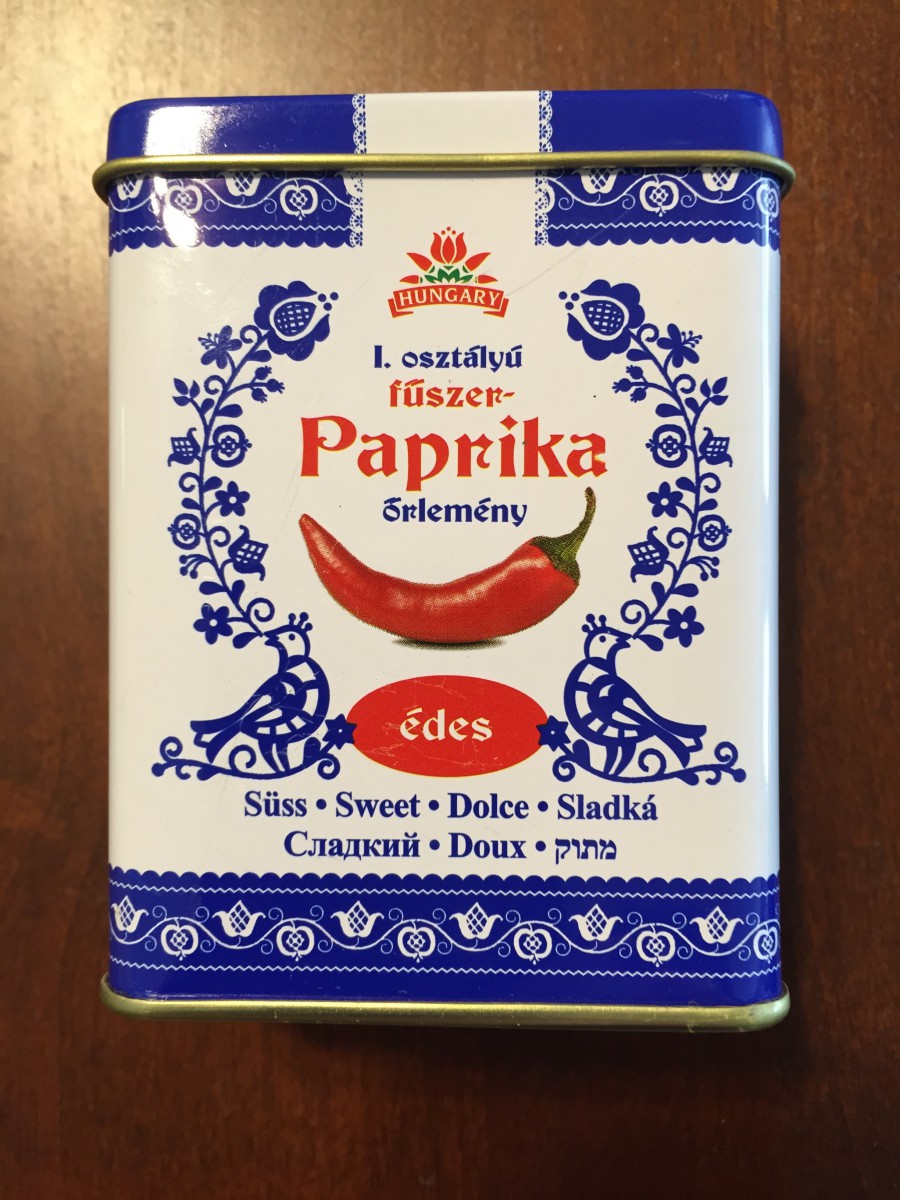
Now I’m sure I made goulash a few times while she was growing up, but I was still surprised that she took such an interest in it. We didn’t buy many souvenirs, but we did buy her a tin of paprika in Budapest:

Hungarian paprika, sweet

Paprika can range from mild to wickedly hot. We were careful to get her a container labeled sweet. Now we’ll just have to get her to make us a big batch of goulash.

3. Miska Jug

The only other souvenir we brought back is this wine pitcher from Budapest. The shop was full of variations of these, but we finally settled on this one.

Hungarian Miska Jug
Hungarian Miska Jug

It’s a Miska (which I think is pronounced mishka) Jug:

Description of Miska Jug

Click on any photo for a larger version.

Blog a Day Challenge: June Report

I anticipated that June would be a challenge for me because for the first two weeks of the month we were on vacation in Europe. I knew that both internet connectivity and time to write and post would be limited.

The reality turned out to be even worse than I had expected. Internet connectivity was very limited (see last month’s featured post, linked below). In addition, both my husband and I caught the cold that we shipmates so generously shared amongst ourselves. I spent a lot of my free time sleeping in an attempt to recover. These two factors combined meant that I didn’t publish any posts and wrote only outlines and bare-bones notes for each day’s entry.

I have therefore spent the last two weeks of June frantically trying to catch up on travel posts at the same time I was writing new daily posts. I just made it.

I knew that there would be nowhere near an equitable distribution of posts across my three blogs because all the travel posts belonged on my personal blog, Retreading for Retirement.

For all these reasons I’m not at all concerned with this month’s statistics, although I include them here for uniformity in reporting and for contributing to my end-of-year summary.

Here are my statistics for last month:

Number of posts written: 30

Shortest post: 110 words

Longest post: 800 words

Total words written: 13,840

Average post length: 461 words

Distribution of posts across my three blogs:

The total of posts here may not equal the number of posts written last month because I occasionally publish the same post on more than one blog. However, I have included each post only once in my total word count.

Last month’s featured post:

4 Out of 5 Stars to Viking River Cruises

Recent News on Aging

Anti-ageing pill pushed as bona fide drug

From the journal Nature comes this article that poses a paradigm-shifting question: Is aging a natural occurrence of life or a treatable condition?

Doctors and scientists want drug regulators and research funding agencies to consider medicines that delay ageing-related disease as legitimate drugs. Such treatments have a physiological basis, researchers say, and could extend a person’s healthy years by slowing down the processes that underlie common diseases of ageing — making them worthy of government approval. On 24 June, researchers will meet with regulators from the US Food and Drug Administration (FDA) to make the case for a clinical trial designed to show the validity of the approach.

The article focuses on a clinical trial called Targeting Aging with Metformin, or TAME:

Plans call for the trial to enrol 3,000 people aged 70–80 years at roughly 15 centres around the United States. The trial will take 5–7 years and cost US$50 million.

The key to the significance of such research is that it examines a change in the way clinicians would approach aging: instead of treating conditions such as heart disease, cancer, and cognitive impairment that arise with aging, they would treat aging itself. If this were possible, aging itself would become a treatable condition instead of a natural progression of life.

Two Views of Aging While Creative

In this article for Psychology Today, Susan K. Perry addresses the question “What happens when prolific writers get old?” She contrasts two books by writers who remained creative into old age:

  • At Eighty-Two, A Journal by poet, novelist, and memoirist May Sarton, who died in 1995
  • Essays After Eighty by poet and essayist Donald Hall, recently published

About Sarton’s journal Perry writes, “Most of all I noted and appreciated her honesty about the highs and ever-more-frequent lows of her mood.” Perry contrasts Sarton’s outlook with Hall’s: “According to his new book of essays, he’s still at it in his mid–80s… . He omits nothing (or little) of the humiliations and challenges of growing old.” She continues:

Above all, Hall’s essays demonstrated to me that not all aging men and women become depressed to the point of not being able to be creative.

The 10 warning signs of Alzheimer’s

Most researchers and clinicians agree that early diagnosis and treatment of Alzheimer’s disease can help slow the disease’s progress. And if you’re at or approaching your older years, you’ve probably seen quizzes and lists all over newspapers, magazines, and the internet on warning signs you should look for.

But while early diagnosis leads to early intervention, some news out of the 2013 Alzheimer’s Association International Conference is troubling: An expert panel found 16 online tests for Alzheimer’s disease scored poorly on scales of overall scientific validity, reliability and ethical factors.

While such self-diagnosis tools may be unreliable, other people may be more accurate in recognizing these warning signs put together by the Alzheimer’s Association:

  1. Memory changes that disrupt daily life
  2. Challenges in planning or solving problems
  3. Difficulty completing familiar tasks at home, at work, or at leisure
  4. Confusion with time or place
  5. Trouble understanding visual images and spatial relationships
  6. New problems with words in speaking or writing
  7. Misplacing things and losing the ability to retrace steps
  8. Decreased or poor judgment
  9. Withdrawal from work or social activities
  10. Changes in mood and personality

But don’t try to diagnose Alzheimer’s disease at home. Visit a doctor for a thorough examination and diagnosis.

For more information see Alzheimer’s Association.

New questions about why more women than men have Alzheimer’s

Nearly two-thirds of Americans with Alzheimer’s disease are women, and now some scientists are questioning the long-held assumption that it’s just because they tend to live longer than men.

What else may put woman at extra risk? Could it be genetics? Biological differences in how women age? Maybe even lifestyle factors?

Here’s yet another article indicating that we need much more research into Alzheimer’s disease: “A recent Alzheimer’s Association report estimates that at age 65, women have about a 1 in 6 chance of developing Alzheimer’s during the rest of their lives, compared with a 1 in 11 chance for men.” Further, evidence suggests that once women develop Alzheimer’s, their condition worsens at a faster pace than in men.

Plans are underway to study both genes and hormones as possible contributors to the increased prevalence of the disease in women over men.

The unforgettable Glen Campbell

David Wild discusses watching CNN’s film Glen Campbell … I’ll Be Me:

Like a lot of people around the world, I have been listening to and loving the extraordinary music of Glen Campbell all of my life. Yet it was only this week that I could emotionally bring myself to see “Glen Campbell … I’ll Be Me,” the very beautiful, very musical and even more moving documentary directed by James Keach that quite rightly received an Oscar nomination for Best Original Song.

Especially take a look at Wild’s list of the 10 most unforgettable of Glen Campbell’s songs.

Three Things Thursday

I’m really excited about today’s Three Things Thursday, the purpose of which is to “share three things from the previous week that made you smile or laugh or appreciate the awesome of your life.”

Tacoma Rainiers Game!

Our new activities director took a group of us from Franke Tobey Jones to a Tacoma Rainiers baseball game this week.

The Rainiers, of the Pacific Coast League, is the AAA team of MLB’s Seattle Mariners. That means that players stop here just before being called up to the Major League Baseball team. In fact, we watched Franklin Gutierrez play in Tacoma on Tuesday, then saw him on television with the Mariners on Wednesday, just after being called up. Fortunately, it’s a short trip from Tacoma to Seattle.

Tuesday nigh was a beautiful night to be at a baseball game. It was a sunny day, but our seats were in the shade of the high stadium wall up the third base line. The temperature was just right. Here are some photos. (Thanks to my husband for photo #3).

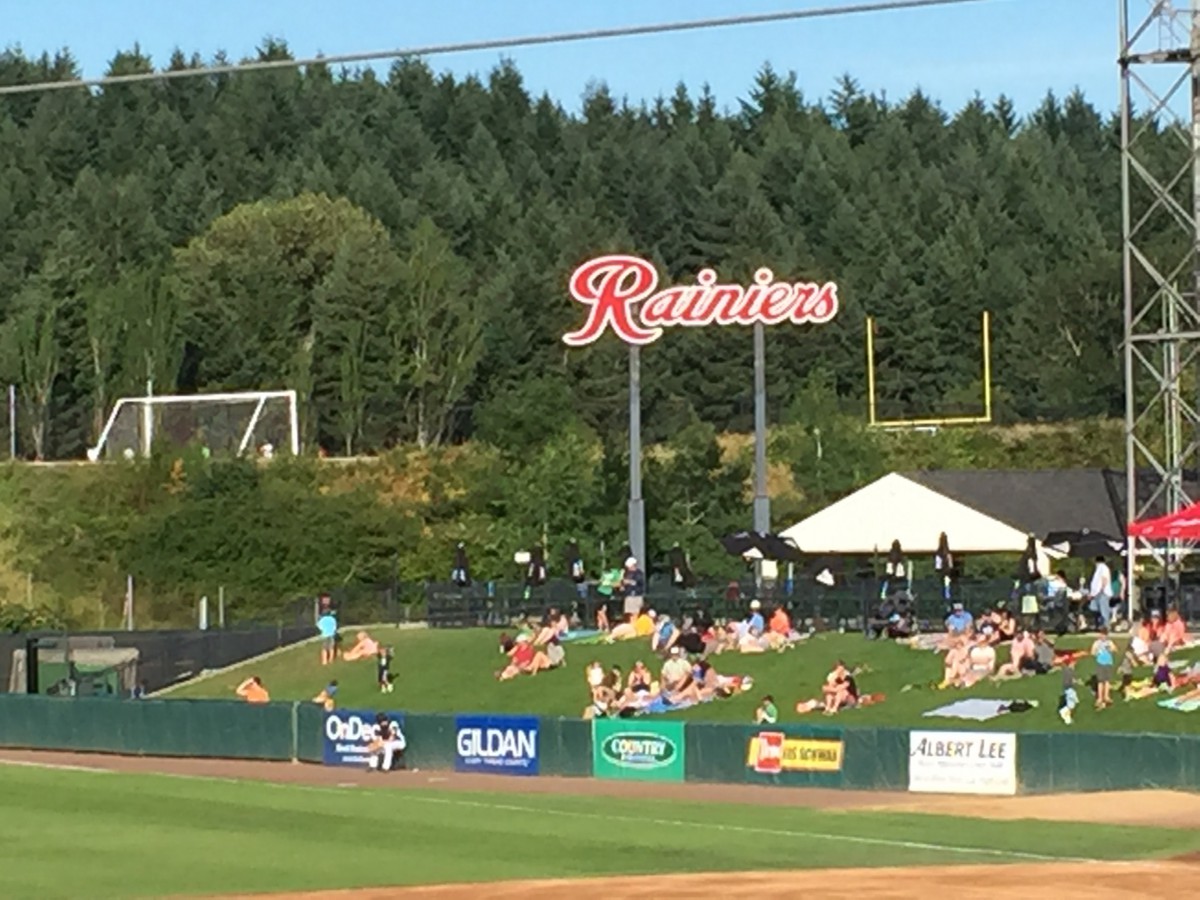
1. Stadium Hill

Hill along first base side of Cheney Stadium

The grassy hill next to right field, up along the first base line, is a popular destination for families with young children. Both young and older fans can spread out and relax while watching the game. A lot of foul balls end up there, so if you go, you should bring your glove.

2. Rainiers’ Mascot: Rhubarb

The Seattle Mariners’ mascot is a moose, and I used to think that Rhubarb, the Rainiers’ mascot, is also a moose. But this week I discovered that Rhubarb is in fact a reindeer. It has a nice alliterative ring to it: Rhubarb, the Rainier Reindeer.

Rhubarb, Rainiers' mascot
Rhubarb, Rainiers’ mascot

But be honest here. Could you really tell from those antlers that Rhubarb is a reindeer and not a moose?

Cheney (pronounced chee-nee) Stadium, home of the Rainiers, is a very family-friendly place, and Rhubarb plays a big part in creating that atmosphere. He dances on top of the dugouts, and mingles and schmoozes with fans up in the stands. And after every Sunday game at the stadium, Rhubarb brings kids down onto the field and leads them in running around the bases.

3. Tribute to Ben Cheney

Statue of Ben Cheney

Ben Cheney was one of the community leaders responsible for getting a stadium built in just three months and 14 days, in time to open as the home of the San Francisco Giants’ AAA club in 1960. Since that time Tacoma has been the home of a number of minor league teams. The Rainiers have played at Cheney Stadium since 1995.

Cheney Stadium underwent a massive remodeling between the end of the 2010 season on September 2 and opening day of the 2011 season on April 1.

The spirit of Ben Cheney attends every home game at the stadium named in his honor.

U.S. Open: We Tuned in for the Scenery But Stayed for the Drama

I have absolutely zero interest in the sport of golf. But the U.S. Open is being held at Chambers Bay, which is just a hop, skip, and a jump from our new hometown of Tacoma, WA. So I tuned in to Fox this afternoon to see if the Goodyear blimp (which we’ve seen, as a far-off speck in the sky, circling for the last couple of days) would provide some shots of our beautiful local scenery.

And it certainly did. The weather here has been clear and just gorgeous all four days of the tournament. The blimp caught postcard-perfect shots of Mount Rainier, Puget Sound, and the Tacoma Narrows Bridge. But what surprised both my husband F. and me was that, between the gorgeous scenery shots, we got caught up in the tournament drama.

Even though I don’t follow golf, I am interested in other sports, notably baseball, basketball, NFL football (which you are required to like when you move to the Seattle-Tacoma area), and tennis. But I’m not much into personalities and statistics. Even though baseball is my first love and I watch the World Series faithfully every year, no matter who’s playing, sometimes, come January, I’ve forgotten who won.

What I like is watching games. I love the way games unfold and the way players react to and cope with changing situations. This is why I prefer National League baseball to American League play: because the AL use of the designated hitter means that managers don’t have to make key decisions about whether to pinch hit for a pitcher who’s working well to take advantage of a potential scoring situation. I love to see which players step up in clutch moments and which ones choke, which athletes are able to recognize and adapt to what their opponents are doing and which ones stubbornly keep doing what they’re doing and hoping for different results. I love the pressure of the moment, the opportunity to step up or shut down.

And the final round of this year’s U.S. Open golf tournament provided some of the best sports drama I’ve seen in a long time:

  • one player who was completely out of the running until an amazing string of birdies brought him within one stroke of the lead
  • three or four players who kept tossing the lead, or a share of the lead, around among themselves
  • a player who made a seemingly unbelievable putt near the end of his final round
  • another player who could have won the tournament, then could have forced a playoff on the following day, and then finally lost the tournament, all because of his inability to putt

I admit that I can’t putt either—or I assume I can’t; I’ve never tried—but that’s why these guys were at Chambers Bay while I was watching on TV in my living room just a few miles away. But even though we got caught up in the drama, I don’t anticipate watching too many more golf tournaments—unless the U.S. Open comes back to Chambers Bay one day.