Working on Vertical Writing

Gestation of Ideas: On Vertical Writing and Living

Nick Ripatrazone discusses vertical writing, a concept he learned from writer Andre Dubus’s essay “The Habit of Writing,” which appeared in the anthology On Writing Short Stories, edited by Tom Bailey. Dubus writes that, instead of trying to force stories into being, he gives ideas time to gestate until the story emerges. As the anthology title says, Dubus is referring to his writing of fiction. However, giving the creative process time to work by allowing ideas to gestate also benefits nonfiction writers. Therefore, I’ve been trying to apply what Ripatrazone describes here to my own writing.

Dubus defines vertical writing by contrasting it to horizontal writing. In this passage, Ripatrazone describes the difference:

Horizontal writing is focused on amassing pages and words. When Dubus wrote horizontally, he wrote convinced that fiction was created through aggregation. Vertical writing, in contrast, values depth over breadth. Stories are written when they are ready to be written; they are not forced into existence by planning or excessive drafting. Horizontal writing seeks to move across the page; vertical writing seeks to dig into the page … . Curiously enough, by seeking to undermine the stereotype that writing is the result of inspiration, writers have fallen for the other, no less romantic opposite: that writing is factory work, and daily devotion is rewarded with final drafts. Both approaches are magical thinking. Vertical writing is no less work, but it is better work, work at the right time. It requires patience in the willingness to wait for a story to feel ready to be written, as well as the attention and focus necessary to inhabit the story once gestated.

Replace fiction and story with something like essay, piece, or work, and you have something that applies to nonfiction as well.

In my years of studying English, I learned to write literary criticism that removed any trace of personal interaction with the texts I read. Such academic writing is horizontal writing, and I became quite good at it. I can organize, analyze, and argue logically until the cows come home. But eventually that kind of writing wasn’t enough for me. I decided in my late 50s to go back to school to study psychology, and I ended up focusing on life stories. Life writing, by definition, demands personal involvement. Switching from my ingrained habit of impersonal writing to more personal, intimate writing has been a major challenge for me.

This concept of vertical writing gives me a new way to look at what I’m now working on, writing that values depth over breadth. After so many years of keeping myself at (my own) arm’s length, I’m trying to learn to drill down rather than expand sideways, to go deeper and see what I can learn about my world and myself. I never know what I truly think or believe about something until I’ve written my way through it.

I’m in a different place in my life than Ripatrazone is in his. Because he teaches high school English and has twin daughters just under two years old, he does not have a lot of time to write. He says that focusing on vertical writing has allowed him to use his writing time with more satisfaction than before:

A vertical writing life is no easy life, but it is deeper, more worthwhile. I feel like I have more ownership over what I create. I am no longer concerned with numbers; no more spreadsheets of magazines that I hope to conquer as if publishing was a territorial battle. Writing is the slowest of games, the most methodical of the arts. Its parts are nearly infinite; its wholes cannot be tricked into existence.

His references to numbers and spreadsheets pulled me up short, because I’ve been carefully using Excel to track my output since I began my challenge of writing a blog post every day in 2015. After three months, I had just about convinced myself not to worry so much about the numbers. I will continue to record my numbers (because, after all, we live in the era of Big Data), but I’m not going to fixate on them so much.

I’m going to concentrate more on the writing than on the recording of numbers, because:

Vertical writing is not easy… . It is very possible, very easy, to be owned by our goals. To be owned by our next book. To be owned by the feeling that we are competing with a world that outmatches us. Vertical writing — vertical living — has convinced me otherwise. It has reminded me why I began to write as a child: the joy of discovery, the surprise of creation, the power of imagination. When I used to write horizontally, I filled boxes with chicken-scratched, multiple drafts. I was concerned with speed and number, acceptances and rejections. Now I am concerned with depth and discovery, and the result is that I live with stories in a deeper way.

I need to focus on living with my own writing in a deeper way.

The Best Ways to Survive a Stroke | Next Avenue

10 warning signs, plus what to do to save someone’s life — or your own

via The Best Ways to Survive a Stroke | Next Avenue.

Too Many Open Browser Tabs

Whenever I find an interesting article, I leave it open on my browser because I just know it will form the basis of a spectacular blog post. I’ve always done this, but in the past I would finally just close everything and start over again because the web is, after all, an infinite source of riches. But since I challenged myself to write a blog post a day in 2015, I’ve been less eager to close all those tabs down. What if I face a day when I can’t think of anything to write about?

My browser has now become so bloated that I have to do something to make my system work faster. Instead of just closing all those tabs, I’m resorting to a collection of the very best ones here. Because I have lots of wide-ranging interests, this is quite an eclectic collection. But every one of these articles is worth attention. I guarantee it.

The Moral Bucket List

New York Times op-ed columnist David Brooks writes here about some special people:

ABOUT once a month I run across a person who radiates an inner light. These people can be in any walk of life. They seem deeply good. They listen well. They make you feel funny and valued. You often catch them looking after other people and as they do so their laugh is musical and their manner is infused with gratitude. They are not thinking about what wonderful work they are doing. They are not thinking about themselves at all.

Brooks distinguishes between two types of virtues, the résumé virtues and the eulogy virtues:

The résumé virtues are the skills you bring to the marketplace. The eulogy virtues are the ones that are talked about at your funeral — whether you were kind, brave, honest or faithful. Were you capable of deep love?

He goes on to say that a while back he set out “to discover how those deeply good people got that way.” In the rest of the article he describes what he found out.

It’s a good article, and I encourage you to read it. But I’ve left this browser tab open for a while now because this article reminded me of a former friend of mine. She could, at times, act caring and loving, but I always detected the tiniest disconnection between her inner workings and her outer behavior. For example, one day after she had spent a long time describing how each of her three children had recently hurt her feelings, she paused for a second while looking at me, then asked, “How’s your daughter?” During that second I could see the gears working inside her head: “I’ve talked about my kids, so I should now ask about hers.” I knew she wasn’t truly interested, so I said, “She’s fine” and left it at that. She visibly exhaled with relief.

This women always blamed other people for any problem in her own life. Everything was always the other person’s fault. She even developed a convoluted philosophy of life—it involved a person’s True Center of Pure Being (her caps)—that allowed her to avoid having to take responsibility for her own actions. When one of her children made her feel down on herself, she would explode and scream at me, trying to make me feel just as bad about myself as she felt about herself. When I told her, several times, how hurtful her behavior was to me, she said that I should understand that she was under a lot of pressure. “I’m not what I do,” she said.

This woman is the opposite of the people David Brooks describes. One can’t simply invoke one’s True Center of Pure Being. She is what she does. We all define ourselves by what we do and say. And this is why she’s a former friend, not a current one.

Sex, Dementia and a Husband on Trial at Age 78

This article brings up one of those issues that’s so complex and deeply personal that I have trouble figuring out what I think about it. In Iowa, Henry Rayhons, age 78, has been arrested for having sex with his 78-year-old wife, who had severe dementia, in a nursing home. The couple was married in 2007 after each had been widowed.

The top-level issue is whether Mrs. Rayhons was capable of giving consent for sex. But the lower-level issue is the question of who gets to decide whether Mrs. Rayhons was capable of giving consent: her husband, nursing home administrators, her doctor, her children?

This case suggests that someone must take the initiative in setting guidelines:

Sex is one of the most ambiguous areas in the scientific understanding of Alzheimer’s. While there are established methods of measuring memory, reasoning and the ability to dress, bathe and balance checkbooks, no widely used method exists for assessing the ability to consent to intimate relations.

Furthermore, dementia symptoms fluctuate. What may be appropriate on one day may not be appropriate on another day. Even more confusing, what may be appropriate in the morning may not be appropriate in the afternoon of the same day.

I’m glad I’m not sitting on the jury for this case.

Parsing Ronald Reagan’s Words for Early Signs of Alzheimer’s

Lawrence K. Altman, M.D., reports:

Now a clever new analysis has found that during his two terms in office, subtle changes in Mr. Reagan’s speaking patterns linked to the onset of dementia were apparent years before doctors diagnosed his Alzheimer’s disease in 1994.

The findings of the study by Arizona State University researchers were published in The Journal of Alzheimer’s Disease. Altman points out that these findings “do not prove that Mr. Reagan exhibited signs of dementia that would have adversely affected his judgment and ability to make decisions in office.”

But the findings do suggest that alteration in speech may one day be used to predict the development of Alzheimer’s and other neurological conditions long before clinical symptoms appear. Earlier detection could lead to earlier treatment, which in turn could help reduce or at least slow damage to the brain.

This research used the same computer algorithm that other researchers have used to analyze changes in writing by novelists, which I have written about here:

Canadian researchers have reported that analyses of syntax in novels by Iris Murdoch and Agatha Christie indicated early signs of dementia (Ms. Murdoch died of Alzheimer’s; Ms. Christie is suspected to have had it.) The same analysis applied to the healthy P. D. James, who died at 94 last year, did not find signs of dementia.

Scientists not involved in this study caution that much more research is necessary before analyses such as this can confidently be used in examining for Alzheimer’s disease.

AIR: Part One

Such a beautiful essay and beautiful photos about a beautiful woman.

jessdewes's avatarJess Dewes

On January 30th, 2014, a woman walked into my photography studio carrying a tote bag full of oxygen tanks and jewelry. She smiled at me from under the hose that disappeared into her nostrils and I fell for her instantly.

On film, first meeting, 1/30/14.

A few months prior to the day Julie VonderHaar came to my studio for a portrait, I was invited to be part of a group photography show at a gallery called SOHA in South St. Louis, MO.  I was informed that the theme of the exhibit was simply AIR. Each photographer (8 total) was to interpret the theme however they liked and create something for the show. As a businessperson, exhibiting in shows like this is rarely lucrative, but the artist in me couldn’t resist the opportunity to stretch a bit beyond my work portfolio of baby portraits, corporate head shots, and wedding documentation.

I knew…

View original post 1,388 more words

At Home: My Two-Year Anniversary in Tacoma

Today I celebrate two years of living in Tacoma. I actually arrived in Tacoma on April 9, 2013, then stayed in a motel overnight before moving into my new home on April 10.

We had been visiting Tacoma for a week each year for several years before deciding to move here. I therefore knew a little about getting around, but not very much. I knew only one route to my new home from the motel where I stayed. (We’d been staying there regularly for many years.) I have since discovered a few alternate routes to my house, including one that cuts about 15 minutes off that route I drove on my first day as a resident here.

After two years, I finally feel that I’m beginning to know my general way around. I still use Google Maps a lot, but now when people say, “That store is on Hosmer Street” or “We’re on Steele Street,” I have a general idea of where to head. I also no longer fear getting lost and can approach finding somewhere I’ve never gone before as an opportunity to explore new places.

I arrived at my house at 10:00 AM on April 10, 2013, in a torrential downpour. Of course I knew about the frequent rain here—our daughter had been reminding us that we’d have to get used to it—so I wasn’t surprised. After getting my keys, I pulled my car into the attached garage and unloaded the boxes of necessities that I had brought with me from St. Louis. My car could not have held even one more dish or pan.

By the time I had unloaded the boxes—not unpacked them yet, but at least removed them from my car and put them in the appropriate rooms—it was 11:00 AM. I was ready to head out to Target, Costco, and Safeway to purchase necessities I hadn’t been able to bring with me (coffee maker, vacuum cleaner, cleaning supplies, and yes, food). Was I surprised to find that the sky was clear and the sun was shining brightly.

That was the first time I realized that the old adage “If you don’t like the weather, just wait a minute and it will change” applies here more than anywhere else I’ve ever lived. In the two years I’ve been here I’ve learned a lot about dealing with the weather:

  • Even if it’s raining now, it might not still be raining an hour from now.
  • Even if it’s not raining now, that doesn’t mean it won’t be raining an hour from now (so bring along that umbrella or raincoat).
  • A morning of fog and drizzle (quite common) doesn’t mean that the afternoon won’t be beautifully sunny.
  • The hottest part of the day here isn’t around high noon, as it was in St. Louis, but usually at 3:00 or 4:00 PM.
  • If you expect to live around here, you can’t be skittish about occasionally getting a bit wet. Also, my mother was right when she told me, “You’re not sugar. You won’t melt.”

I do not miss the unbearable heat and humidity of St. Louis summers at all.

But after 40+ years in St. Louis, I do kind of miss the St. Louis Cardinals and still follow them in the standings. Nonetheless, I have adopted the Seattle Mariners as my home MLB team and faithfully follow their ups and downs (so far, unfortunately, mostly downs) and tune in to the games. I’m grateful that the Mariners AAA minor league team, the Rainiers, is headquartered right here in Tacoma. Attending their games is much easier—and much cheaper—than making the trip up to Seattle’s Safeco Field. And I’ve become an enthusiastic football fan here in Seattle Seahawks territory, where everybody is expected to be The Twelfth Man. Like a lot of other people around here, I still wish the Supersonics, the local NBA team, had not moved away and remade itself as the Oklahoma City Thunder.

Our recent five-day trip to Tampa, FL, for the Women’s Final Four college basketball championship tournament made me realize how much I’ve come to think of Tacoma as my home. Two features here that I love the most are the water, with its high and low tides, and Mount Rainier. There’s water aplenty in Tampa, too, but the sun just doesn’t glint off Tampa water the same way it does off the water of our Commencement Bay. And Tampa is just so FLAT. After about four days, I was craving a glimpse of my mountain.

Because our flight back from Tampa didn’t get in until after dark, we couldn’t see the mountains from the plane as we usually can. But I could feel their presence. For air travelers, the local airport represents home, and when we stepped off the plane at Sea-Tac Airport, I felt that’s where I was. I’ve flown into Sea-Tac lots of times over the years, and I was always excited to see my daughter and to be on vacation. But this time, walking through Sea-Tac made me feel grounded, made me feel that I was back where I truly belonged.

It’s great to be back in the Pacific Northwest, where there’s still a chill in the air that requires a light jacket. Goodbye to the 88 degrees F. of Tampa. It was a great place to visit, but I’m glad to be home. In Tacoma, WA.

Three Things Thursday: Headgear at the Women’s Final Four

Once again it’s time for the blog challenge Three Things Thursday, the purpose of which is to “share three things from the previous week that made you smile or laugh or appreciate the awesome of your life.”

three-things-thursday-participant

Headgear at the Women’s Final Four

I’ve written about our visit to Tampa for the Women’s Final Four college basketball championship.

One of the things I love so much about this experience is seeing how creative some of the fans get with their clothing. Here are my awards for outstanding headgear at this year’s Women’s Final Four:

3rd Place

Notre Dame "Fighting Irish" Leprechaun Hat
Notre Dame “Fighting Irish” Leprechaun Hat


2nd Place

UConn Husky Hat
UConn Husky Hat

1st Place

Basketball with red-and-white SC Gamecock


Honorable Mention

(OK, so this is the fourth thing)

Basketball Net Hat
Basketball Net Hat

Championship Game

Related Post:


Notre Dame and UConn faced off in the 2014 championship, so this year was the rematch. Last year UConn won by 19 points.

Spirit was high before the game, with each team’s fans cheering loudly when their band played and when the players came on court to warm up.

Once the game started, Notre Dame jumped out to an early lead:

Notre Dame took an early lead.

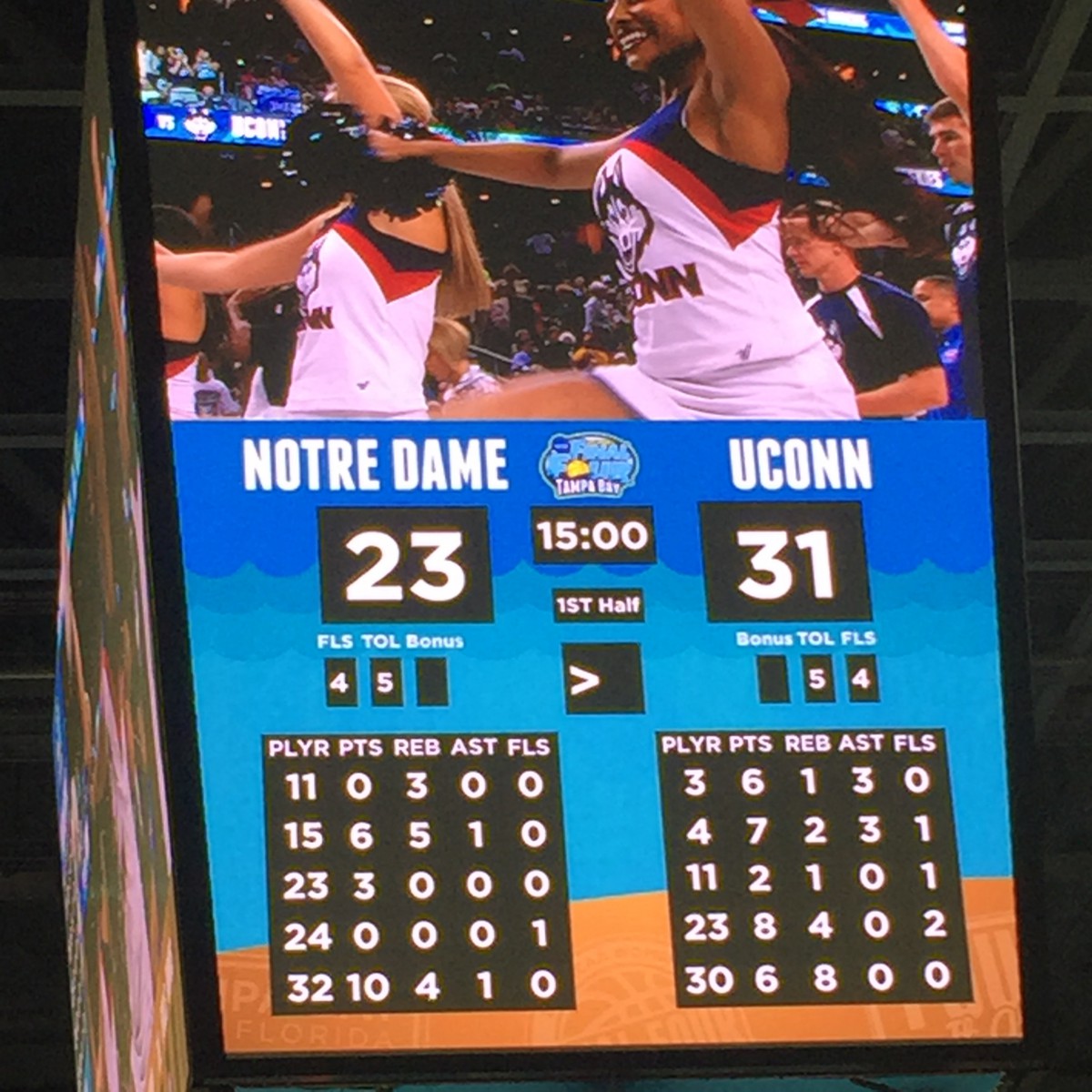
But UConn fought back and was up at half time:

UConn was ahead at half time.

The second half was filled with drama. UConn would pull ahead by 10, then Notre Dame would go on a run and cut the lead to 5, but the Huskies players stepped up and built the lead back up to 10.

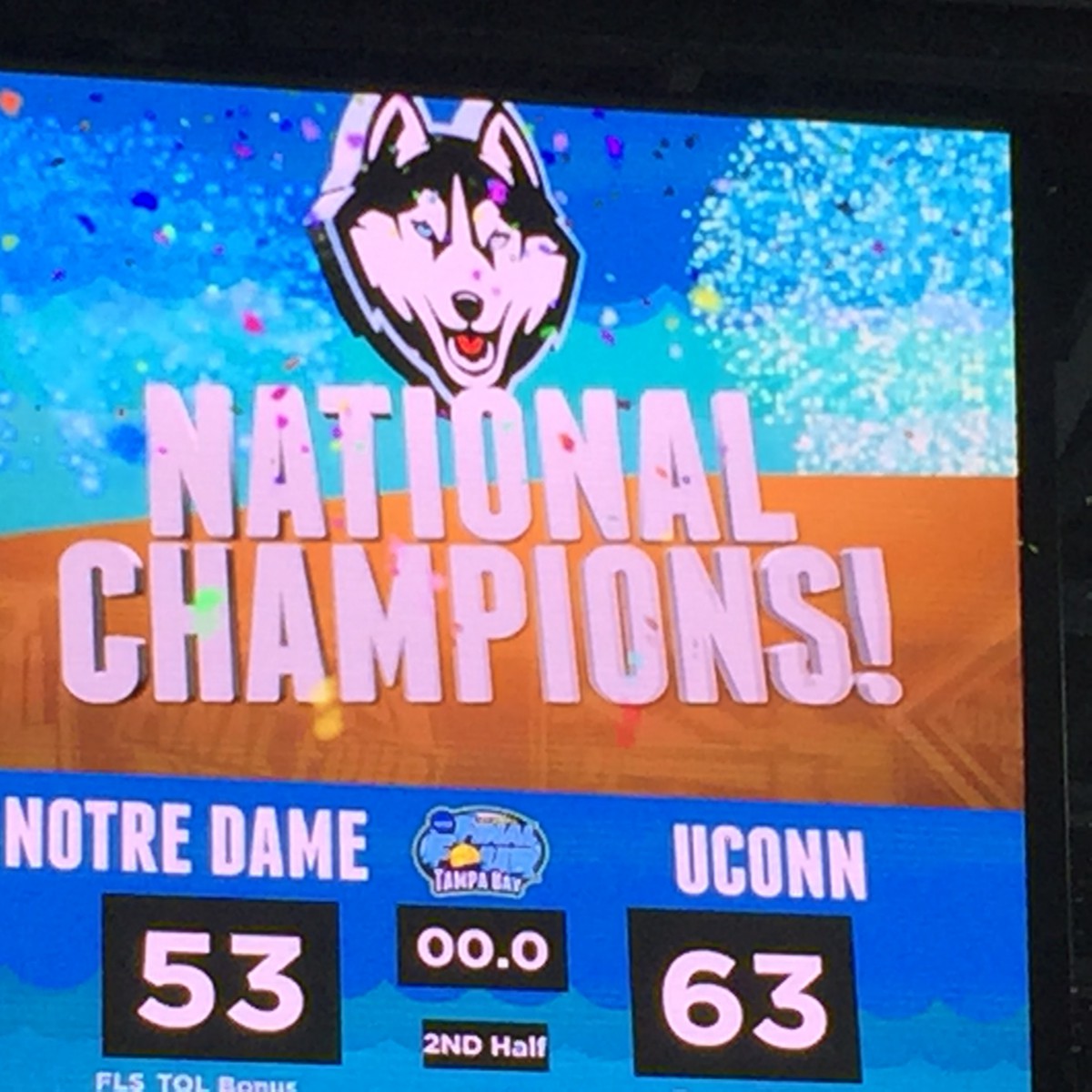
Finally, though, the game produced the same result as last year, although by a smaller margin. UConn won its third consecutive championship.

A Long Trip Home

As this post goes live, we will be at the airport preparing for the long flight home. From the maps in the airline magazine on the plane, my husband figured that the trip between Seattle and Tampa is probably the second longest flight one can take from one major city in the United States to another. (Seattle-Miami would be a little longer.)

It was an enjoyable quick trip, but we’ll be glad to get back to the Pacific Northwest. A temperature of 88 degrees F. is one reason we left St. Louis. And although there’s a lot of water around Tampa, there are no mountains. And I miss my mountain:

Mount Rainier

Women’s Final Four: Tampa

We are in Tampa, FL, for the Women’s Final Four College Basketball Championship. For the past 15 years or so we have made the Women’s Final Four a vacation trip. We go almost every year, regardless of what teams get through the earlier rounds of the tournament.

UConn Husky
UConn Husky

We are not completely disinterested fans, however. My husband and I both grew up in Connecticut, and although neither of us attended the University of Connecticut, we still root for its teams, particularly the women’s basketball team. Most years we get to see the UConn women at the Final Four. This year they are going for a threepeat: a third consecutive national championship.

But even if the UConn women weren’t here again this year, we’d still have a good time. I love college sports. I love the bands and the mascots and the partisan fans with their signs, costumes, and painted faces.

2014 was a particularly special year because, as we were in Nashville for the Women’s Final Four, the UConn men were winning the men’s championship. The day after the men won it all, the women did the same. The University of Connecticut is the only school that has ever had its men’s and women’s basketball teams win their national championships in the same year, and UConn has done it twice (2004 and 2014).

Notre Dame "Fighting Irish" Leprechaun
Notre Dame “Fighting Irish” Leprechaun

That won’t happen this year, but the women are still in the running for another trophy. Last night’s semifinal games were a mixed bag. The first game featured Notre Dame against South Carolina. The South Carolina women began the season ranked #1. They started out slowly in their game against ND but did manage to catch up. The second half, especially the last 10 minutes of that 20-minute period, was exciting. SC managed to pull ahead by one point near the end and had a good chance to win, but they failed to score with the final seconds ticking away, allowing ND to score a bucket and win by one point.

South Carolina Gamecock
Maryland Terrapin
Maryland Terrapin

The second game between UConn and the University of Maryland was quite different. Maryland stayed close for a while, but UConn was up by 11 at halftime. Eventually UConn pulled away. The final score was Maryland 58, UConn 81.

The championship showdown comes tomorrow night. (Those of you who can’t be here can watch on ESPN.)


security guy
Subtle security guy circulating among crowd.

As always, immersing ourselves in the crowd outside the stadium before the gates opened offered lots of interest. A not-very-subtle security guy walked slowly past us, with his earwig and walkie-talkie. Don’t they know that, in 88 degree weather, in a crowd wearing shorts and tank tops, a guy in a suit, even a light-colored one, would stick out? Maybe that’s the point. Maybe his presence was an announcement: “Don’t try anything. We’re watching.”

And in addition to a couple of pairs of ordinary police circulating, I also saw a group of six more intimidating officers march by, 3 x 2. They were more heavily dressed, including their gadget-laden belts and heavy lace-up boots. These were not your ordinary Officer Friendly cops. They weren’t wearing helmets and didn’t have SWAT emblazoned across their backs, but they might as well have. I thought it prudent not to try to photograph them.

It’s not terribly surprising to see such sights at a time when a young man is on trial for bombing the 2013 Boston Marathon.

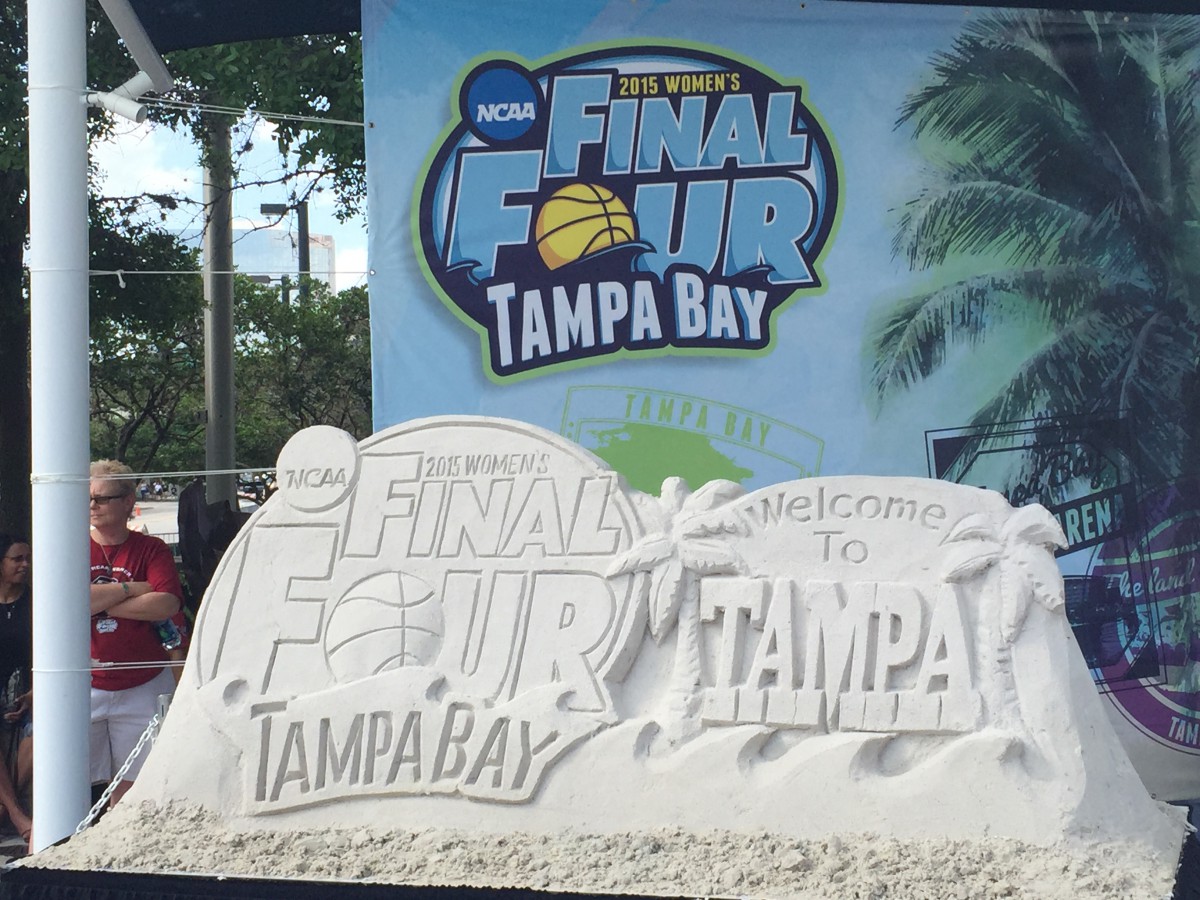
On a cheerier note, I marvel at the creativity and patience of the creator of this sand sculpture outside the arena:

sand image
Of course there must be sand in Tampa.

Departing from Sea-Tac Airport

During the 40+ years we lived in St. Louis, we became spoiled air travelers. St. Louis was the hub for TWA, which meant that we could get a direct flight from our home airport to just about any other major city in the United States. And back in the truly good old days, we often had our choice of several direct flights and could pick the most convenient time for us.

But when TWA went belly up, American Airlines absorbed it and soon phased out St. Louis as a hub in favor of Chicago and Dallas/Fort Worth. No longer could we get a direct flight to anywhere and instead had to travel to either Chicago or DFW to get a connecting flight to wherever we wanted to go. The number of available flights also dwindled. We usually ended up with no choices, forced to take the one available flight to the new hub and then the one flight to our destination city.

Now that we’ve retired to Tacoma, WA, Sea-Tac Airport has become our new hometown airport. Alaska Airlines has for some time been the major airline headquartered at Sea-Tac and has been increasing its service area. In fact, Alaska initiated a nonstop flight between Sea-Tac and St. Louis just before we left St. Louis.

Recently, Delta Air Lines has begun to compete with Alaska Airlines as the major carrier out of Sea-Tac. This healthy competition is good for consumers in terms of number of destination cities and number of available flights.

But the addition of flights is a drawback in that Sea-Tac does not have the infrastructure to support both the increased number of flights and the increased number of passengers. Where passengers already see this problem is in the horrendously long lines that form at the entrances to the security checkpoints.

And the problems will only get worse. On January 27, 2015, The Seattle Times reported on plans to expand Sea-Tac to accommodate an expected boom of passengers over the next 20 years: Traffic at the airport is expected to grow from last year’s [2014] 37 million passengers to 66 million 20 years from now:

A new International Arrivals Facility planned for 2019 is only the beginning. Also on the drawing board are plans for 35 more airplane gates added to the north and south of the airport’s 81 current gates, and potentially an additional new passenger terminal.

This article reports that Alaska Airlines and Delta Air Lines are involved in a dispute over “how, or even whether,” the new International Arrivals Facility (IAF) should be funded. The cost of the proposed new facility was recently increased to $608 million.

More recently KING 5, Seattle’s NBC affiliate station, reported on March 5, 2015, about a public meeting at which Sea-Tac International Airport and Port of Seattle officials presented expansion plans:

Sea-Tac projects up to 66 million passengers by 2034 and indicates it needs to add gates, a new international terminal and reconfigure other infrastructure around the property.

There will be several more public meetings in upcoming months to gather public input on the expansion plans.

In the meantime, anyone flying out of Sea-Tac Airport should plan to allow plenty of time for getting through the screening process. When we arrived at about 6:45 for a recent early-morning flight, the line was not too long, but later in the day the line can snake out of sight down the concourse. Plan to arrive at least two hours before your scheduled departure time, or even earlier if you’re flying out during the peak mid-day hours.

Three Things Thursday

Once again it’s time for the blog challenge Three Things Thursday, the purpose of which is to “share three things from the previous week that made you smile or laugh or appreciate the awesome of your life.”

three-things-thursday-participant

Food in Portland

I’ve written about our trip last weekend to Portland, OR, here and here.

Although we weren’t there for very long, we did have some memorable food experiences.

1. Kells Irish Pub

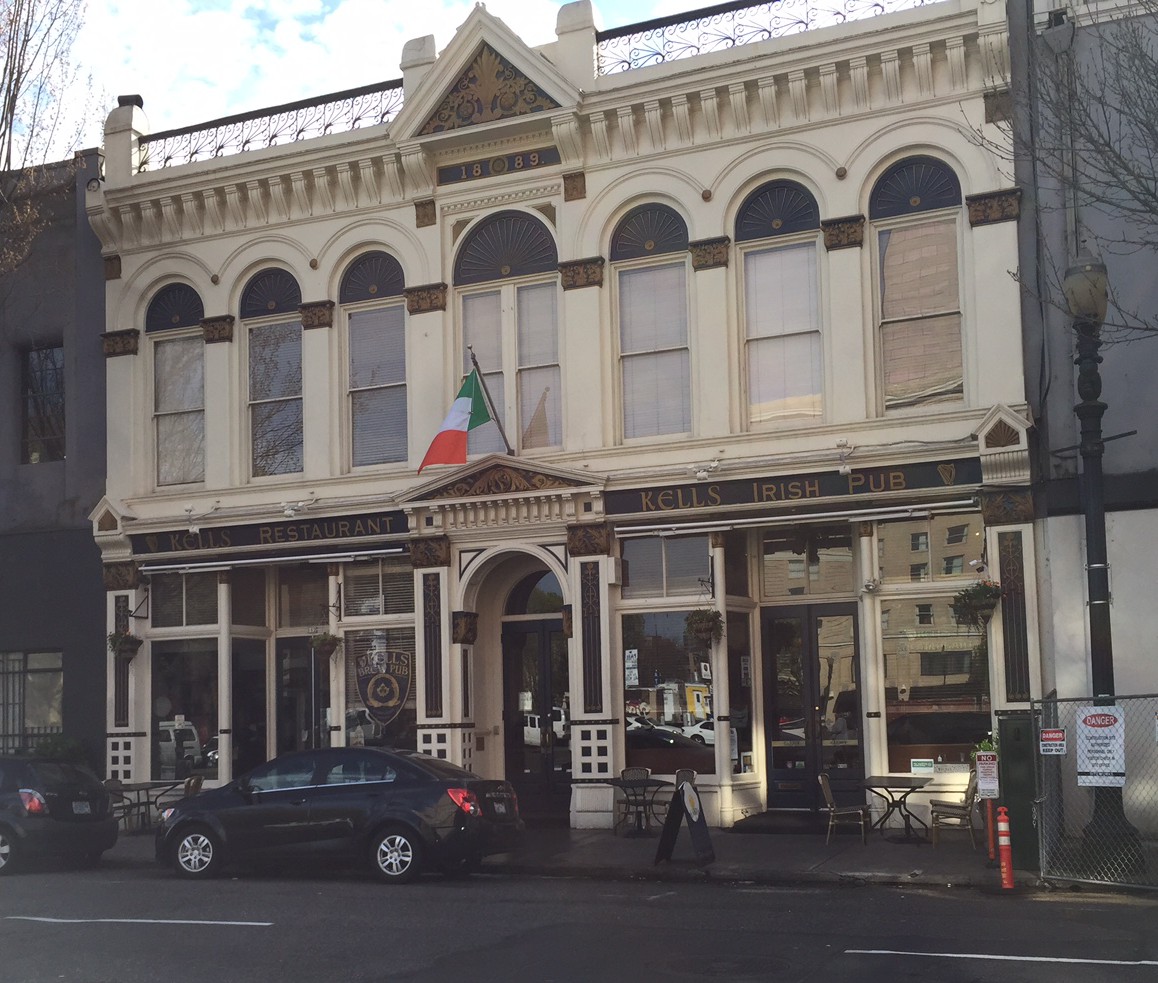
The conference my daughter and I attended was at the Embassy Suites in Portland’s historic Old Town district. We arrived in time for a mid-afternoon lunch at nearby Kells Irish Pub:

112 SW Second Avenue, Portland, OR 97204
(503) 227–4057

Like most of the businesses in this redeveloped area, Kells is in a historic old building. This one was built in 1889 and is on the National Historic Register:

Kells Irish Pub
Kells Irish Pub

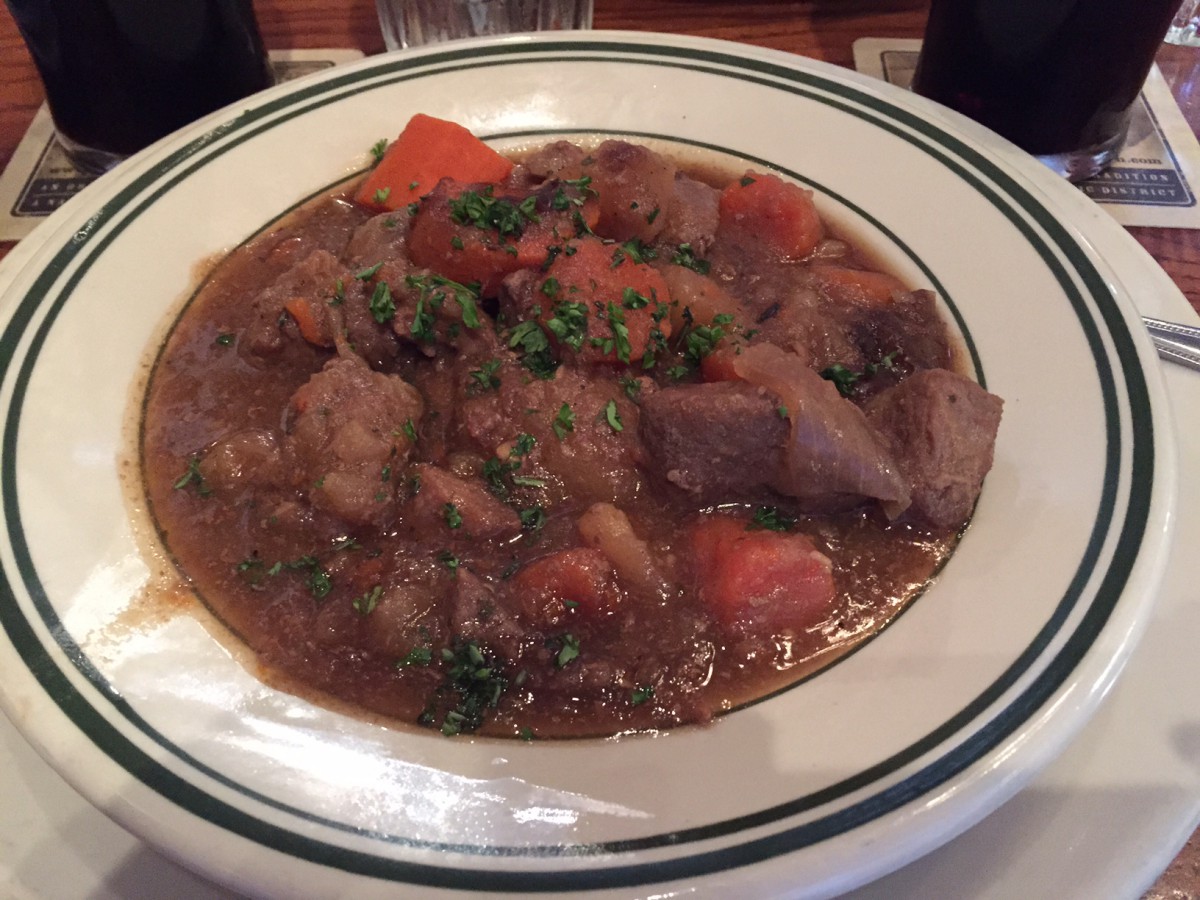
And of course we ate and drank traditional Irish fare:

A pint of Kells Stout between 2 pints of Guinness
Irish lamb stew
Irish lamb stew


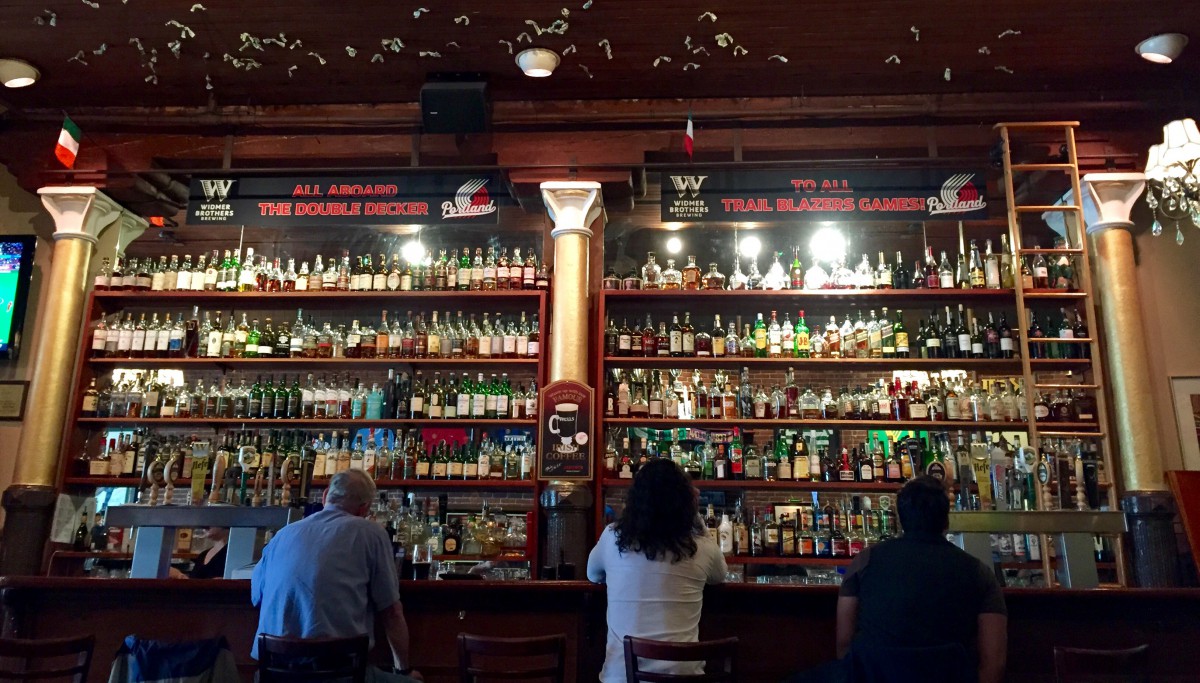
Kells even has a huge wall of whiskeys that requires a library ladder for full access, which you can see at the right side of the photo featured at the top of this post.

They have a second site in Portland and—wait for it!—one in nearby (to us) Seattle and one in San Francisco, a city we occasionally visit.

2. Dan & Louis Oyster Bar

oyster bar 02After the conference Saturday night, we went for dinner to Dan & Louis Oyster Bar, also within walking distance of the hotel in Portland’s historic district:

208 SW Ankeny St. Portland, OR 97204

Opened in 1907, it bills itself as the “oldest family-owned restaurant in town.” It even has its name inlaid in the sidewalk outside the entrance:

oyster bar 01

My husband and I had lunch here when visiting Portland about 15 years ago. I remembered the restaurant having the best oyster stew I’d ever tasted, and I’m happy to report that it still does.

3. Voodoo Donuts

Voodoo Doughnuts
Voodoo Doughnuts

We never did get to eat the creations of the very famous Voodoo Doughnuts because every time we walked by there was a ridiculously long line.

Voodoo Doughnut ONE (original location)
22 SW 3rd Avenue Portland Oregon, U.S.A.
phone 503.241.4704

That may be a good thing, though, because it will probably take me at least a few months to decide which doughnut I want. Check the website for photos and descriptions of their many offerings.