Last Week’s Links

Talking on Zoom could help older people stave off dementia

CNN reports on recent research results:

Talking on video-conference services like Zoom during the coronavirus pandemic has helped older people stave off the effects of dementia, a new study has suggested.

Researchers found that regular communication helps maintain long-term memory, and elderly people who often use online tools showed less decline in memory than those who don’t.

These Farmers Want You to Drink Your Hops and Eat Them Too

“Trashed in the U.S., hop shoots are treasure in parts of Europe.”

Washington State produces lots of hops, the crop that lends much of the bitter taste to beer. In fact, according to this article, “75 percent of the U.S. hops supply is grown in Yakima Valley,” in eastern Washington.

This article presents some entrepreneurs who are exploring ways to use more of the hop plant than the part used in beer brewing.

Mary Beard Keeps History on the Move

“For Beard, change has always been a part of the classics. We need to expose the field’s flaws to learn how we’ve inherited them.”

Since I did my B.A. and M.A. in Latin, I’ve been following the recently publicized issue of universities dissolving their classics departments. Here Katy Waldman profiles British classicist Mary Beard for The New Yorker

Introducing her subject, Waldman writes about how to describe Beard: “‘Classicist’ doesn’t quite capture it. ‘Celebrity historian’ inches closer.” 

The movement to downplay the study of classics centers on the claim that the field embodies an “imperialist mind-set” and “sustains a mythology of whiteness.” But, Waldman writes, “As the field’s most famous practitioner, and a dedicated anti-racist and feminist, Beard takes a middle position: she believes neither that classics deserves a pedestal nor that it must be destroyed.”

Is America a Racist Nation? I Am Sikh and Tired

Vishavjit Singh writes:

My turban and beard have always made me a target of anxiety, stereotyping, or outright racism. Post-9/11, the hate has been taken to a whole new level. Sikhs have been killed, attacked, and verbally abused in a never-ending American saga.

Singh takes a look at some of our inherent biases: “This is not a Black and White problem only. It is an American ailment. It is a human disease.”

They’re Vaccinated and Keeping Their Masks On, Maybe Forever

“Face coverings have been a political flash point for more than a year. But now, the backlash is directed at people who don’t plan to take them off.”

My husband and I have been fully vaccinated since late February. Yet, despite the most recent CDC guidelines, when we went to the farmers’ market yesterday, I put my mask on. 

I’ve decided to continue to wear a mask when I’m in a crowd for quite a while. After being required to do so for more than a year, it’s something I’ve gotten used to doing. I figure that wearing a mask doesn’t hurt me or anyone else, but it does provide an extra bit of protection against any virus particles that might be floating around. My decision has nothing to do with politics. I’m just being as cautious as possible about my own health. 

This article in the New York Times looks at reasons why some people are continuing to mask up.

How About You?

Do you continue to mask up?

© 2021 by Mary Daniels Brown

Last Week’s Links

Their romance was new when covid hit. Both in their 90s, they snuck around ‘like teenagers.’

When their retirement community enforced the COVID-19 regulations for isolation,  Bill Biega, age 98, and Iris Ivers, 91, had to make a quick decision: follow the regulations and stay separated, or cohabit and face the pandemic together. They decided that Iris would move in with Bill. More than a year later, they’re still together.

“Even in your 90s, it’s never too late to have a love life,” Bill says.

How Long Can We Live?

“As medical and social advances mitigate diseases of old age and prolong life, the number of exceptionally long-lived people is increasing sharply.” The United Nations estimates that there will be 25 million centenarians in the world by 2100. 

This article examines the various research approaches into aging and how to prolong lives. 

Affluent Americans rush to retire in new ‘life-is-short’ mindset

In an article from Bloomberg reprinted in the Seattle Times, Michael Sasso declares, “About 2.7 million Americans age 55 or older are contemplating retirement years earlier than they’d imagined because of the pandemic, government data show.” 

He goes on to report that “Early retirements, whether desired or forced, will deprive the labor market of some of its most productive workers and have an impact on the economic recovery that is still too early to evaluate.”

The ‘gray divorce’ trend: As the Gates split shows, more older couples are getting divorced. Here’s why

CNN uses the news that Bill and Melinda Gates are getting divorced after 27 years of marriage as the springboard for a discussion of the upward trend for toward divorce by older adults. 

Johnny Bench Misses His Hall of Fame Friends

I’ve been a baseball fan all my life and have been particularly struck by the number of former players who have died recently. This article focuses on Johnny Bench, the longtime catcher for the Cincinnati Reds. “Bench knew, played with or played against all of the 10 Hall of Famers who died in the past year.”

If you remember watching those men play, this article will tug at your heart strings, as it did mine.

© 2021 by Mary Daniels Brown

Last Week’s Links

For some of us, returning to pre-COVID life is turning out to be harder than we expected

As an introvert, I had no trouble accepting the enforced isolation caused by COVID-19 and am beginning to regret that I’ll gradually be expected to get back out and socialize. But this article examines an aspect of “returning to normal” that I had not thought much about: fear that discontinuing the measures we’ve taken to stay healthy will allow us to get sick.

Some of us have jumped at the chance to see movies in actual theaters, grab a drink at a bar, cheer the Dodgers or attend a small dinner party with fully immunized friends. Yet for others — even the fully vaccinated — the fear that any relaxation of safety protocols will lead to another surge is hard to shake.

Turns Out It’s Pretty Good: Aging

Xochitl Gonzalez writes:

in my experience — I’m in my 40s — aging has not only been dynamic, it’s turned out to be pretty damn good. Now, I’m not talking about aging in terms of night creams and micro-needling. I’m talking about the larger sense, about having more life to live and a joy about living it.

She explains that earlier in her life, she had developed her concept of aging from hearing the lamentations of her grandmother, who had decided that she was old at age 40. But at age 35 Gonzalez realized that her grandmother’s notion of old came from an earlier time, when women’s lives progressed through the various stages society expected of them—getting married and having children—at the pace society expected.

I must admit that I find the notion of someone in her forties discussing being old quite whimsical, but she makes a good point: Since that realization, “Time, going forward, has been marked less by what happened in my past than what might be possible in my future.”

Sleeping Too Little in Middle Age May Increase Dementia Risk, Study Finds

This article on new research suggesting “that people who don’t get enough sleep in their 50s and 60s may be more likely to develop dementia when they are older.”

We should always take research results with a grain of salt and, especially, remember that correlation of two conditions does not prove causation. And this article does point out the limitations of the study. Nonetheless, if inadequate sleep is something we can control, we might do well to correct the situation sooner rather than later. 

The Brain ‘Rotates’ Memories to Save Them From New Sensations

“Our ability to make sense of our surroundings, to learn, to act, and to think all depend on constant, nimble interactions between perception and memory.”

Here’s a report on new research designed to “figure out how the brain prevents new information and short-term memories from blurring together.” 

Historical looks at a previous pandemic and fatal police shootings show familiar inequities

This article is a portrait of Nancy Bristow, history department chair at the University of Puget Sound here in my hometown of Tacoma, WA. One of the sources writer Tom Keogh looks at is Bristow’s 2012 book American Pandemic: The Lost Worlds of the Influenza Epidemic, an account of the 1918-1919 Spanish flu epidemic:

She gives extensive consideration in her work to a subject that has also recently preoccupied the United States during our current COVID-19 pandemic: inequities in how medical treatment has been allocated to people of different classes, color and political power.

But Keogh focuses on Bristow’s 2020 book Steeped in the Blood of Racism: Black Power, Law and Order, and the 1970 Shootings at Jackson State College. Bristow has been teaching African American history for 30 years. About this recent book she says:

“I came to the Jackson story because I’ve been teaching African American history for three decades,” says Bristow. “One of the through lines when you teach a survey of African American history is the persistence of violence. It’s there in slavery, Reconstruction, post-Reconstruction. It continues on up to the present.”

In that book, about a shooting at Jackson State that killed two young Black men and wounded 12 other people, she examines how authorities used rhetoric to excuse violence.

Top tips for older writers who want to write a memoir

“As an older adult, you have a wealth of wisdom and memories to share with the world – but sometimes fear can get in the way of putting yourself on the page. These tried-and-true tips will help you get started.”

I got started studying life writing by working with older adults interested in writing down their life stories and memories for their families. In this article from The Writer Dani Burlison offers advice on how to get started accessing your memories, finding your theme, making your life stories interesting to other people, and finding your voice.

This article is spread over three web pages, so be sure to click on the numbers at the bottom of pages 1 and 2.

I would add to the information Burlison offers the request that you not get too wrapped up in finding an overarching theme for your recollections. It’s enough to write about your memories of events and important people in your life without connecting them with a theme. 

And don’t fuss too much over your writing style. Your family will cherish a collection of self-contained stories written in your usual, conversational voice.

© 2021 by Mary Daniels Brown

Last Week’s Links

The Girl in the Kent State Photo

If you’re old enough to remember the photo above, this article might interest you. I don’t think I ever knew that the girl in the center was only 14 at the time.

My college graduation (Boston University) was canceled because of the killings at Kent State. We were in the middle of final-exam week. Exams already taken would be included in final grades, but the rest of exams were called off. Those of us living in the residence halls were told to move out within the next couple of days.

COVID-19 Vaccines Could Unlock Treatments for 5 Other Deadly Diseases

Research often leads to serendipitous, seemingly unrelated discoveries. This article explains how the COVID-19 vaccines work and why scientists hope their development can yield new treatments for other diseases, including HIV, Parkinson’s disease, and cancer.

Some young women embraced their gray hair during the pandemic. They might not go back.

And here’s a story of a different kind of serendipitous discovery. Maura Judkis, age 34 at the beginning of the COVID-19 pandemic, carefully watched “the silver stripe that expanded every week where I parted my hair.”

Then she discovered the Silver Sisters, an online group of women who were letting their dyed hair grow out and their natural silver (the term they prefer over gray) hair grow in. “The Silver Sisters don’t just accept the inevitable, they embrace it,” Judkis writes.

The process not only allowed her to save about $1,000 annually at the salon but also prompted some self-evaluation: “Confidence with gray hair and comfort with aging are not necessarily the same thing . . . The pandemic was an opportunity to reflect on what we’re really afraid of underneath the hair dye and anti-aging cream, which is mortality.”

Seattle launches second firefighter-social worker team to cover U District, Ballard

Discussion has been going on for a while now about how society can change its emergency response to mental health crises. Here’s how Seattle is changing its response to “non-emergency calls about substance abuse, mental health, medical problems and other issues that don’t require an ambulance ride.”

Looking Forward to Your 170th Birthday

Annie Murphy Paul reviews the book Ageless: The New Science of Getting Older Without Getting Old by Andrew Steele. Paul writes that Steele “relies heavily on examples from the animal kingdom, such as the Galápagos tortoise, which dwells for the many decades of its life in an enviable state known as ‘negligible senescence.’”

But, Paul argues, Ageless contains a major flaw: “Steele does not begin to grapple with the deeper implications of the project he champions so enthusiastically.” Because of this flaw, she calls the book “technically impressive but morally and emotionally shallow.”

Zoom bombings that target marginalized people spark demands for legal protections

With the COVID-19 pandemic, our retirement community has jumped aboard the Zoom bandwagon for social meetings, classes, and other enrichment activities. But my husband and I have declined to participate because we had heard so many stories about how insecure and subject to hacking Zoom is. This article gives some examples.

© 2021 by Mary Daniels Brown

Last Week’s Links

These people thrived in pandemic isolation — and aren’t ready to return to ‘normal’ socializing

“Living life mostly apart from society — with few if any direct contact-based social, work or school obligations — has been a blessed reprieve for socially anxious people.”

CNN describes people with social anxiety and asks us to “[i]magine you are like them, for a moment.” The article has suggestions on re-entry into society for both people who experience social anxiety and people who will be interacting with them.

Column: I abandoned all my big pandemic projects. Here are 13 lessons I learned instead

Mary McNamara, culture columnist and critic for the Los Angeles Times, writes that she had big plans at the beginning of the pandemic. With refreshing humor she reports that, while those big plans didn’t pan out, she did learn a number of lessons, including “dogs fart all the time” and “I do not love to cook.”

5 Ways to Tap Into Your Smartphone’s Audio Powers

Younger generations seem to have developed great proficiency at typing fast with their thumbs. If you’re more like me and still tap out your text messages and emails on your phone very slowly with one index finger, you might find these directions on how to do more on your phone by voice a big time saver. Learn, among other things, how to dictate a voice memo and send an audio message.

Psychiatric and neurological problems are common in COVID-19’s wake, study finds

Some disturbing news from the Los Angeles Times:

New research highlights COVID-19’s lingering effects on the brain, finding that in the six months after becoming ill, roughly a third of surviving patients were diagnosed with at least one neurological or psychiatric disorder.

The neuropsychiatric ailments that followed COVID-19 ranged widely, from stroke and dementia to anxiety disorders and sleep disturbances. Virtually all were more common among patients who became sick enough to be hospitalized with COVID-19, and the risk was even higher for those admitted to an intensive care unit.

These research findings about the neuropsychiatric aftereffects of a coronavirus infection were published recently in the journal Lancet Psychiatry.

Solutions from Around the World: Tackling Loneliness and Social Isolation During COVID-19

The Commonwealth Fund’s mission is “to promote a high-performing health care system that achieves better access, improved quality, and greater efficiency, particularly for society’s most vulnerable, including low-income people, the uninsured, and people of color.”

This report tackles the issue of loneliness, which has been exacerbated by the global pandemic:

As Americans heed the advice of public health and government officials to remain physically distanced from neighbors, friends, and relatives to fight the coronavirus, another epidemic is exacerbated — social isolation. This can result in loneliness, and the negative consequences can be severe: an increased risk of heart disease, depression, dementia, and even death.

There’s news here about programs enacted by several industrialized countries “to address the problem, especially for elderly people and those with underlying health conditions.”

10 Organizations Connecting Generations During the Pandemic

Encore.org is an organization “founded on the belief that the aging of America isn’t so much a problem to be solved as it is an opportunity to be seized.” Here the organization reports on efforts being made to help with the problems of isolation and loneliness that are affecting young people as well as older adults.

This article offers some specific suggestions for “ways to connect the generations.”

Loneliness won’t end when the pandemic ends

The “loneliness epidemic,” as some experts call it, was a problem well before Covid-19. And while physical reunion is now in sight, it’ll take more than dinner parties to reach the marrow of a complicated and deeply cultural problem.

CNN reports on the need to address the problems of isolation and loneliness even after pandemic restrictions have been lifted.

© 2021 by Mary Daniels Brown

Last Week’s Links

5 Medical Appointments You Should Stop Putting Off

I know I have wanted to avoid medical facilities and offices while COVID-19 has been on the rise. But there are some aspects of routine care that shouldn’t be avoided. NPR (National Public Radio) has this advice: “There are some medical appointments you just shouldn’t put off any longer, even if you’re nervous about venturing into a clinic or emergency room.”

Running the Show: Where the writers behind your favorite TV shows explain how they made them

Most of us have been watching a LOT of television over the last year to fill in the empty spaces created by lockdown. 

“Here are the conversations with the creative minds behind some of the TV shows you can’t stop watching. The discussions cover a range of topics, including their journey, their craft, their frustrations and, well, their shows.”

Time, like memory, is fickle: days wrap back on themselves

Writer and art historian Grace Linden muses on the nature of time as the COVID-19 pandemic has affected our perception of it:

The COVID-19 pandemic has wrung meaning from time. Each day is so like the former. April disappeared entirely; Thanksgiving feels as close, or faraway, as last June. I no longer can keep track of the dates; time has become a pool of standing water.

Washington flu deaths dropped from 114 last season to 0. There are a few reasons why

“Washington’s flu deaths dropped from 114 to zero in a year’s time, thanks to coronavirus protocols and an abundance of caution, health officials say.”

According to the article, similar trends have been noted nationally and globally. Let us take our silver linings where we can find them.

The False Dilemma of Post-Vaccination Risk

woman receiving vaccination in left arm

“We’ll never know for sure how contagious people are after they’re vaccinated, but we do know how they should act.”

The rollout of COVID-19 vaccinations “is creating a legion of people who no longer need to fear getting sick, and are desperate to return to “normal” life. Yet the messaging on whether they might still carry and spread the disease—and thus whether it’s really safe for them to resume their unmasked, un-distanced lives—has been oblique.”

Here’s some advice from James Hamblin, a medical doctor who is a staff writer at The Atlantic and a lecturer at the Yale School of Public Health.

Libraries Offering Services to Seniors During COVID-19 Pandemic

Because most older adults face increasing social isolation as they age, the COVID-19 pandemic has been particularly hard on them. This article examines a few libraries that have developed outreach programs to help senior citizens deal with this problem.

© 2021 by Mary Daniels Brown

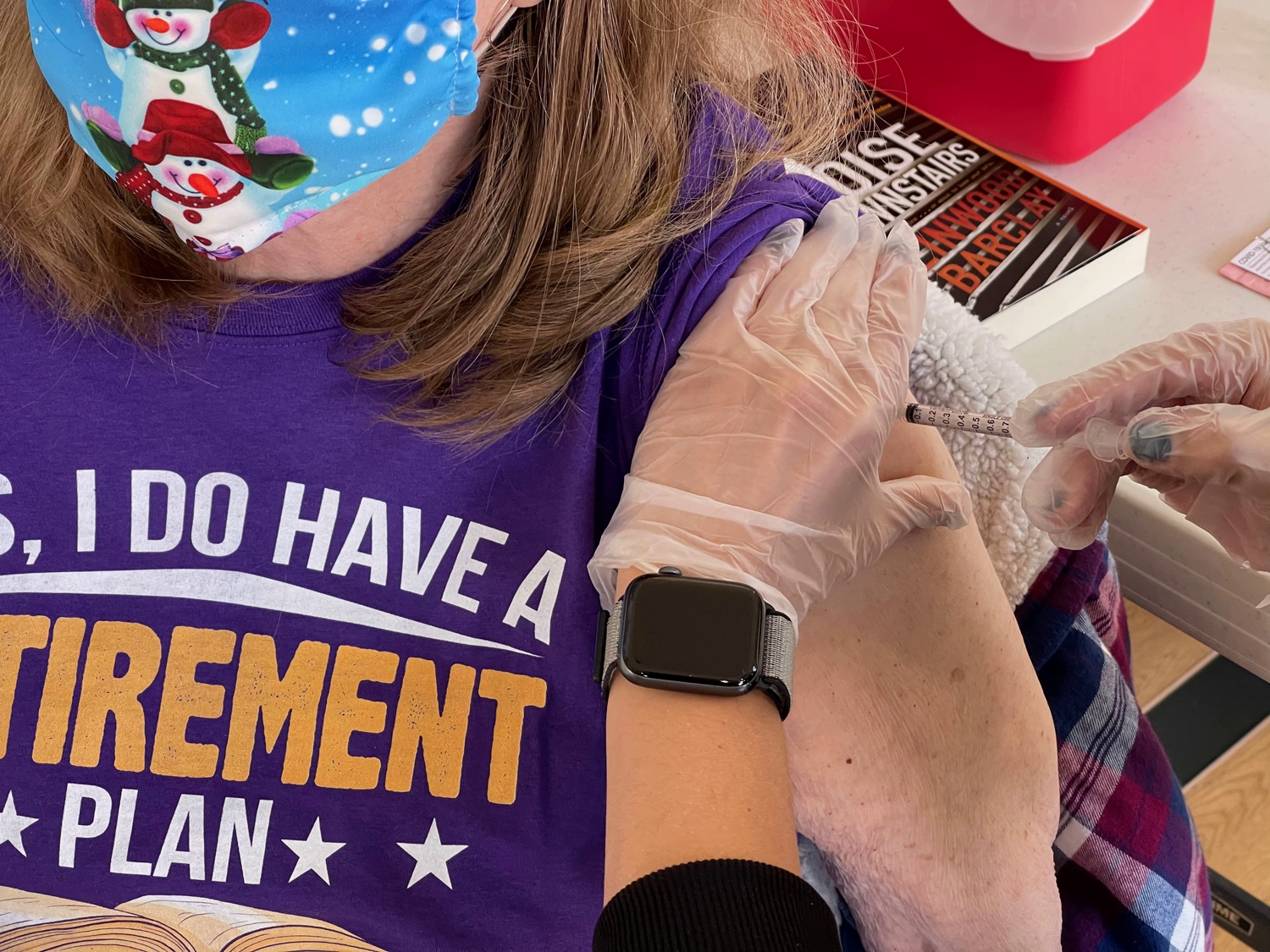
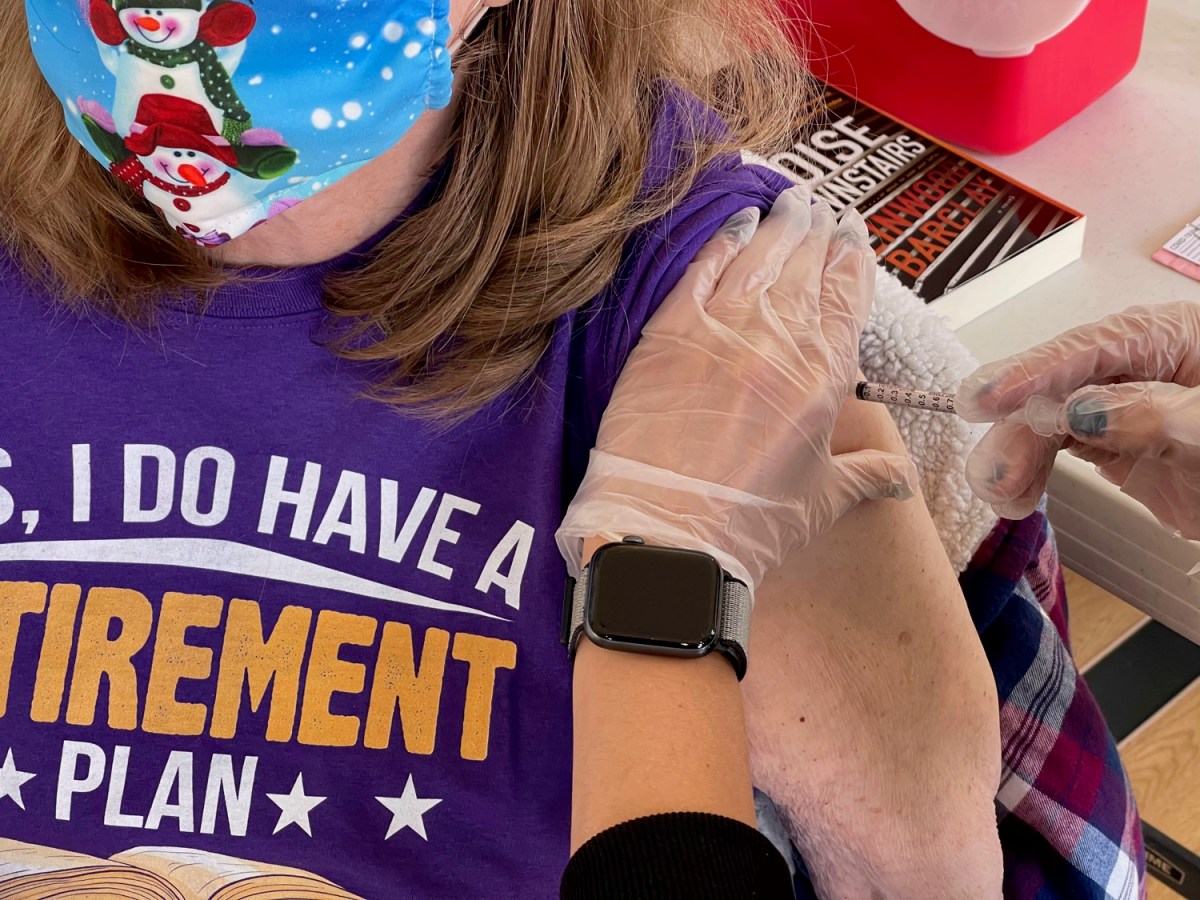
Vaccinated!

My husband and I both got our second dose of COVID-19 vaccine yesterday. I’ve waited to post in case either of us experienced any of the reactions to the second shot that I’ve been reading about.

Last night we each had a very slight bit of soreness in our arm, but that had disappeared by this morning and neither of us has had any further reaction. A few friends who also got their second shot yesterday reported a slight fever and low energy today, but nothing serious.

This article reports that there are still questions about the results of getting the full dose of vaccine, but both my husband and I, being over 70, were happy to get vaccinated.

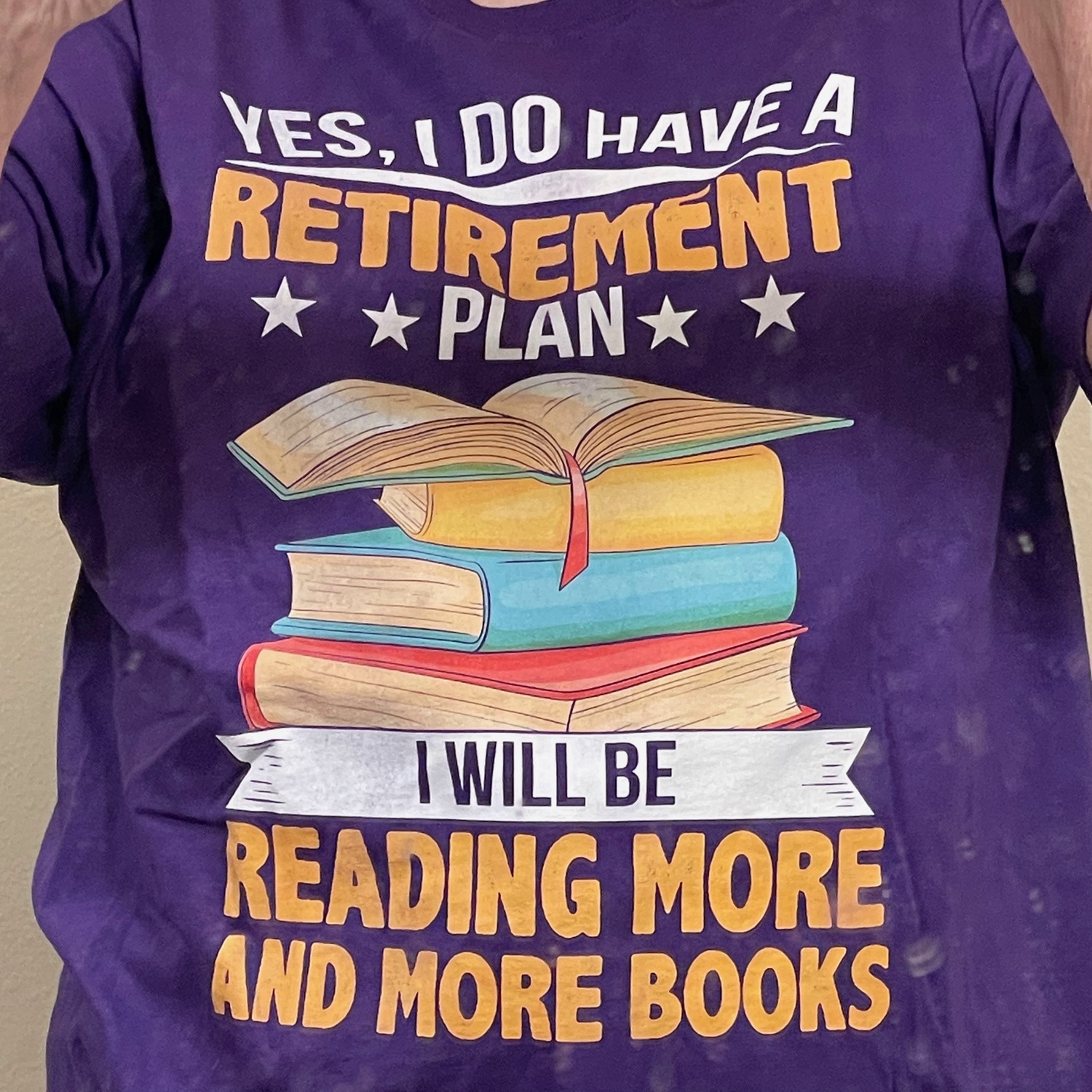
And here’s the short-sleeve shirt I wore to vaccinated:

T-shirt that says "Yes, I do have a retirement plan. I will be reading more and more books."

I hope that all of you are staying healthy and warm.

© 2021 by Mary Daniels Brown

Last Week’s Links

Alzheimer’s Prediction May Be Found in Writing Tests

Gina Kolata reports on a study by IBM researchers suggesting that writing patterns may help to predict Alzheimer’s disease and other neurological disorders years before other symptoms appear.

‘Just Cruel’: Digital Race For COVID-19 Vaccines Leaves Many Seniors Behind

I keep seeing stories from several news sources about older adults eligible for receiving the COVID-19 vaccine who are having trouble making an appointment. 

This article does not contain a link to a central information page. But the CDC offers a page where you can find your state health department. Click here.

It’s not just the pandemic. The moon may be messing with your sleep, too, UW researchers find.

Recent research from the University of Washington suggests that “people tend to have a harder time sleeping in the days leading up to a full moon.”

50 Things Turning 50 In 2021

Among things turning 50 this year: Disney World, McDonald’s Quarter Pounder, Janis Joplin’s album Pearl, the pocket calculator, and Dirty Harry. Now doesn’t that just make your day?

Decades later, infamous Tuskegee syphilis study stirs wariness in Black community over COVID-19 vaccine

Some time back when I was in my late 40s I had a freelance project that led me to the Tuskegee syphilis study. Chalk this up as one of the things we didn’t learn about in history class. 

I sobbed out loud sitting at my computer reading about this research, which studied the effects of the disease in poor Black men. Here’s the worst part: even after drugs were discovered that cured syphilis, the treatment was withheld from study participants so researchers could document the natural progression of the disease.

Today, the repercussions of this ghastly history affect attitudes toward COVID-19 vaccination in the Black community. 

Please read this article.

© 2021 by Mary Daniels Brown

Last Week’s Links

‘People in their 80s and 90s are bloody brilliant!’ Kate Mosse on writing – and being a carer

“The bestselling historical novelist has had a productive lockdown – reading 250 books and writing two, all while caring for her elderly mother-in-law.”

Historical novelist Kate Mosse was “one of a number of novelists commissioned by the Wellcome Trust to write about issues of social or medical care.” The result is An Extra Pair of Hands, to be published later this year. Mosse based the book on her experiences caring for, first, her mother during widowhood and, second, her mother-in-law during the current lockdown. 

Can You Treat Loneliness By Creating an Imaginary Friend?

I began reading this article thinking that it would discuss how many people, even adults, may have felt the need to create imaginary friends for company during this time of social isolation. But I was wrong. 

Here Jim Davies, professor in the Department of Cognitive Science at Carleton University, discusses tulpamancy:

Over the last several years, a community of people, interacting mostly in online forums, like Reddit, have discovered a way to create something like imaginary companions as adults. This process is known as tulpamancy, and the people who engage in it call themselves “tulpamancers.”

The process involves the creation of a tulpa, an imaginary companion who is thought to have achieved full sentience. “In other words, this is a benign hallucination.”

Davies writes, “What is interesting to me about this phenomenon, which is only now beginning to be studied scientifically, is the reason that people decide to create a tulpa in the first place: Most often they do it to relieve loneliness.” He imagines several situations in which this practice might serve a useful function.

James R. Flynn, Who Found We Are Getting Smarter, Dies at 86

“A philosopher who moved into psychology and studied I.Q., he showed that as society grows more technical, human intellectual abilities expand to meet the challenge.”

I offer this piece not specifically for the obituary, but rather for the history and significance of Dr. Flynn’s work in isolating and understanding the field of intelligence testing. His work has continuing importance.

Remote learning isn’t new: Radio instruction in the 1937 polio epidemic

We all know about the use of remote learning during the current pandemic shutdown. Here Katherine A. Foss, professor of Media Studies at Middle Tennessee State University, tell us “This is not the first time education has been disrupted in the U.S. – nor the first time that educators have harnessed remote learning. In 1937, the Chicago school system used radio to teach children during a polio outbreak, demonstrating how technology can be used in a time of crisis.”

Hall of Fame voters pitch a shutout as character questions muddle Cooperstown debate

I’m a big baseball fan, and I’ve been interested over the past several years how the media and fans have reacted to the problem of performance-enhancing drugs in all sports. I was not surprised to hear of the recent vote that kept former MLB players Barry Bonds, Roger Clemens, and Curt Schilling out of the Baseball Hall of Fame this year. In this article for the Washington Post Dave Sheinin examines how the voting works, including an explanation of how “the so-called character clause” in the voting instructions works.

© 2021 by Mary Daniels Brown

Last Week’s Links

I’m signing off as TV critic, but here are six shows I’d happily watch again

Hank Stuever wrote this piece when stepping down as TV critic for the Washington Post. I like it for its description of how television changed during his tenure as critic:

TV, which once seemed a manageable part of the cultural diet, became all-consuming. Netflix released its first big streaming hit, “House of Cards,” in 2013, and the steady supply of TV programs that I once jokingly thought of as an open fire hydrant instead began to resemble a tsunami. The customs of TV were upended: where to watch it, how to watch it, how much of it to binge-watch at a time. Also, new manners: how to talk about it, how not to spoil it for others.

Stuever ends with his list of “shows I reviewed that I would totally watch again.” I thoroughly disagree with the first on his list, “’Twin Peaks: The Return’ (Showtime, 2017).” My husband and I loved the original show but thought that this reboot was a thorough waste of time. However, three of the others he lists were total winners with us: The Americans, Lost, and Mad Men.

Turning the Page on the Year

“If ever there were a new year that called for a new notebook, this would be it.”

Dr. Perri Klass admits that she loves notebooks even if she’s not as diligent in writing in them as she’d like to be. I used to write in a journal just about every day, but for about two years, when we were traveling extensively in early retirement (and hopefully we’ll be able to do that again some time), I let myself fall out of the habit. (Yes, it’s much easier to let a habit lapse than to build a habit in the first place.)

But I’ve been building up the old habit over the last couple of months and intend to do much better this year.

You’re Not Listening. Here’s Why.

“There’s an unconscious tendency to tune out people you feel close to because you think you already know what they are going to say.”

Kate Murphy, author of You’re Not Listening: What You’re Missing and Why It Matters, says that while researching her book, she “earned something incredibly ironic about interpersonal communication: The closer we feel toward someone, the less likely we are to listen carefully to them. It’s called the closeness-communication bias and, over time, it can strain, and even end, relationships.”

There’s some good stuff here, including a possible explanation for “why people in close relationships sometimes withhold information or keep secrets from one another.”

No, it’s not weird to talk to yourself. Mental health experts point to pandemic, unrest as possible reasons

“Experts say [self-talk is] common and that, with the added stressors of a pandemic alongside protests over police brutality and race relations in America, self-talk can be a way to feel control in a world that offers individuals very little.”

Why Do Dwarves Sound Scottish and Elves Sound Like Royalty?

My husband and I had just finished three evenings of watching the extended versions of Peter Jackson’s movie trilogy of Lord of the Rings when the photo of Gimli the Dwarf popped up in my email. I had thought about the language of dwarves and elves during the films (the extended versions are LONG movies) and was therefore interested in reading how these fantasy dialects had originated. 

We have J.R.R. Tolkien to thank for the way these characters of fantasy speak. Tolkien, who has a philologist, “would create languages first, then write cultures and histories to speak them, often taking inspiration from the sound of an existing language.” 

Undecided On Getting A Covid-19 Vaccine? Beware Of These Two Cognitive Biases

Dr. Joshua Liao explains how availability bias and confirmation bias may influence our decisions about getting a coronavirus vaccine.

© 2021 by Mary Daniels Brown